
Shoppers comparing everyday prices
You want to keep an eye on the cost of bread during the summer holidays, so you compare loaf sizes and, where available, the price per kilogram or per slice.


When comparing everyday white bread during the summer holidays, look beyond the price per loaf. Where possible, compare the price per kilogram too, and think about how much you’ll actually eat. A half loaf or a loaf you can freeze in portions may suit a small holiday household better. When choosing, check the nutritional information, allergens and ingredients on the packaging too.
You want to keep an eye on the cost of bread during the summer holidays, so you compare loaf sizes and, where available, the price per kilogram or per slice.
You’re shopping for a few people or for breakfasts and lunches at different times. It’s worth considering whether you’ll finish a whole loaf and whether you can freeze any slices you don’t use.
You want to know which ingredients and allergens a particular loaf contains, and compare the fibre and salt listed on each pack.
Start with a loaf size you can use during your stay. Then compare similar products on the same price basis, and read the label before you buy.
| What to consider | What to check when buying | Who should give this more weight? |
|---|---|---|
| Cost of bread | Where possible, compare the price per kilogram of similar loaves. If that isn’t available, also check the weight and number of slices. | If I buy bread every day, I don’t want to treat different sizes as if they were equivalent offers. Around 33% of consumers put this cost comparison first. |
| Size and waste | Choose a half or whole loaf based on how much you expect to eat. If you plan to freeze it, check the storage instructions. | In a small household, I want to avoid having slices left over. For around 27% of consumers, reducing waste is the top priority. |
| Availability | Check what’s available at the branch where you shop, especially if you’re looking for a particular type of bread. | If I’m planning my shopping around a holiday, the bread needs to be available when I want it. This certainty comes first for around 20% of consumers. |
| Label | Read the ingredients, allergens and nutritional information, including fibre and salt, on the pack you choose. | If I eat bread regularly, I want to know what this particular variety contains. Around 20% of consumers give checking the label their highest priority. |
A half loaf and a whole loaf, or a tin loaf and a tiger loaf, aren’t necessarily comparable. Differences in weight affect what the price per loaf tells you.
Use the same price basis for both products, and check the type of bread, weight and number of slices too.
According to the Voedingscentrum, bread is among the foods that are often wasted. A large loaf won’t necessarily suit a small or changeable holiday household.
If necessary, choose a half loaf. If you want to freeze a whole loaf, follow the instructions on the packaging and divide it into useful portions.
The Voedingscentrum recommends replacing white bread with wholemeal or brown bread as often as possible. Don’t assume a particular fibre content or iodised salt based on the name of the loaf either.
Compare the fibre information on the label and read the ingredients list for the loaf you’re buying.
Ingredients and allergens can vary from one product to another. According to the Netherlands Food and Consumer Product Safety Authority, allergen information for pre-packed products should appear on the label.
For packaged bread, read the label. For unpackaged bread, ask for allergen information before buying.
The range and product information available vary between loaves and shops. Compare a specific variety rather than just the supermarket chain name.
Albert Heijn lists AH Wit heel as a whole white wheat loaf.
The online white bread range includes both half and whole loaves.
Lidl lists an 800 g white loaf as an in-store product.
ALDI’s daily fresh bread range lists a whole loaf called Wit brood.
PLUS has a product page for PLUS Weite brood heel, an 800 g loaf.
Dirk lists Bakker van der Akker Boeren tijger wit heel.
This selection includes white baguettes and pistolets for anyone who prefers smaller types of bread. Their shape and portions aren’t directly comparable with a whole sliced white loaf, so compare the quantity and product information before deciding.
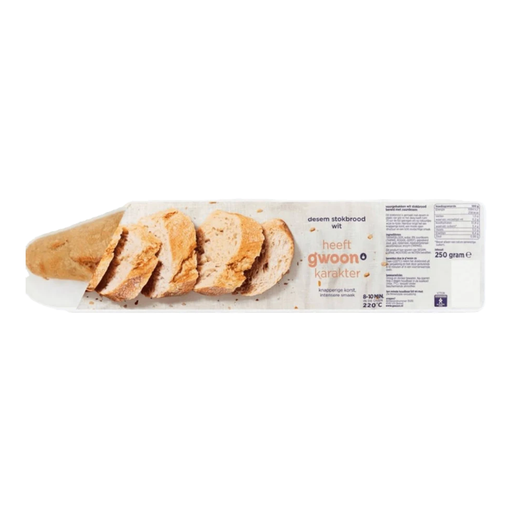 Image unavailable
A white baguette for anyone looking for a 250 g loaf instead of a whole sliced loaf.
If they’re important to your choice, check the ingredients and allergens on the packaging.
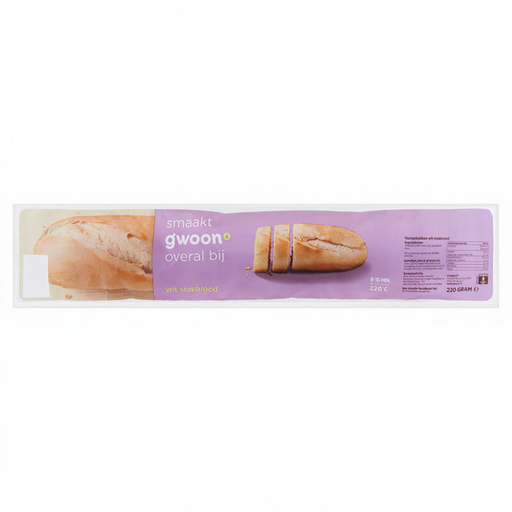 Image unavailable
A 220 g white baguette for when you don’t want to buy a whole sliced loaf.
Check the preparation instructions before choosing this variety for your holiday accommodation.
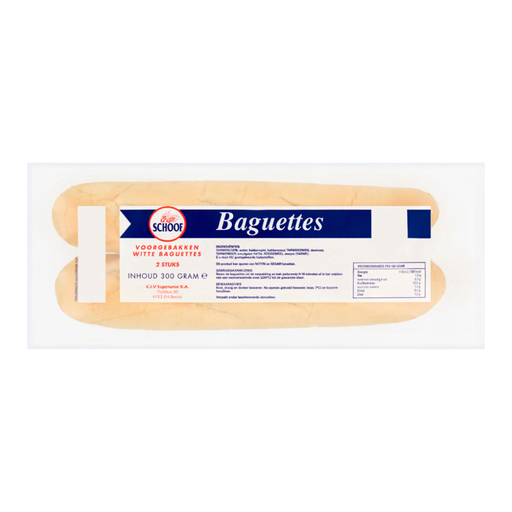 Image unavailable
Two white baguettes for anyone who’d rather split the quantity between separate loaves.
The stated weight of 300 g is for the pack. Check the ingredients and allergens for this variety on the label.
 Image unavailable
Four white pistolets for anyone looking for individual rolls instead of a whole loaf.
Before comparing these with other bread, check the pack weight and the basis for the nutritional information on the label.
Read the ingredients list for the loaf you’ve chosen. Don’t assume that every white loaf contains the same type of salt. Albert Heijn lists iodised salt in AH Wit heel, but that doesn’t tell you anything about another variety.
Consider buying a half loaf, or freeze a suitable whole loaf in portions soon after buying it. Take only what you need out of the freezer, and follow the storage and freezing instructions for the product you choose.
Compare the amount of fibre listed per 100 g on the labels of the loaves you’re considering. The Voedingscentrum recommends replacing white bread with wholemeal or brown bread as often as possible, especially if you eat bread every day.
For pre-packed bread, allergen information is on the label; the Netherlands Food and Consumer Product Safety Authority describes this as part of the labelling requirements. For unpackaged bread, ask for the information before buying, and always check the specific variety.