
Vandaag of morgen in huis

Kwaliteit gegarandeerd

Welkomstaanbiedingen ontgrendelen: GRATIS bezorging | Tot 80% korting | Gratis 30 dagen JoyPlus-proefperiode
Download de app
A wheeled trolley makes it much easier to move groceries, camping gear, garden supplies or household items. Not every model, however, suits every surface or load. A compact shopping trolley for city use needs different features from a large camping cart for grass and sand.
When comparing, watch out for three common pitfalls:
Check both the maximum load capacity and the volume in liters. A 60 liter shopping trolley is handy for daily groceries, while a transport wagon from 127 to 300 liter is better for camping, moving house or garden work.
Use the maximum load capacity as an upper limit. Distribute heavy items as evenly as possible over the base and avoid letting the load stick out above the rim. Also check whether the manufacturer specifies a total weight or a weight per shelf. On a three-tier household trolley the load capacity may differ per level.
For shops, flats and smooth floors, four swivel casters are usually fine. If you often go over thresholds, kerbs or steps, larger fixed wheels or a shopping trolley with stair-climbing wheels are a better bet.
A trolley with a brake adds stability when parked. Check how many wheels have a brake, and whether the brakes are easy to reach. On a camping cart, broad tyres and a sturdy frame matter more than simply the number of wheels. Also consider wheel size: larger tyres usually deal with obstacles more easily, but can increase the folded dimensions.
A bag made from 600D Oxford fabric with a PE coating is often described in product listings as water-resistant. That doesn’t mean the bag is fully waterproof. Store damp fabric only after it’s dry.
Aluminium frames are relatively light and work well on a foldable grocery hand cart. Steel and stainless steel suit a fixed kitchen trolley or a mobile storage trolley for indoor use. Also check whether the wheels, bag or shelves are removable. That makes cleaning easier, especially after carrying groceries, potting soil or beach gear.
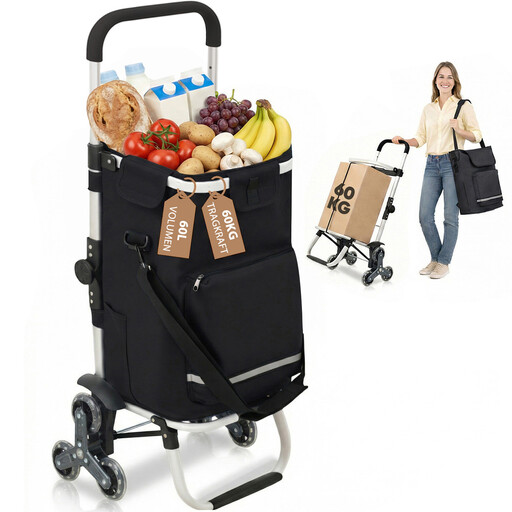
Why it suits this profile: This model combines a shopping trolley, sack truck and removable shoulder bag. The 60 liter capacity and 4 kg weight are spot on for everyday groceries and city use.
According to the listing, the PU wheels are designed for stairs and uneven terrain. Before buying, check your actual stair width and do not load the trolley beyond 60 kg.
Aluminium frame, adjustable handle, cool bag and a 3‑in‑1 design.
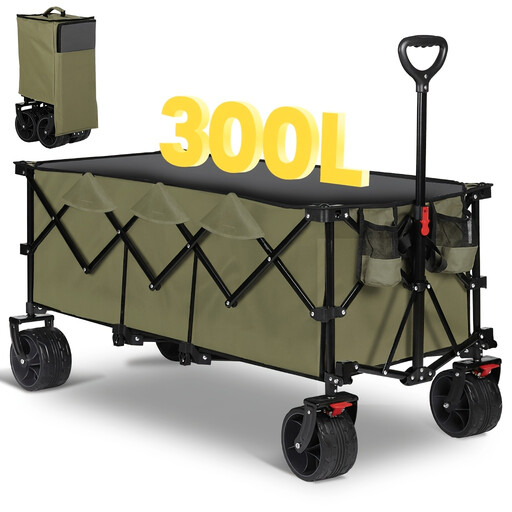
Why it suits this profile: This large wagon is geared towards heavy loads for camping, the garden or transport. The stated capacity is 300 liter with a maximum load of 200 kg.
Broad 7‑inch tyres and brakes are clearly stated in the product details. Make sure the wagon is fully unfolded and locked before loading it.
Four-way folding, a huge capacity and two cup holders.

Why it suits this profile: This model is aimed at camping, festivals, gardening and groceries. The product details mention 127 liter capacity, a load of up to 200 kg and a foldable design.
The listing cites dual brakes and 360° swivel wheels. Use the cart on a stable, level surface and check it’s fully locked.
Generous cargo space, foldable frame and steel tubing for outdoor use.
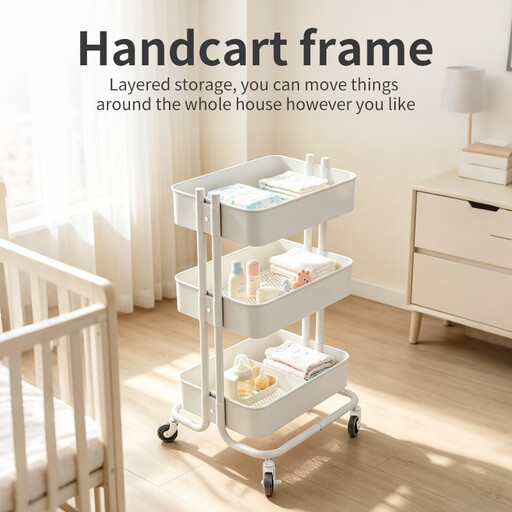
Why it suits this profile: This mobile storage trolley is designed for the kitchen, bathroom, bedroom or salon. The three open tiers make use of height without taking up much floor space.
The product details state two lockable brakes and a load capacity of up to 7 kg per shelf. That is clearer than a vague “heavy duty” claim.
Three metal baskets, 360° wheels and a compact design for daily use.
Measure doorways, lifts and your storage cupboard before ordering. A trolley that’s almost a metre high may be comfortable to pull, but awkward to store. Also check:
If product details contradict each other, ask the seller for confirmation. For example, the first foldable hand cart lists 100 kg in the title, while the description claims up to 150 kg. Only base your purchase on the weight the seller confirms in writing.
We’ve compiled a complete, up-to-date list of products that fully meet these strict selection criteria and current European safety regulations.
Look for a model with six stair-climbing wheels or special PU wheels. Load, stair width and angle still matter. Don’t force a heavily loaded trolley over multiple steps; follow the seller’s instructions for use.
Lifespan depends on load, surface, storage and maintenance. Dry a fabric bag after rain, remove sand from the wheels and don’t exceed the stated load capacity. For intensive outdoor use, broad tyres and a sturdy frame are generally more practical than small swivel casters.
Maintenance usually comes down to cleaning, checking wheel fixings and storing the frame or bag dry. A model with removable wheels and a detachable bag can be easier to clean. On a 3‑tier trolley, also check regularly that screws and brakes are secure.
