For a few small, dry leaves just inside the entrance, a standard cylinder vacuum may do the job, provided the manual permits this use. If you regularly deal with leaves or coarser debris, a compact wet and dry vacuum is a better fit; check the hose, nozzle and storage space. Being able to vacuum up wet dirt does not automatically mean an appliance or plug is safe to use in the rain.
Who is this buying guide for?
Anyone who regularly finds leaves by the door
You want to clear leaves and other coarser debris without using a standard household vacuum for something it was not designed to do. The Consumers' Association describes a wet and dry vacuum as an option for tougher cleaning jobs.
Anyone with a cramped entrance
You need an appliance that is easy to manoeuvre and store. The hose, nozzle and reach are all important points to check for each model.
Anyone with an exposed doorstep
You need to distinguish between being able to vacuum up liquid and using the appliance safely outdoors in damp conditions. Check the usage restrictions for the exact model and its electrical connection.
What should you look for when choosing?
First, decide whether you only need to clear a few leaves indoors or regularly collect larger leaves. Then check that the appliance will fit through the entrance, can reach the socket and has somewhere to be stored.
| What to consider |
What should you check? |
Who is this important for? |
| Leaves and coarser debris |
Check which types of debris are suitable, and whether leaves will fit through the hose and nozzle. Also check the filter set-up for dry vacuuming. |
If there are whole leaves by the door regularly, I want to know whether the appliance can handle them without using a standard vacuum for coarse debris. Around 36% of consumers are most concerned about whether it can handle leaves. |
| Manoeuvring and storage |
Measure the storage space and the distance to the socket; compare the appliance dimensions, hose, cable, weight and supplied nozzle. |
In a narrow entrance, I want to be able to move around without the hose or appliance getting in the way, and then put it away afterwards. Around 29% of consumers give manoeuvrability and storage the highest priority. |
| Moisture and electrical use |
Establish whether you will be working somewhere fully dry and sheltered. Check the manual for outdoor use, damp conditions and the specified filters. |
In an open entrance, I want to know whether the conditions and electrical connection are suitable for use. Around 21% of consumers base their choice mainly on moisture and safe electrical use. |
| Emptying and filters |
Check how to empty the container, which bags or filters are needed and what maintenance instructions apply to the model. |
If I regularly clear leaves, I want to know how to empty the container and maintain the filter. Around 14% of consumers put emptying and filter maintenance first. |
Common pitfalls
-
Choosing a standard cylinder vacuum just because you already have one
A standard household vacuum is not designed for coarse waste or liquids. Leaves may be larger than the debris the appliance was designed to handle.
First, assess the quantity and size of the leaves, then check your model's manual. If you regularly deal with coarser debris, you could compare wet and dry vacuums.
-
Assuming ‘wet and dry’ means ‘rainproof’
An appliance's ability to vacuum up liquid does not, by itself, tell you whether its motor, cable or plug is protected from rain.
Check the usage restrictions for the exact model, and do not use it in conditions for which safe use is not specified.
-
Comparing only container capacity or motor power
In a narrow entrance, the nozzle, hose, cable and available storage space also determine whether an appliance is right for the job.
Measure the entrance and storage space, then compare the specifications for the exact model, including its reach from the socket.
Brands to consider
Nilfisk
The Buddy II range includes compact wet and dry vacuums. The wheeled Buddy II 12 is an option to consider for use by an entrance.
- Nilfisk describes the Buddy II range as suitable for indoor and outdoor cleaning, with container capacities of 12–18 litres.
- Check the conditions for outdoor electrical use for the exact appliance; the product information does not prove how well it picks up leaves at this entrance.
Einhell
The TC-VC 1812/1 S is a wet and dry vacuum with a compact container and crevice nozzle, worth considering for a sheltered entrance.
- Einhell lists a 12 l container, a 1.5 m hose and a 2.5 m cable for this model.
- Einhell specifies different filters for wet and dry vacuuming. The supplied cable may be too short if the socket is further away.
Kärcher
The WD range includes wet and dry vacuums. The WD 3 Premium Home Vac is a model to consider for household debris and confined indoor spaces.
- Kärcher lists a 17 l container, a 4 m cable and a removable handle for this model.
- The product information focuses on indoor cleaning. Do not assume from this that use in the rain is permitted or that the model is proven to pick up outdoor leaves effectively.
Bosch DIY
The UniversalGardenTidy 3000 is an alternative if the job is mainly collecting leaves outdoors, rather than choosing a cylinder vacuum.
- Bosch lists blowing, vacuuming and shredding, a 50 l collection bag and a weight of 4.7 kg in vacuum mode.
- This set-up and weight may be less suitable if you only need to clean a narrow entrance. These specifications are not a direct comparison test against compact wet and dry vacuums.
Joybuy products
This product selection is aimed at collecting dry leaves outdoors; it is not a cylinder vacuum for the floor of a narrow indoor hallway.
 No image available
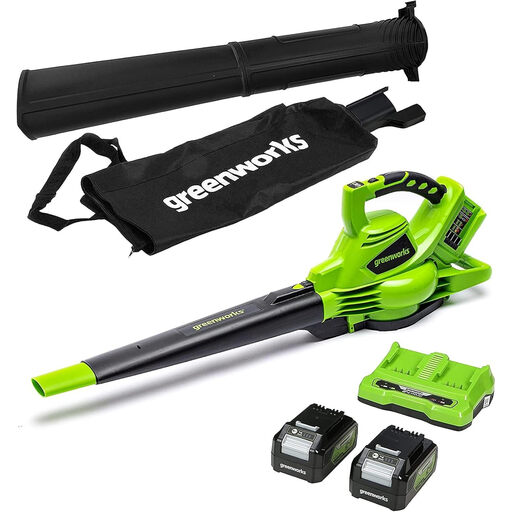
Greenworks GD24X2BVK4X 48V (24V x 2), with two batteries
This garden leaf blower and vacuum is designed for dry leaves outdoors; the product information says not to vacuum up wet leaves.
The product description lists six speeds, a 45 l collection bag, a shoulder strap, 322 km/u and 9 m³/min. The product name specifies two 24 V 4 Ah batteries and a dual charger.
Joybuy
Frequently asked questions
Can I vacuum up leaves with my standard cylinder vacuum?
That may be possible for a few small, dry leaves indoors, if your model's manual allows it. The Consumers' Association does not recommend standard household vacuums for coarse waste or liquids, and recommends a multi-purpose or wet vacuum designed for coarser debris.
Which nozzle should I use next to the threshold?
A crevice nozzle can help you reach narrow corners. It comes with the Einhell TC-VC 1812/1 S; for another model, check what is included and whether leaves will fit through the nozzle and hose.
Do I need to do anything to the filter after vacuuming leaves?
Follow the filter and cleaning instructions for your exact model. Einhell specifies a foam filter for wet vacuuming and a bag and filter for dry vacuuming with the TC-VC 1812/1 S. Kärcher recommends letting a cleaned cartridge filter dry completely before using it again.
Does ‘wet and dry vacuum’ mean I can use it in the rain on the doorstep?
No, that description alone does not tell you. Check the usage restrictions for the exact appliance and its electrical connection; the Netherlands Food and Consumer Product Safety Authority states that manufacturers must provide information on safe-use restrictions. An NVWA warning about other outdoor products illustrates a potential risk from plugs that are not splashproof, but does not tell you whether a particular vacuum is rainproof.
What can I do if the vacuum breaks too soon during normal use?
In the Netherlands, you are entitled to a product of satisfactory quality, but there is no fixed statutory guarantee period for all products. According to the Dutch government, the retailer is your point of contact if there is a problem with a product. Whether repairs should be free depends, among other things, on what you could reasonably expect from the product and whether you used it in accordance with the instructions.


