If you want rolls that can handle generous fillings, don’t rely on the term ‘thick cut’: for the products discussed here, the thickness of the sliced halves isn’t specified. Judge how sturdy the roll itself is, and match the pack size and storage instructions to when you plan to eat them. If you want to freeze your rolls, check the packaging; Albert Heijn, for example, says its gluten-free part-baked rolls aren’t suitable for freezing.
Who are these options for?
If you’re planning generously filled rolls
If you’re buying rolls for hearty snacks, you’ll want to know how well the halves hold up under the filling. Check their shape, and if necessary, cut one open first before choosing the same variety for several meals.
If you’re planning a week’s supply
You’ll want the number of rolls to match the days you plan to eat them. So compare pack size, preparation method and storage advice. Albert Heijn says its gluten-free part-baked rolls aren’t suitable for freezing at home.
If you choose based on the label
If fibre, ingredients or allergens influence your choice, compare the nutritional information per 100 g and read the label on the variety you buy. ‘Gluten-free’ alone doesn’t tell you whether other allergens are present.
What should you look for when shopping for the week?
Start with the filling you have in mind and how many times you plan to eat the rolls. Then compare how they’re prepared and check the label: weight or fibre content alone won’t tell you how sturdy a sliced roll is.
| What to consider | What to check before buying | Most relevant if |
|---|
| Sturdiness for fillings |
Check the shape and size; if possible, cut one roll open first to see whether the halves can handle your filling. |
I use generous or moist fillings and want to avoid the halves collapsing. Around 45% of consumers put sturdiness first. |
| Stock and preparation |
Compare the number of rolls, preparation instructions and storage advice on the packaging. |
I want to eat rolls on different days without preparing more than I need. Around 33% of consumers put planning their supply first. |
| Nutritional information and allergens |
Read the ingredients and allergen information on the current label; compare fibre and salt on the same basis, per 100 g. |
I need to know which ingredients a roll contains and what its nutritional values are. Around 22% of consumers give this label information top priority. |
Common mistakes
-
Treating ‘thick cut’ as a guaranteed measurement
A product name, its weight or the description ‘multiseed’ doesn’t prove that a sliced roll can hold a hearty filling.
Judge the roll itself and try one with the filling you plan to use before buying more.
-
Assuming you can freeze any part-baked roll
The Netherlands Nutrition Centre lists freezing as a storage option for part-baked rolls, but Albert Heijn expressly says its gluten-free part-baked rolls aren’t suitable for freezing at home.
Follow the storage advice on the pack you choose and match the number of rolls to when you plan to eat them.
Using an unsuitable storage method can affect the quality of the rolls.
-
Confusing gluten-free with allergen-free
A gluten-free roll may contain other allergens. ‘Multiseed’ and ‘wholemeal’ also don’t tell you everything about the ingredients or nutritional value of a particular roll.
Read the current ingredients and allergen information, and compare nutritional values per 100 g.
Brands compared
Albert Heijn
Albert Heijn lists a pre-baked wholemeal roll sold individually and gluten-free part-baked rolls sold in packs of two.
- According to Albert Heijn, its wholemeal roll contains 100% wholemeal flour and 7,1 g of fibre per 100 g.
- Albert Heijn says its gluten-free part-baked rolls aren’t suitable for freezing at home. Check the current ingredients and allergen information on the packaging for both varieties.
Jumbo
Jumbo lists part-baked white and multiseed rolls, both in packs of four weighing 300 g.
- Jumbo lists 5,7 g of fibre per 100 g for its multiseed variety and 2,1 g per 100 g for its white variety.
- Both varieties contain wheat and gluten. The multiseed variety also contains barley and may contain sesame, among other allergens; assess its suitability for your filling separately.
Lidl
Lidl describes its white rolls as suitable for baking at home and lists them in a 700 g pack.
- The rolls are designed to be baked at home.
- Lidl says this product is only available in store; check the packaging and the rolls there to see if they suit you.
ALDI
ALDI lists an individual white roll in its range of pre-baked rolls.
- You can assess an individual roll before choosing more.
- Check the label in store if ingredients, allergens or nutritional values are important to your choice.
Rolls on Joybuy
This option is a pack of four rolls for planned meals. If you want to add generous fillings, check the sliced halves for yourself.
 No image available
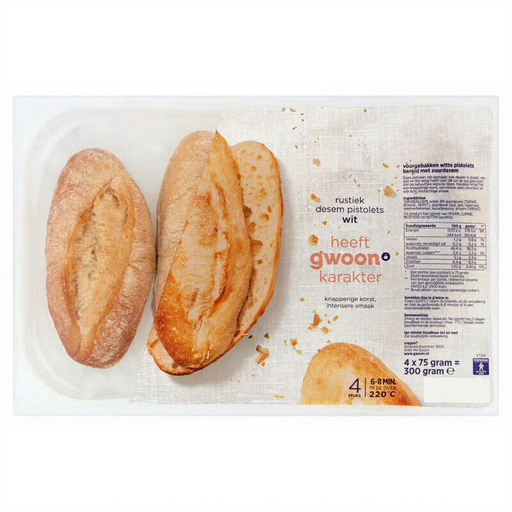
g'woon White Rustic Pistolet, 4 rolls
A pack of four rolls may suit several planned meals.
Check the preparation and storage instructions, and the current ingredients and allergen information, on the packaging. Assess the halves separately if sturdiness for generous fillings matters to you.
View on Joybuy
Frequently asked questions
Can I buy rolls for the whole week and freeze them?
You can do this with some part-baked rolls, but always follow the instructions on the packaging of the product you choose. The Netherlands Nutrition Centre recommends storing part-baked rolls in the freezer for 1–3 months and notes that their quality may deteriorate over time. Albert Heijn, however, says its gluten-free part-baked rolls aren’t suitable for freezing at home.
How do I bake part-baked rolls?
Follow the preparation instructions on the packaging you choose. For its white and multiseed rolls, Jumbo recommends 10–12 minutes in a preheated oven at 200 °C. For AH Gluten-Free White Rolls, Albert Heijn recommends 6–7 minutes in the oven at 180 °C, or 5 minutes at 180 °C in a preheated air fryer, cooking no more than two at a time.
Do all Dutch rolls contain iodised salt?
Don’t assume they do without checking the label. Albert Heijn lists iodised salt in the wholemeal and gluten-free rolls discussed here; ‘salt’ appears in the ingredients list for the Jumbo varieties discussed here. If this ingredient matters to your choice, check the packaging of the product you buy.
Is a gluten-free roll also free from other allergens?
No. ‘Gluten-free’ doesn’t mean that a product is free from all other allergens. For AH Gluten-Free White Rolls, Albert Heijn says the product may contain eggs, milk, soya, almonds and hazelnuts. Always check the current packaging.


