
Vandaag of morgen in huis

Kwaliteit gegarandeerd

Welkomstaanbiedingen ontgrendelen: GRATIS bezorging | Tot 80% korting | Gratis 30 dagen JoyPlus-proefperiode
Download de app
A weekly pill organiser can make taking medicines, vitamins and supplements every day more manageable. However, not all models are equally convenient. A compartment that is too small, a lid that is difficult to open or day labels that quickly fade can soon become frustrating.
For users in the Netherlands, other considerations matter too: will the pill organiser fit in a wash bag, is the material clearly specified and does the pill box offer enough room for large capsules? The points below will help you choose based on verifiable product specifications rather than marketing copy alone.
A compact pill box may seem convenient, but it does not always have room for fish oil capsules, large multivitamins or several tablets per dose. Check whether the seller refers to large or extra-spacious compartments. A pill box for vitamins and supplements often needs more capacity than a model designed for a few small tablets.
Secure lids are useful during transport, but they can be difficult for older people or those with arthritis to operate. Look for descriptions such as ergonomic lids or an easy-open design. A closure should remain securely shut in a bag without requiring unnecessary force to open.
Print that comes away or fades makes weekly planning less reliable. Permanently engraved or etched day labels are therefore a practical specification to look for. Also check that the layout clearly distinguishes between the seven days.
A simple 7-day pill box usually has one compartment per day. This suits users who take their medicines once a day. If you are looking for a pill box for taking medicines three times a day, you will need a model with separate compartments for, for example, morning, afternoon and evening.
Also consider how the compartments are separated. Individual lids prevent the contents of several days from becoming mixed up. A removable day section can be useful for work, a weekend away or a short trip.
Look beyond the external dimensions. The internal space per compartment determines whether the pill box is suitable for your daily quantity. A large pill box may be more suitable for fish oil, magnesium supplements and large capsules, while a slim travel format is mainly suitable for a few small tablets.
Use the product photos and specifications as a guide, but do not rely solely on phrases such as “extra large”. The number of capsules that fit depends on the shape and size of your own supplements.
A BPA-free pill box may appeal to anyone who wants to choose contact materials carefully. Check that BPA-free plastic is clearly stated in the product information and that the material is intended for daily use. The models below mention medical-grade or food-grade plastic, among other materials.
Clean the compartments according to the product instructions. For the models mentioned, cleaning with a damp cloth is recommended. Allow the compartments to dry completely before refilling them. Also store medicines according to the advice on the packaging; a pill box does not replace the original packaging when protection from light, moisture or temperature is important.
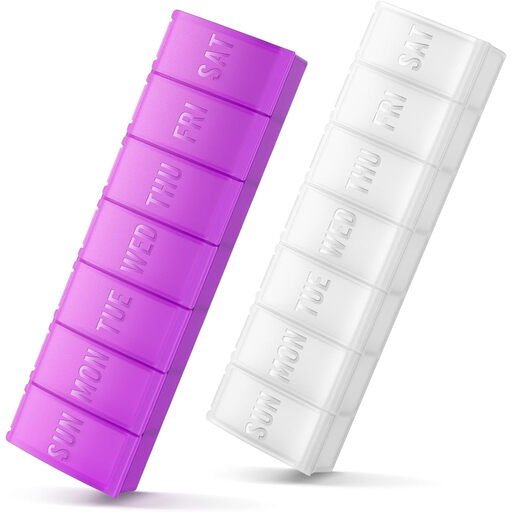
Why it suits this profile: This set of two has seven-day compartments and is suitable for everyday use or for keeping a second organiser as a spare. According to the product description, the spacious compartments are designed for large vitamins, fish oil and supplements.
The product information states that it is made from BPA-free medical-grade plastic and features etched day labels and easy-open lids. This addresses unclear markings and difficult opening.
Two organisers, seven-day compartments, large sections and a design that requires no assembly.
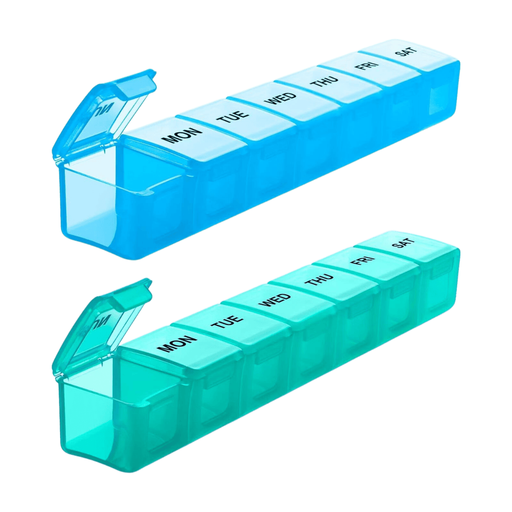
Why it suits this profile: This model is aimed at users who value extra space and sturdy construction, for example when taking several supplements a day or travelling regularly.
The description mentions extra-large compartments, reinforced hinges, moisture resistance and more durable day labels. However, check that your own capsules fit within the stated capacity.
BPA-free plastic, two organisers, seven spacious compartments and a compact format for travelling.
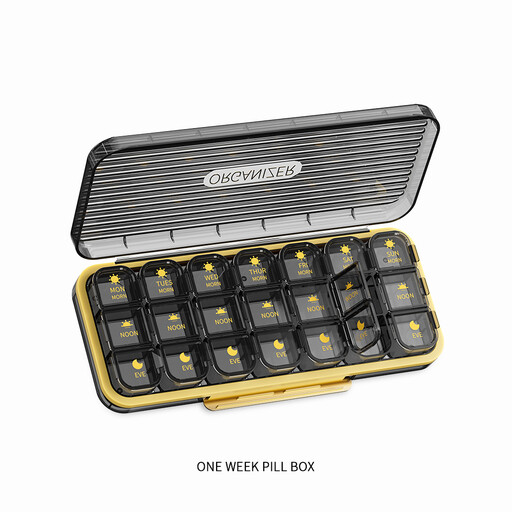
Why it suits this profile: The layout for three doses a day fits a set routine of morning, afternoon and evening. The seven-day sections are portable and suitable for medicines, vitamins, fish oil and supplements.
The separate layout helps prevent confusion between dosing times. The day compartments are also removable, which can be practical for a weekend or trip.
Three dosing times a day, seven days and portable, removable compartments.
We have put together a complete, up-to-date list of products that fully meet these strict selection criteria and the applicable European safety regulations.
A pill organiser can also be used for food supplements, but first check the recommended dosage and storage conditions. This applies, for example, to a magnesium supplement, vitamin D supplement, probiotics or vegan food supplements.
If you are unsure about combinations, dosages or chronic conditions, it is advisable to consult a pharmacist or doctor. An organiser helps with planning but does not provide personalised medical advice.
Fill the compartments at a set time, for example at the beginning of the week. Check each day label and compare the contents with your dosing schedule or the patient information leaflet. If you have several dosing times, choose a pill box for three doses a day with separate compartments.
Its lifespan depends on the plastic, hinges, number of openings and cleaning method. Check regularly that the lids close properly, the labels remain readable and no cracks have developed. Replace the organiser when a compartment no longer closes reliably.
Yes, a travel pill box is useful when you want to take a compact weekly supply with you. Check in advance that the compartments are large enough and that your medicines may be stored in an organiser according to the instructions. For air travel and crossing borders, it may be advisable to carry medicines in their original packaging together with any relevant documentation.
