For filming the whole weaving area and your moving hands, a continuous light with suitable diffusion is a sensible starting point. A compact panel may be more practical for close-up details or a studio you often need to clear away. How much of the area a light covers depends partly on its distance and modifier, while adjustable colour temperature alone does not guarantee consistent yarn colours. So make test recordings with your own camera and yarns, and check the exact model, included accessories and electrical documentation before buying.
Who is this choice relevant to?
Weavers filming the whole process
If you want to keep your hands, threads and a larger working area in shot, a suitably large, soft light source is a good place to start. Adobe Stock Contributor explains that a larger light source produces softer light.
Weavers showing yarn colours
When demonstrating colour combinations, you’ll want to take changing ambient light and your camera’s white balance into account. Canon Europe describes white balance as a camera setting that affects how colours are captured.
Weavers with a small home studio
If you want to move or put away your light and stand after filming, weigh a panel’s compact size against the coverage you need for your working area. Ulanzi describes the VL120 RGB as a compact panel with a built-in battery.
What should you look for when buying?
COB continuous light with diffusion
A good fit if: you want to light the whole weaving area and both hands evenly from a fixed position. Models such as the amaran 100x S and Godox SL60IIBi have a Bowens mount for compatible light modifiers.
Bear in mind: you’ll need room for the light, modifier and mount. Light readings taken with a reflector don’t automatically tell you how much light will reach your work through diffusion.
Compact, rechargeable panel
A good fit if: you film close-up details or often move and pack away your setup.
Bear in mind: a small panel has not been shown to be a substitute for a large, diffused light source that needs to cover an entire loom.
For a weaving demonstration at home, the main considerations are coverage, colour consistency, uninterrupted recording and the space available for your setup.
| What to consider |
What should you look for? |
Who will find this important? |
| Seeing the whole working area |
Check the dimensions of the light modifier and its distance from the loom; review a test image of the entire working area. |
If I want to show my hands, threads and weave structure at the same time, I need light that reaches the whole working area. Around 36% of consumers put this coverage first. |
| Yarn colours |
Compare the stated colour temperature range for the exact model and test your yarns using a fixed white balance. |
When I demonstrate colour combinations, I want to see how my own yarns look in the recording. Around 29% of consumers give colour rendering their highest priority. |
| Flicker and noise |
Film at the dimming level, shutter speed and recording duration you intend to use; record sound too and check the clip. |
If I’m explaining things as I go, I don’t want distracting bands in the picture or fan noise in my recording. Around 21% of consumers prioritise uninterrupted video. |
| Space and setup |
Check what’s included and whether the light, power supply, stand and diffusion will fit in the space available. |
When I need to clear away my home studio after filming, I want to be able to move and store the light easily. Around 14% of consumers prioritise a compact setup. |
Buying pitfalls
-
Assuming lux figures with a reflector show how much light will reach your weaving
Stated light measurements apply to specific conditions, such as a particular reflector and distance. A modifier and its positioning will change the setup.
Compare the measurement conditions, check what’s in the box and make a test recording of the whole working area. A softbox is not listed as part of the standard box contents for the amaran 100x S, so you may need to buy a compatible modifier and mount separately.
-
Assuming different versions are the same based only on a model range or wattage
Ulanzi distinguishes between the VL120 RGB and the VIJIM VL120 Bi-Color. The stated colour temperature can also vary by version.
Check the full model name, power supply, colour temperature and included accessories before treating a light as the same version.
-
Assuming a high colour rendering index tells you everything about the video
Ambient light and camera settings affect how yarns appear on screen. Sony Support explains that LED lighting can cause flicker or banding in certain recording conditions.
Test the light with your own camera, yarns and intended settings, and review both the picture and the audio recording.
Video lighting brands to consider
amaran
The 100x S is a bi-colour COB continuous light with a Bowens mount, designed for a fixed setup around your working area.
- amaran states that the 100x S has an adjustable range of 2700–6500 K.
- Stated light measurements vary by reflector and distance. A softbox is not listed as part of the standard box contents; the specifications are not an independent test of yarn colours.
Godox
The SL60II range includes a daylight version and the bi-colour SL60IIBi, both with a Bowens mount.
- Godox states that the SL60IIBi has a range of 2800–6500 K and adjustable brightness.
- The stated lux values are measured with the standard reflector at one metre. A claim of low fan noise is not an independent noise measurement.
SmallRig
The RC 120B is a bi-colour COB light with a Bowens mount for a fixed studio setup.
- SmallRig states a colour temperature range of 2700–6500 K.
- The manufacturer lists different plug versions. Check the exact EU version before using it in the Netherlands; the stated light output with a reflector is not the same as the output from a softbox on a loom.
Ulanzi
According to Ulanzi, the VL120 RGB is a compact battery-powered panel for portable close-ups or fill lighting.
- Ulanzi lists a built-in 3100 mAh battery for the VL120 RGB.
- A compact panel has not been shown to provide full coverage of a large working area. Check the full version too: the VL120 RGB and VIJIM VL120 Bi-Color are different models.
COLBOR
According to COLBOR, the W200 is a mains-powered 200 W continuous light with a built-in power supply and a Bowens mount.
- COLBOR lists a colour temperature range of 2500–7000 K for the W200.
- Check the full model identity and version; colour temperature specifications for another light should not automatically be attributed to the W200.
Joybuy products for a portable filming setup
The Joybuy lights below are portable options for close-up filming or a home studio you want to move around; the product information lists built-in batteries.
 No image available
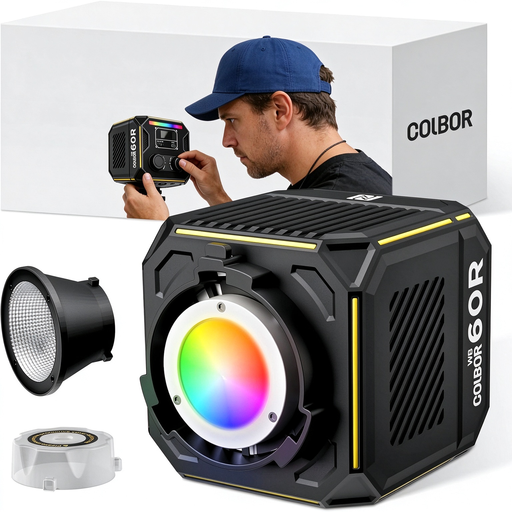
COLBOR 60W RGBCW COB video light, 59Wh battery, 2700–6500 K
The built-in battery makes this light an option for a portable filming setup.
- 60 W; built-in 59 Wh battery
- 2700–6500 K, with bi-colour and RGB colour control
- The description lists DC and USB-C power
View at Joybuy
 No image available
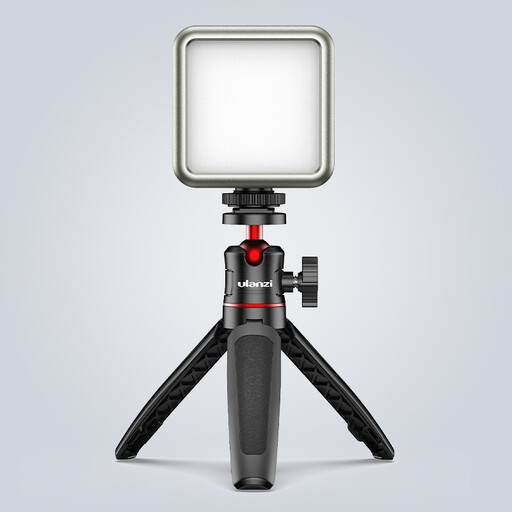
Ulanzi VL49 RGB video light, 2000 mAh, 2500–9500 K
Its compact size and built-in battery make it suitable for portable close-up filming.
- 2000 mAh battery
- 2500–9500 K and dimming control
- Magnetic mount on the back
View at Joybuy
 No image available
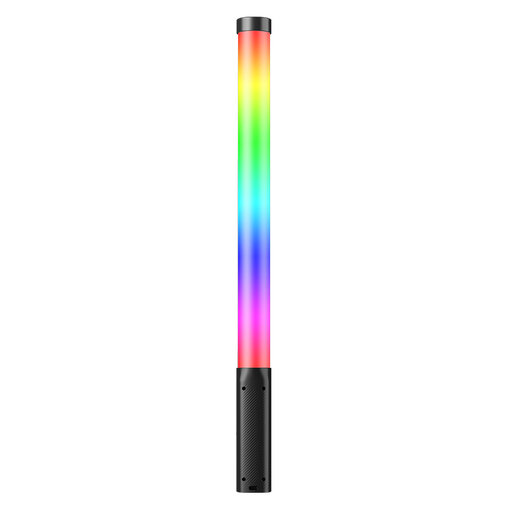
Ulanzi VL119 10W RGB light wand
The built-in battery and tripod mount support a setup you can move around.
- 10 W; colour temperature of 2500–9000 K
- 3300 mAh battery; weight 202 g
- 120° beam angle and 1/4-inch thread
View at Joybuy
 No image available
Ulanzi LM001 rechargeable mini video light
This rechargeable version is handy to take with you or put away after filming.
- 81-LED array
- Adjustable range of 3200–5600 K
- USB-C port; the product name lists a 500 mAh battery
View at Joybuy
 No image available
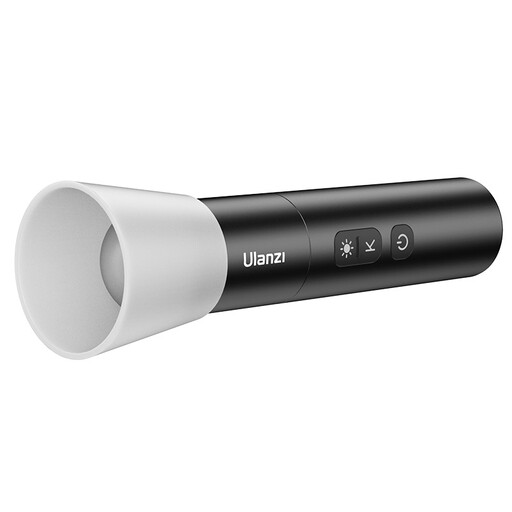
Ulanzi LM07 LED video light, 2000–5500 K
This rechargeable light is a portable option, and its zoom setting lets you adjust the beam.
- 2000 mAh battery; weight 187 g
- Zoom adjustment from spot to flood
- CRI >90 according to the product description
View at Joybuy
Frequently asked questions
Why isn’t a bare light automatically suitable for a weaving demonstration?
How clearly you can see your work depends partly on the size and position of the light source. Diffusion can soften harsh shadows from your hands and threads, but test whether the whole working area still gets enough usable light after diffusion.
How can you stop yarns looking different in successive recordings?
Keep ambient light as consistent as possible, match the colour temperature and check the white balance with a test recording of the yarns you use. A light’s specifications alone don’t determine how the camera captures colours.
What can you do if bands appear in the picture?
Make a test recording at the dimming level you intend to use and check your camera’s shutter speed and anti-flicker settings. Sony Support explains that LED lighting can cause flicker and banding in certain recording conditions; there’s no single setting that works for every combination of light and camera.
Is CE marking required for a mains-powered studio light in the Netherlands?
Electrical equipment covered by the EU Low Voltage Directive, including equipment designed for 50–1000 V AC, is subject to conformity requirements and the required CE marking. This requirement does not prove that a specific listing or version complies; check the documentation for the exact product.
Can you try out a light bought online and return it?
For a standard online consumer purchase, you usually have a 14-day cooling-off period from delivery. ACM ConsuWijzer explains the conditions and exceptions for unpacking and trying out a product; check what applies to your specific purchase.


