
Detail-focused skyline photographer
You want to capture fine lines in buildings and bridges, perhaps for a large print or a cropped image. The Consumentenbond points out that both the sensor and the lens matter for image quality.


First, decide what angle of view you need from your chosen position, then consider sensor resolution and lens quality together. The Consumentenbond highlights that both contribute to image quality, so more megapixels alone don’t guarantee sharper detail. A mirrorless camera lets you choose from interchangeable lenses, while a compact camera with a fixed zoom lens is easier to carry. For twilight shots, you’ll also need to consider exposure control and a stable set-up.
You want to capture fine lines in buildings and bridges, perhaps for a large print or a cropped image. The Consumentenbond points out that both the sensor and the lens matter for image quality.
You photograph a skyline with a bright sky, dark buildings and reflections. You want control over the exposure and may sometimes need a stable set-up.
You want a camera that’s easy to carry and are weighing up whether a fixed zoom lens will do the job or whether interchangeable lenses are worth the extra kit. The Consumentenbond describes compact cameras as having a fixed lens and generally being small and light.
Choose this option if: you want to capture both a wide river bend and distant building or bridge details, and are happy to bring a suitable lens.
Bear in mind: a camera body isn’t automatically a complete kit. Check the lens mount and the angle of view you need.
Choose this option if: you want to take one camera with you on a walk and its fixed zoom range suits the positions you usually shoot from.
Bear in mind: you can’t change the lens later, so check in advance that its optical zoom range suits the compositions you want.
| What to consider | What to look for | Who it matters most to |
|---|---|---|
| Fine building details | Consider sensor resolution alongside the lens and the crop you want. | If I want to crop building and bridge lines later or print them large, I’ll want to assess the sensor and lens together. Around 36% of consumers rank preserving detail as their top buying priority. |
| Exposure at twilight | Check the exposure options and whether a stable set-up suits the way you shoot. | At twilight, I want to capture the bright sky, dark buildings and reflections carefully; around 29% of consumers prioritise low-light exposure. |
| Portability | Compare the weight of the complete kit, including the lens, and decide whether you want to change lenses. | If I want to take the camera on walks, the convenience of a compact kit matters. Around 21% of consumers rank portability as their top buying priority. |
| Cropping from the opposite bank | Check the optical zoom range or which suitable wide-angle and telephoto lenses are available. | When I want to switch between a wide cityscape and distant architectural details, flexible framing matters; around 14% of consumers prioritise this. |
A sensor specification alone doesn’t tell you how sharply the complete camera-and-lens combination will capture a building detail.
Alongside resolution, compare suitable lenses and, where possible, sample images or tests of the exact camera-and-lens combination.
You may need different focal lengths for a wide skyline and a distant building detail. A body on its own doesn’t automatically include a lens that suits your position.
Check what’s included in the kit, the lens mount and the angle of view you’ll need from the river.
A mirrorless camera may need a separate compatible lens, so factor the lens you need into your choice of kit.
These zoom descriptions refer to different ways of framing a shot, so they aren’t directly interchangeable.
Compare the optical zoom range with the distance to your subject and the framing you want.
Sony offers two different approaches here: a full-frame mirrorless camera with an interchangeable lens and a compact camera with a fixed zoom lens.
The Nikon Z 7II is a full-frame mirrorless camera to consider if high resolution and interchangeable lenses matter to you.
The EOS R5 Mark II and EOS R8 are full-frame models with different stated resolutions and interchangeable lens systems.
The Fujifilm X-T5 is an APS-C mirrorless camera with an interchangeable lens, for those weighing up resolution and hands-on controls against carrying a complete kit.
This selection includes compact cameras and a mirrorless camera for capturing a skyline or cityscape. Check which type of zoom or lens suits your position for each model.
 Image unavailable
The stated optical zoom may be useful if you want to frame distant details from a fixed position.
The product listing specifies 64 MP, 12× optical zoom and 4K video.
 Image unavailable
This compact camera could suit you if you also want to take still photos while out walking.
The product description specifies a 1-inch CMOS sensor; 4K/120fps is a video specification.
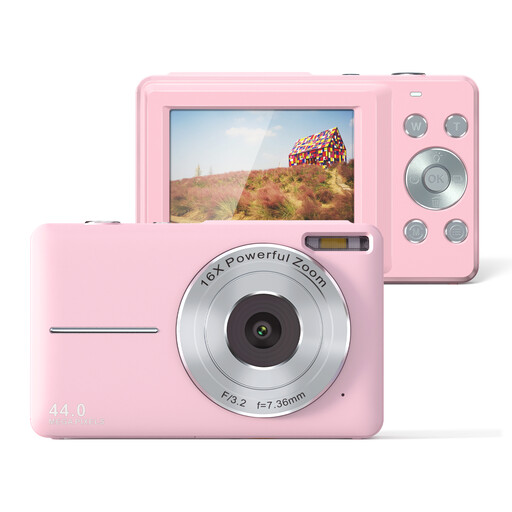 Image unavailable
This pocket-sized model could suit you if you’re looking for a camera to take on the go and want to use digital zoom.
The title specifies 44 MP and 4K; the product description lists 16× digital zoom.
 Image unavailable
The stated optical zoom may be useful if you want to frame subjects at different distances from one spot.
The product title specifies 8× optical zoom, 64 MP, 5K and a dual lens.
 Image unavailable
This mirrorless camera is listed with a zoom lens, which may be useful if you want to adjust the angle of view as you shoot.
The product description specifies a 24.2 MP APS-C sensor, E-mount and 16–50 mm zoom lens.
No, not automatically. Consider resolution alongside the sensor, lens and sharpness of the finished photo. The Consumentenbond points out that both the sensor and lens matter for image quality.
Try different positions and exposures. When photographing water, Canon recommends considering factors such as the camera’s height and the movement of the water.
Check exactly what’s included in the offer. A mirrorless camera has an interchangeable lens, but a body without a suitable lens won’t automatically give you the angle of view you need for your riverside location.
According to the Dutch government, a product must meet what you could reasonably expect from it; there is no fixed general statutory warranty period in the Netherlands. For an eligible online distance purchase, you generally have a cancellation period that, according to ACM ConsuWijzer, ends 14 days after delivery. Check the terms and any exceptions.
That depends on who publishes the photo, for what purpose and who can be identified in it. The Dutch Data Protection Authority treats identifiable people as personal data and distinguishes between use for personal or household purposes only and wider publication. Don’t assume that a photo taken outdoors is automatically free to publish.