
Vandaag of morgen in huis

Kwaliteit gegarandeerd

Welkomstaanbiedingen ontgrendelen: GRATIS bezorging | Tot 80% korting | Gratis 30 dagen JoyPlus-proefperiode
Download de app
A water flosser can be a practical addition to daily toothbrushing and traditional flossing. It is particularly useful if you wear braces, have implants, tight gaps between your teeth or find dental floss difficult to use. Even so, many models look very similar. Marketing claims about high pressure, long battery life and antibacterial performance do not always tell the full story.
Pay particular attention to these three pitfalls:
A portable water flosser generally works with pulsing jets of water. Pressure is often expressed in PSI. A model with several settings is more practical than a device with just one fixed, powerful jet.
A gentle setting is useful for beginners or people with sensitive gums. If you are looking for a water flosser for braces, also look for an orthodontic nozzle and a jet that can be directed between brackets and along the gumline. An electric flosser does not replace a check-up or advice from a dentist.
Also check whether the product information clearly states how many settings are available. For example, the Sunluxy L5 is listed as offering 60–140 PSI, 1,600–1,800 pulses per minute and four settings. According to the product information, the BAIR CARE V6 offers pressure of 75–80 PSI and an on-demand pressure function.
A small reservoir keeps an oral irrigator compact, but may mean refilling it more often. For home use, around 250 to 300 ml is often a practical middle ground. If you use your water flosser on the go, you may place greater value on a foldable or removable reservoir.
Consider the following:
The BAIR CARE V6 has a magnetically removable reservoir and, according to the product description, folds down to approximately 10 cm. The Sunluxy L5 uses a removable 260 ml tank. A larger tank is not always more convenient: it takes up more space and can make the device heavier.
A cordless water flosser is useful in bathrooms without a suitable power socket and when travelling. Do not just look at the stated number of days; also consider the charging time, charging standard and port.
USB-C charging is convenient if you already use a suitable cable. The Sunluxy L5 lists a 1,500 mAh battery, around three to four hours of charging time and up to 50 days of use according to the product information. The BAIR CARE V6 lists around four hours of charging time and up to 30 days of typical use.
Read the IPX rating carefully. According to the product information for some models, IPX7 provides protection during temporary immersion, while IPX6 indicates protection against powerful water jets. Both IPX6 and IPX7 appear in the supplied information for the Sunluxy L5. Always check the current product specification and never use the device while it is charging.
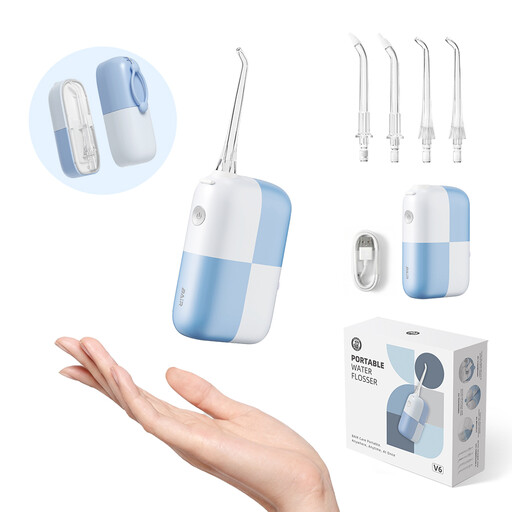
Why it suits this profile: This compact 145-gram model is designed for people looking for a portable water flosser for use at home, in the office or while travelling. The on-demand pressure function gives beginners control over when the jet starts.
The product information states a fixed pressure range of 75–80 PSI rather than an unclear maximum pressure. The reservoir is removable, making it easier to clean.
IPX7 according to the product listing, USB-C charging, around 30 days of battery life and storage space for several nozzles.
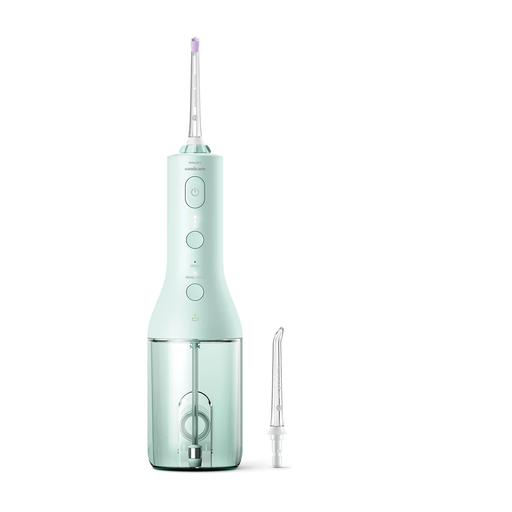
Why it suits this profile: This model is ideal for anyone looking for an established product range, a 250 ml reservoir and simple operation with two modes and three intensity levels.
The controls specify clear modes and intensity levels. Claims about cleaning results come from Philips’ product information and should not be interpreted as a personal or medical guarantee.
QuadStream nozzle according to Philips, two modes, three intensity levels and a removable 250 ml tank.
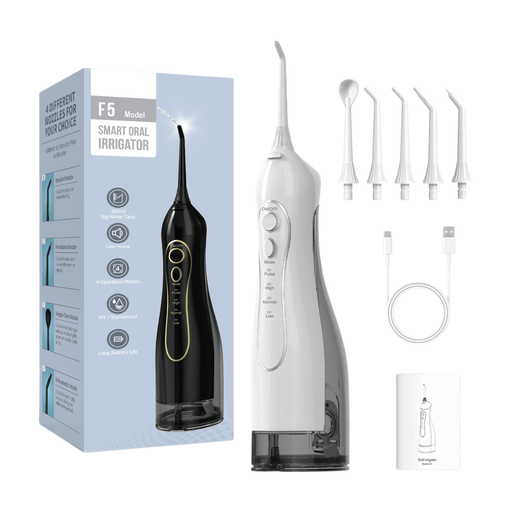
Why it suits this profile: The F5 is designed for users who need several settings, a relatively large reservoir and different nozzles, for example for use around braces.
The product page lists five pressure settings and a range of 40–140 PSI. This means you can start at a lower level rather than always using a single powerful setting.
300 ml tank, five nozzles, 360° rotating nozzle, IPX7 according to the product listing and up to 40 days of battery life according to the manufacturer.
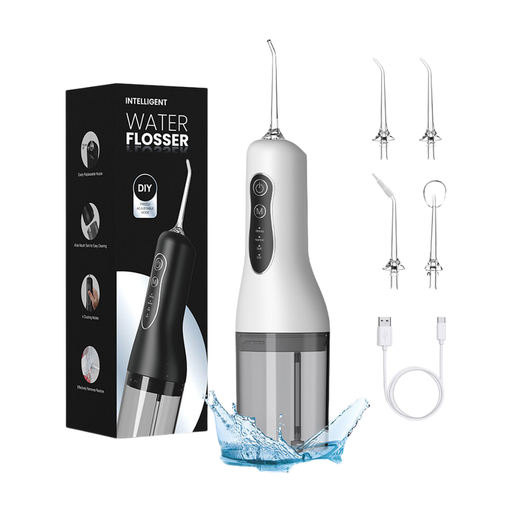
Why it suits this profile: This compact model combines a removable 260 ml tank with USB-C charging and several nozzles. That makes it suitable for everyday use and travelling.
The product description specifies the tank capacity, charging time and four settings. Before buying, however, check the current IPX rating, as the supplied specifications are not entirely consistent.
Four settings, smart memory function, 1500mAh battery and three types of nozzle supplied according to the product information.
We have put together a complete, up-to-date list of products that fully meet these strict selection criteria and the applicable European safety regulations.
When using a new oral irrigator, start with the lowest setting. Fill the reservoir with clean, lukewarm water and direct the nozzle at the spaces between your teeth and along the gumline. Keep your mouth partly closed and move systematically along your teeth to minimise splashing.
After every session:
Stop if you experience persistent bleeding, clear irritation or severe discomfort, and ask a dentist for advice. A water flosser is an oral-care aid, not a treatment.
It can be practical, but check whether an orthodontic nozzle is included and follow your orthodontist’s or dentist’s instructions. A model with several settings can help you start gently.
Its lifespan depends on charging habits, maintenance, water quality and the availability of replacement nozzles. Empty the tank after use, allow the device to dry and replace the nozzles according to the product manual.
In addition to the purchase price, your main costs are electricity, water and any replacement nozzles. A USB-C model can be convenient if you already have a suitable charger. Always check the charging voltage and only use accessories intended for the model.
