
Vandaag of morgen in huis

Kwaliteit gegarandeerd

Welkomstaanbiedingen ontgrendelen: GRATIS bezorging | Tot 80% korting | Gratis 30 dagen JoyPlus-proefperiode
Download de app
A water flosser can be useful for rinsing away food particles from between your teeth, along the gumline or around braces. However, not every model is equally suited to everyday use. A high pressure rating in the product title, for example, doesn’t tell you much if the device doesn’t have a gentle setting. A compact tank can also be inconvenient if you have to refill it during every cleaning session.
In this buying guide from the Joybuy Product Recommendation Officer, you’ll find out what to look for in a cordless water flosser, which specifications really make a difference and which type suits your needs.
A model rated at 140 PSI sounds powerful, but maximum pressure isn’t automatically comfortable or necessary. For beginners and people with sensitive gums, a low setting is more important than a high peak pressure. So always check:
A water flosser with multiple settings usually offers more flexibility than a device with just one powerful jet.
A portable water flosser is often compact because it has a smaller tank. That’s handy in a wash bag, but it may mean you have to refill it during a full cleaning session. For home use, a tank of around 250 to 350 ml is often a good compromise between size and convenience. A countertop model with a 600 ml tank takes up more space, but needs refilling less often.
IPX6, IPX7 and IPX8 refer to different levels of protection against water. They don’t mean you can use or charge every device in all conditions. Check the instructions and make sure the USB-C port is dry before connecting it. Never use an electric oral irrigator while it’s plugged into the charger, unless the manufacturer explicitly says you can.
Water pressure is often measured in PSI. A range such as 60–140 PSI means you can switch between a gentler and a more powerful jet. This is particularly useful if you need a water flosser for sensitive gums, are trying one for the first time or want to alternate between everyday and more intensive cleaning.
Also check the pulse frequency. The Sunluxy L5 lists 1,600–1,800 pulses per minute and four settings: Strong, Standard, Soft and DIY. Treat these as product specifications, not a guarantee of a particular oral care result.
A larger tank can be useful in a water flosser for home use. If you travel often, you’re more likely to prioritise weight, dimensions and how easy the tank is to fill and clean. According to the product information, the BAIR CARE V6 weighs 145 grams and folds down to around 10 cm. The Rushi R-A31, by contrast, has a 350 ml tank, giving you more water for each session.
Check which attachments are included. A standard nozzle is suitable for everyday use, according to the product description. An orthodontic nozzle can be useful around brackets and wires, while a pocket or gum nozzle is designed for targeted cleaning.
Empty the tank after use, rinse the attachments and let all the parts dry completely. A removable tank with a wide opening makes this easier. Also check whether replacement nozzles are available and what the warranty covers.
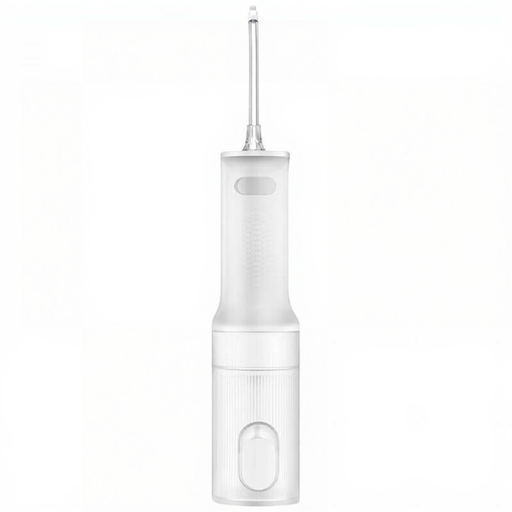
Why it suits this profile: This compact model has three settings, a transparent 200 ml tank and USB-C charging. That makes it a straightforward choice if you’re using an electric water flosser for the first time.
The three settings mean you don’t have to start with a strong jet. The product specifications include a Gentle setting for a softer clean.
200 ml tank, three settings, IPX7 water resistance according to the product information and up to 30 days’ use per USB-C charge.
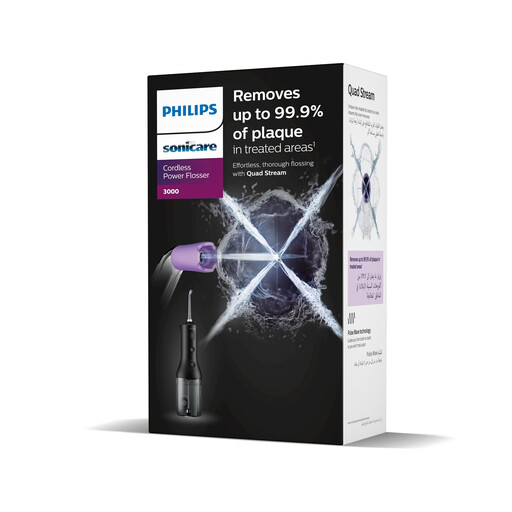
Why it suits this profile: This model combines a 250 ml reservoir with two modes and three intensity levels. Philips says the Quad Stream tip is designed to spread the water flow over a larger area.
The three intensity levels mean you’re not limited to choosing between a gentle and a powerful setting. According to the product information, the tank holds enough water for a session of up to 60 seconds.
Two cleaning modes, three intensity levels, a 250 ml reservoir and a two-year warranty, according to the product information provided.
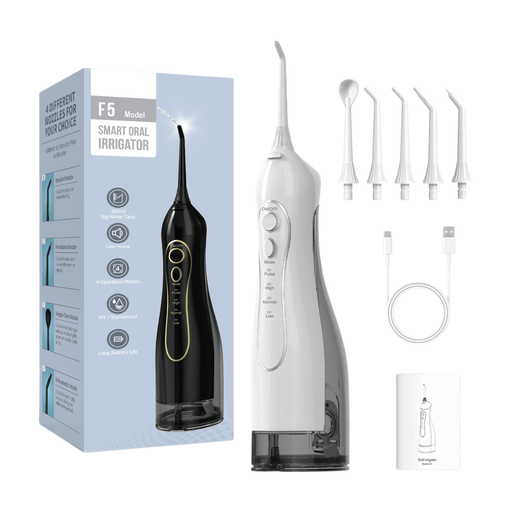
Why it suits this profile: The F5 is designed for users who want multiple attachments and a generous tank. The set includes an orthodontic nozzle and a gum nozzle, among other accessories.
The pressure can be adjusted from 40–140 PSI and there are five settings. So you don’t have to settle for a single fixed jet that might feel too strong or too gentle.
Removable 300 ml tank, five settings, 360° rotating nozzle, 2,000 mAh battery and IPX7 rating according to the product information.
We’ve put together a complete, up-to-date list of products that meet these strict selection criteria and the applicable European safety requirements.
Fill the tank with clean, lukewarm water and start on a low setting. Place the nozzle in your mouth before switching the device on, and lean over the sink. Move it slowly along the gumline and between your teeth. Don’t direct the jet towards your eyes, ears or nose.
If you’re choosing a water flosser for braces, check whether an orthodontic nozzle is included. If you have implants, persistent irritation or recurring bleeding, ask your dentist for advice before increasing the intensity. A water flosser also doesn’t automatically replace brushing or other oral care.
That depends on your routine and the manufacturer’s instructions. Many people include a water flosser in their oral care routine once a day. Start gently on a low setting and only increase it if it remains comfortable.
Battery life varies by model and setting. The product information gives estimates ranging from around 14 to 90 days. These are the manufacturer’s usage estimates. Actual battery life depends on the pressure setting, how often you use it and charging conditions.
After the initial purchase, the main ongoing costs are usually water, electricity and replacement nozzles. Before buying, check that compatible attachments are available and how often the manufacturer recommends replacing them. This helps ensure a cheaper device doesn’t become less practical over time.
