
People who often wear dirty workwear
You want to choose a programme that suits the fabric, care label and level of soiling, rather than relying only on a quick or energy-saving cycle. Consumentenbond explains how programmes differ.


Start with the care label and the separate load you usually wash, then choose a machine with programmes and dimensions that suit your utility room. The energy label helps you compare the eco 40-60 programme, but it doesn’t automatically make that programme suitable for heavily soiled clothes or a wash that needs to meet hygiene requirements. Protective clothing must also be washed according to its care label and work instructions.
You want to choose a programme that suits the fabric, care label and level of soiling, rather than relying only on a quick or energy-saving cycle. Consumentenbond explains how programmes differ.
You want to match the drum capacity to the separate load you usually wash, rather than automatically choosing the largest drum. Consumentenbond and Milieu Centraal recommend choosing a machine that suits the load you typically wash.
You need to weigh up the dimensions, access route and positioning, as well as the potential consequences of a leak. Consumentenbond stresses the importance of a stable, level installation and describes different types of water protection.
Start with the care label and the separate load you usually wash. Then check whether the machine will fit and which operating and service terms matter to you.
| What to consider | What to look for when buying | Who should give this extra thought? |
|---|---|---|
| Programmes for fabric and level of soiling | Compare the available cotton, mixed and synthetics programmes and their permitted load sizes with the care labels on your clothes. | I want to be able to choose a suitable programme for the fabric and level of soiling of my workwear; around 40% of consumers put programme choice first. |
| Capacity for your usual workwear load | Weigh a typical separate load and compare it with the machine’s stated capacity and the programme’s load limit. | If I often wash a similar amount of workwear, I want a drum that suits it; around 30% of consumers prioritise a suitable load size. |
| Space and water protection | Measure the access route, installation space and door swing; check the floor, connections and water protection for the exact model. | In a cramped utility room, I want to be sure the machine will fit and stand securely; around 20% of consumers prioritise making sure it fits. |
| Energy and water use, installation and service | Compare the energy-label consumption per 100 cycles and water use per cycle. Ask separately what installation includes and check the warranty terms. | When weighing up the operating and service terms, I want to know what to expect in advance; around 10% of consumers prioritise these costs and terms. |
A large drum isn’t necessarily an advantage if you rarely fill the machine properly. The permitted load can also vary from programme to programme.
Weigh a typical separate load and check the maximum load for the programme you actually plan to use.
Eco 40-60 is intended for normally soiled cotton that can be washed at 40 or 60 °C according to its care label. Protective clothing may have its own care requirements.
Follow the garment’s care label and instructions. If you’re dealing with protective clothing or possible exposure to hazardous substances, speak to your employer and follow the relevant work instructions.
Depth, access, door swing and a stable installation all affect whether the washing machine will fit practically in your utility room. Installation may be a separate service.
Measure the route and installation space, check the connections and ask what installation includes before you order.
According to AEG, the AEG LF628400 from the 6000 ProSense range is an 8 kg front-loading washing machine with a spin speed of 1400 rpm and a stated depth of 577 mm. Compare these dimensions with your load and available space.
According to Bosch, the Serie 6 WGG244FSNL is a 9 kg front-loading washing machine with a maximum spin speed of 1400 rpm and dimensions of 845 × 598 × 590 mm.
According to Siemens, the Siemens iQ500 WG44J209NL is a 9 kg front-loading washing machine with a maximum spin speed of 1400 rpm and dimensions of 845 × 598 × 590 mm.
According to Miele, the W1 WWD380 WCS PWash&Steam&9kg is a 9 kg front-loading washing machine with a spin speed of 1400 rpm.
According to Samsung, the Samsung WW90DG6U85LEU3 from the AI Wash 6000 series is a 9 kg model with dimensions of 600 × 850 × 550 mm.
Compare these washing machines for machine-washable workwear by looking at suitable programmes, load size and available space. The care label always takes precedence.
 No image available
Worth comparing if you wash cotton or synthetic workwear and have loads of up to 9 kg.
The product details list programmes for cotton, synthetics, pre-wash and Bubble Soak, plus dimensions of 600 × 550 × 850 mm.
 No image available
An option worth comparing if you want to wash smaller separate loads too and want to factor water protection into your choice.
The product details list Mini Load, Sport, Stain Removal and Pre Wash, AquaStop and dimensions of 845 × 598 × 590 mm. Check that the programmes suit the fabric and care label.
 No image available
Worth comparing if you’re looking for an 8 kg washing machine and its stated depth matters in your utility room.
The product details list 1400 rpm, a depth of 475 mm, 16 programmes and features such as Extra Rinse and Pre-Wash. For each garment, check that the selected programme and any steam function are suitable.
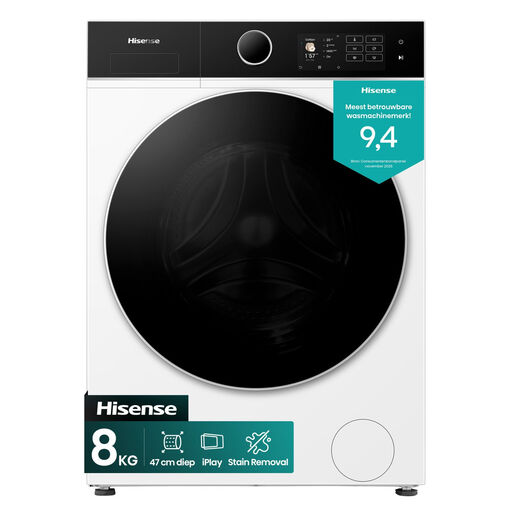 No image available
Worth comparing if you have loads of up to 8 kg and need to consider the machine’s depth when deciding where to put it.
The product details list 1400 rpm, a depth of 47 cm and 18 programmes. According to the product information, waterproof thick fabrics must not be washed in this machine; always check the care label.
 No image available
An option worth comparing if you wash synthetic workwear or mixed loads.
The product details list 1400 rpm, dimensions of 84,5 × 60 × 54,6 cm and programmes such as Synthetics, Mixed Load, StainExpert and Hygiene+. The product information warns against washing items that have been treated with flammable solvents, industrial chemicals or dry-cleaning fluids.
No. Eco 40-60 is intended for normally soiled cotton that can be washed at 40 or 60 °C according to its care label. For other fabrics or levels of soiling, check the label and programme instructions; the programme name doesn’t guarantee that the wash will reach 60 °C.
Measure the access route and installation space, check the connections and position the machine on a firm, level surface in line with the installation instructions. Remove the transit bolts before use and ask in advance what any installation service includes.
No, not automatically. According to ACM, Dutch statutory warranty doesn’t have a fixed time limit: with normal use, it depends on what you could reasonably expect from the product. The retailer is your point of contact; an additional manufacturer’s warranty doesn’t replace your statutory rights.
The fact that an item is machine-washable doesn’t settle this. Protective workwear may be personal protective equipment; follow the garment’s care instructions and discuss possible exposure and appropriate treatment with your employer. A steam or hygiene programme doesn’t, by itself, mean you can wash this type of clothing at home.
For household appliances, the Dutch take-back scheme requires the retailer to take back an old, similar appliance free of charge, according to the Dutch Government. This scheme doesn’t apply to business equipment.