
People who wear washable work trousers
You want to wash ordinary work trousers with your household laundry and are looking for settings that match the care label. DASSY advises following the care instructions on the garment.


Choose the drum capacity based on your usual full loads, not just your seasonal laundry. A larger machine makes sense mainly if you regularly fill it appropriately, as Consumentenbond and Milieu Centraal advise. Let the care label determine which programme is suitable, and compare energy consumption on the EU energy label. A steam or quick programme does not automatically make protective work trousers suitable for home washing.
You want to wash ordinary work trousers with your household laundry and are looking for settings that match the care label. DASSY advises following the care instructions on the garment.
You change your clothes with the seasons and want a drum that suits your usual loads, without routinely choosing extra capacity for the sake of one larger wash. Consumentenbond and Milieu Centraal advise choosing a machine based on how full you can usually load it.
You need to check whether home washing is suitable for the specific protective properties and care instructions. Arboportaal explains that protective workwear can be personal protective equipment; the washing machine programme does not determine the correct washing method.
First check the trousers’ care label, then choose the drum capacity based on your usual loads, and finally compare the programmes and energy consumption.
| What to consider | What should you look for? | Who should pay particular attention? |
|---|---|---|
| Care label and garment care | Check the material, permitted temperature, and instructions for spinning and drying. For protective clothing, also follow the prescribed washing method. | If you want to avoid choosing a programme that conflicts with the care instructions for your work trousers, start by checking the label. Around 40% of consumers give garment care their highest priority. |
| Drum capacity | Compare the stated load capacity with your usual full loads, and check the maximum load for the programme you want to use. | If you do a seasonal wash as well as your usual laundry, you’ll want enough room without choosing a drum that you don’t usually fill appropriately. Around 30% of consumers prioritise a suitable drum capacity. |
| Energy consumption | Compare the energy class and kWh per 100 cycles on the EU energy label, and check which cycle those figures refer to. | If you’re comparing washing machines for regular use, you’ll want to weigh up the standardised energy consumption alongside the programmes that suit your clothes. Around 20% of consumers make energy consumption their top consideration. |
| Installation and connections | Measure the available space and allow for the door and connections. Follow the model’s installation instructions before use. | If the machine needs to go in a specific place, you’ll want to know in advance whether there’s enough room to install and connect it. Around 10% of consumers prioritise installation. |
The loads you do during the rest of the year also matter when you’re deciding on capacity.
If necessary, weigh a typical load of laundry and compare it with the stated capacity before choosing a larger drum.
Programme names do not replace the garment’s care label. For protective clothing, the care instructions and workplace arrangements may also determine how it should be washed.
Follow the care label and, for protective workwear, discuss the prescribed washing method with your employer.
A manufacturer’s warranty and a consumer’s statutory rights are not the same. The Dutch Government explains that the retailer is your point of contact if you have a problem with a product.
Check what any additional warranty covers, and report a problem with a faulty product to the retailer.
The Serie 6 front-loading range includes models you can compare by load capacity and dimensions.
The 6000 ProSense range includes models with load detection and an 8 kg capacity.
The SuperSpeed 6000 series includes a model with a 9 kg capacity.
The W1 range includes, among others, the WWC380 WCS PWash&Steam&8kg.
These freestanding front-loaders offer a range of drum capacities and features to compare with your usual laundry loads and the instructions on the care label.
 Image unavailable
The 9 kg drum capacity may suit households that regularly do larger loads as well as washing their work trousers.
Load capacity: 9 kg. Maximum spin speed: 1400 rpm. Energy class A; 44 kWh per 100 cycles. The product information lists Quick 15 and Super Speed for a small load.
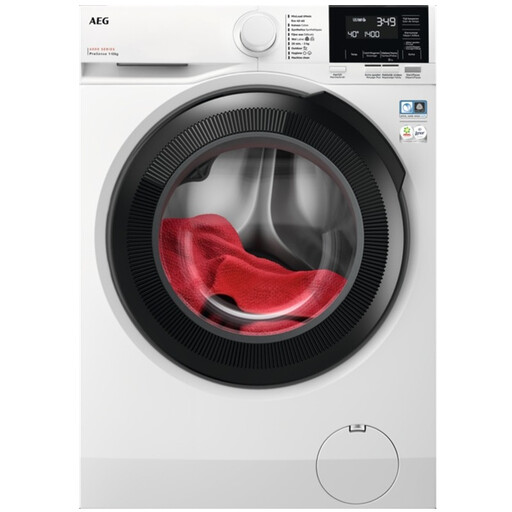 Image unavailable
With a 10 kg capacity, this model could be a good option if your usual laundry loads are regularly large.
Load capacity: 10 kg. Maximum spin speed: 1400 rpm. Energy class A; 51 kWh per 100 cycles. The product information lists ProSense load detection.
 Image unavailable
The 8 kg capacity is an option to compare when weighing up your usual laundry loads against a seasonal wash.
Load capacity: 8 kg. Maximum spin speed: 1600 rpm. Energy class A; 42 kWh per 100 cycles. The product information lists PreciseWash, MixLoad and ProSteam.
 Image unavailable
This 8 kg model can be compared with other drum capacities for households with varying laundry loads.
Load capacity: 8 kg. Maximum spin speed: 1400 rpm. Energy class A. The product information lists PreciseWash and MixLoad.
 Image unavailable
The 8 kg capacity may suit usual loads that are a similar size to this stated capacity.
Load capacity: 8 kg. Maximum spin speed: 1400 rpm. Energy class A; 47 kWh per 100 cycles. The product information lists ProSense load detection.
Not based on that word alone. Follow the specific care instructions and, if the trousers protect you from a workplace hazard, discuss the prescribed washing method with your employer. Whether a particular pair of trousers can be washed at home depends on the care label and the applicable workplace instructions.
No. The European Commission describes Eco 40-60 as a programme for normally soiled cotton that can be washed at 40 °C or 60 °C. Check the material and care label first; the programme name does not replace the permitted temperature or other care instructions.
Measure the available space and follow the installation instructions for your chosen model. Remove the transit bolts before use; Bosch warns that leaving them in place can cause problems when the drum spins.
No. A manufacturer’s warranty is not the same as the statutory guarantee in the Netherlands. Whether you are entitled to a remedy for a particular fault depends, among other things, on what you could reasonably expect from the product with normal use; the retailer is your point of contact.
Not always. The Dutch Government states that a 14-day cooling-off period applies in many cases to distance sales, but there are exceptions. Check the terms that apply to your specific purchase.