What should you look for?
First, weigh a typical load of towels. Then check that your chosen programme fits your schedule and consider where the washing can dry.
The points below are for consumers who want to wash damp cotton towels before the working week. The energy label gives you a basis for comparing eco 40-60; for other programmes, check the information for that specific programme.
| What to consider |
What should you check? |
Who should pay particular attention? |
| Washing and drying in time |
Check the programme length and permitted cotton load, and think about where the towels will dry afterwards. |
If I wash the towels at the weekend, I want to know whether the programme fits my schedule and whether I can dry them afterwards. Around 40% of consumers in this situation say washing and drying in time is their top priority. |
| Drum capacity to suit your needs |
Weigh a typical load and compare it with the machine’s capacity and the programme’s load limit. |
When I have a full basket of towels, I want a drum that can handle my usual load without choosing a consistently larger capacity than I need. Around 30% of consumers in this situation prioritise a suitable capacity for cotton towels. |
| Running costs |
Compare kWh per 100 eco 40-60 cycles and water consumption on the same label basis; look up the relevant figures for other programmes. |
If I often use a different cotton programme, I don’t want to assume the consumption shown on the label applies to it. Around 20% of consumers in this situation say running costs are their main consideration. |
| Drying space |
For a washer-dryer, check the washing and drying capacities separately and compare the drying capacity with the load you want to dry. |
If I have little space to dry towels, I want to know whether one appliance can meet both my washing and drying needs. Around 10% of consumers in this situation say limited drying space is their top priority. |
Washing machines at Joybuy
This selection includes front-loading washing machines and washer-dryers for different towel loads. Compare the stated washing capacity with your usual load, and check the drying capacity separately for washer-dryers.
 No image available
Haier HWD90-BP14929A-S washer-dryer
An option if you want to wash and dry your towels in one appliance; match the drying load to the lower drying capacity.
9 kg washing capacity; 5 kg drying capacity; 1400 rpm.
View at Joybuy
 No image available
Samsung WW90DG6U25LE washing machine
An option if you’re looking for a 9 kg machine; check whether the quick programme’s load limit suits your towels.
9 kg capacity; 1400 rpm.
The SuperSpeed cycle mentioned is for 5 kg in 39 minutes; that doesn’t mean it’s suitable for a full drum of towels.
View at Joybuy
 No image available
Midea MF205D80WB/W-NL washer-dryer
An option if you want to wash and dry with one appliance; check that the drying capacity suits the load you need to have dry in time.
8 kg washing capacity; 6 kg drying capacity; 1400 rpm.
View at Joybuy
 No image available
Midea MF110W80BA10/W-NL washing machine
An option if you’re looking for a freestanding front-loader; check the load limit for a short programme before choosing it for towels.
8 kg capacity; 1400 rpm.
A 15-minute programme is listed, but its permitted load isn’t specified.
View at Joybuy
 No image available
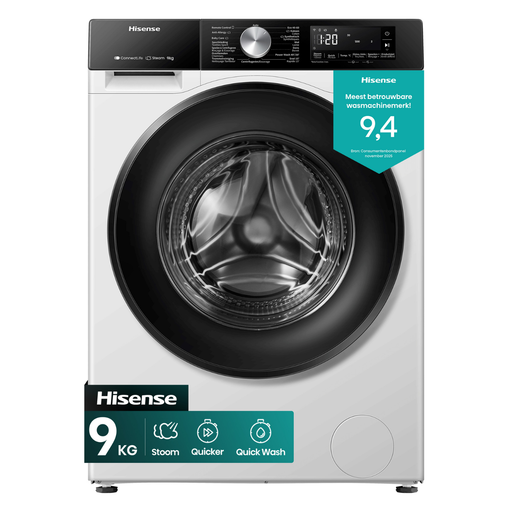
Hisense WF3S9045BW3/BLX washing machine
An option if you wash larger loads of towels; weigh your usual load and check which programme is suitable for it.
9 kg capacity; 1400 rpm.
A 15-minute quick programme is listed. Check the permitted load before choosing this programme for towels.
View at Joybuy
Frequently asked questions
Do cotton towels always need to be washed at 60 °C?
No, ordinary cotton towels don’t always need to be washed at 60 °C. Milieu Centraal says they’ll usually come clean at a lower temperature too. Follow the care label and take any particular hygiene needs into account.
Does eco 40-60 mean the washing is done at 60 °C?
No. Eco 40-60 is designed for normally soiled laundry that the care label says can be washed at 40 or 60 °C. The actual temperature varies from machine to machine; Consumentenbond advises that if you have a specific hygiene need, you shouldn’t rely on the programme name alone.
Is an energy label required for a new washing machine?
Yes, new washing machines offered for sale in the Netherlands must have an energy label available. The Dutch government describes this as a legal information requirement, not an obligation to choose an A-rated machine. The label also doesn’t show the consumption of every individual programme.
What should I check before delivery and installation?
Measure the available space and check the delivery and installation terms before ordering. Consumentenbond also recommends placing the machine on a stable surface to reduce noise and disruption.
Who should I contact if my washing machine develops a fault?
Report a fault to the retailer. According to the Dutch government, if a product is faulty, the retailer can’t simply refer you to the manufacturer. A manufacturer’s guarantee doesn’t replace your statutory rights against the retailer.


