First, measure the installation space and the room needed to open the machine. Then choose a drum and programme that can accommodate your blanket according to its care label. A narrow top-loader may help if width is the main constraint, while a shallower front-loader could be a good option if depth is limited. Neither type makes an oversized or heavily shedding blanket suitable for machine washing.
Who is this relevant to?
Someone with a narrow laundry space
You need to fit the machine between existing obstacles and want to know whether there’s room to open the lid or door. The Consumentenbond discusses top-loaders as an option for narrow spaces; check the dimensions of the exact model and the clearance in your layout.
Owner of larger washable blankets
You want to know whether a typical blanket load will fit in the drum, rather than relying solely on the maximum capacity in kilograms. The Consumentenbond notes that the stated load capacity applies to cotton, and that the permitted load can vary by programme.
Owner of a pet that sheds heavily
You regularly wash blankets covered in pet hair and want to know how much preparation and filter maintenance this involves. Bosch recommends removing as much loose hair as possible beforehand; follow your machine’s manual for filter and drain maintenance.
What should you look for when buying?
Narrow top-loader
Choose this option if: width is the main constraint and there’s enough room above the machine to open the lid.
Bear in mind: AEG lists the LTR6363A as 397 mm wide, with a maximum capacity of 6 kg; check that your blanket and chosen programme are suitable.
Shallower front-loader
Choose this option if: depth is the main constraint, but there’s room for a width of around 60 cm and space in front of the door.
Bear in mind: Haier lists the HW80-BP14357TU1 as 468 mm deep, with a maximum capacity of 8 kg; the installation space required may be greater than the appliance depth.
Standard front-loader
Choose this option if: a standard front-loader fits with the necessary door and connection clearance, and you want enough drum space for your usual washing.
Bear in mind: a larger drum won’t solve a lack of installation space; compare the dimensions and the load capacity of the programme suitable for your blanket.
| What to consider |
What should you look for? |
Who is this important for? |
| Space and opening clearance |
Measure the alcove, connection space and clearance needed to open the door or lid; check the installation requirements for the exact model. |
If I need to fit the machine between obstacles, I want to know whether it will fit and whether it can be opened. Space is the main priority for around 33% of consumers in this decision-making context. |
| Blanket load |
Check the care label, drum and loading opening, and the permitted load for the suitable programme. The Consumentenbond states that the maximum load capacity applies to cotton. |
If my blanket is bulky, I want to be sure I can wash it according to its care label without forcing it into the drum. Having enough room for a typical blanket load is the main priority for around 27% of consumers. |
| Pet hair and maintenance |
Remove loose hair before washing and check the manual for instructions on maintaining the filter and drain system. |
If I often wash blankets covered in hair, I want to know how much preparation and maintenance is needed. Dealing with hair and maintenance is the main concern for around 27% of consumers. |
| Consumption |
Compare kWh per 100 cycles, water per cycle, programme duration and spin noise on the EU energy label, using the same measurement basis. |
If I wash frequently, I want to factor in consumption alongside space and load capacity, without treating label figures as a prediction for every blanket programme. Running costs are the main consideration for around 13% of consumers. |
Common mistakes
-
Comparing only the appliance’s width or depth with the alcove
Connections and the space needed for a door to swing open or a lid to lift also matter. The machine may not be practical to use, even if its stated external dimensions seem to fit in the alcove.
Measure the entire installation space and check the installation requirements and opening clearance for the exact model before buying.
-
Assuming that an 8 kg capacity means any thick blanket will fit
The maximum load capacity doesn’t automatically apply to every fabric and programme. The blanket’s volume and the drum opening also matter.
Check the care label against the model manual, including both the permitted load for the programme and the available space in the drum.
-
Relying on a steam or hygiene programme to remove pet hair
A programme’s name doesn’t prove that it will remove hair from your pet blanket. Bosch recommends removing as much loose hair as possible from hairy fabrics beforehand.
Remove loose hair before washing and follow your machine’s instructions for the filter and drain system.
-
Assuming energy-label consumption figures apply to every blanket programme
Label values use a defined basis for comparison and don’t necessarily predict the consumption of the programme your blanket needs.
Compare label figures on the same basis and choose a programme according to the blanket’s care label.
Brands to consider
AEG
The 6000 Series LTR6363A is a top-loader worth considering if width is the main constraint.
- AEG lists this model as 397 mm wide, with a maximum capacity of 6 kg.
- The specifications don’t confirm whether a particular blanket will fit in the drum or can be washed on a suitable programme.
Haier
The X5 HW80-BP14357TU1 is a front-loader worth comparing if depth is the main constraint.
- Haier lists this model as 468 mm deep, with a maximum capacity of 8 kg.
- Check the full installation space and programme load capacity; neither can be determined solely from the appliance depth and maximum load capacity.
LG
The F4X1008NWH is an 8 kg front-loader worth comparing if a standard front-loader fits in your installation space.
- LG lists steam and Allergy Care features for this model.
- These feature descriptions aren’t independent evidence that the model removes pet hair from blankets. LG also recommends checking the space around and behind the machine.
Bosch
The Serie 4 WAN2827DNL is an 8 kg front-loader that can serve as a reference for a standard installation.
- Bosch lists this model with a maximum spin speed of 1400 rpm.
- Bosch recommends removing as much loose hair as possible from hairy fabrics before washing; this isn’t a special hair-removal feature of the model.
Joybuy washing machines for a standard installation
These Joybuy products are freestanding front-loaders for a standard installation. Compare the capacity with the care label and the load capacity of the programme you choose.
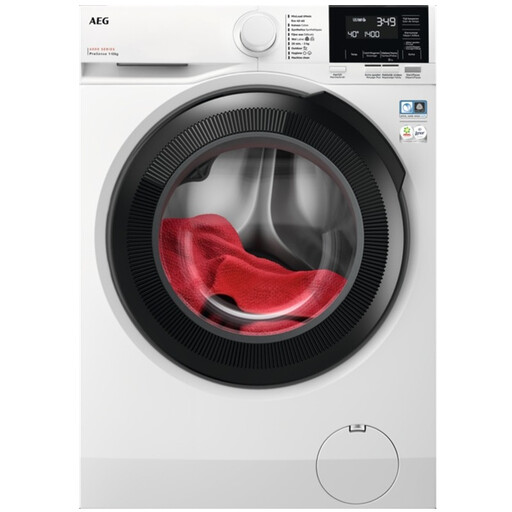 No image available
AEG LR63R144, 6000 Series, 10 kg
Worth considering for a larger blanket load if the care label and chosen programme allow it.
ProSense; 1400 rpm; energy class A.
Joybuy
 No image available
AEG LR73R862, 7000 Series, 8 kg
Worth considering for a blanket load if the care label and chosen programme allow it.
ProSteam; 1600 rpm; PreciseWash; energy class A.
Joybuy
 No image available
AEG LR73S840, 7000 Series, 8 kg
Worth considering for a blanket load if the care label and chosen programme allow it.
ProSteam; 1400 rpm; PreciseWash; energy class A-40%.
Joybuy
 No image available
AEG LF61R840, 6000 Series, 8 kg
Worth considering for a blanket load if the care label and chosen programme allow it.
57.7 cm deep; 1400 rpm; Anti-Allergy Vapour; energy class A.
Joybuy
No image available
AEG LR73S862, 7000 Series, 8 kg
Worth considering for a blanket load if the care label and chosen programme allow it.
ProSteam; 1600 rpm; PreciseWash; energy class A-30%.
Joybuy
Frequently asked questions
Can every blanket labelled ‘washable’ go in any washing machine?
No. Follow the care label and check that the fabric, size and load are suitable for your machine’s instructions and chosen programme. The Consumentenbond says the stated maximum load capacity applies to a cotton wash, not automatically to every programme.
What should I do about pet hair before and after washing?
Remove as much loose hair as possible before loading the machine; Bosch recommends shaking hairy fabrics out beforehand. Check your model’s manual for instructions on cleaning the pump filter and other parts, as drain systems can vary.
What should I check when installing a machine in a small space?
As well as the appliance dimensions, check the space needed for connections and to open the door or lid. Before using the machine, remove the transit bolts according to the model’s installation instructions; AEG specifically highlights this for washing machines.
What are my rights in the Netherlands if the washing machine turns out to be faulty?
According to the Dutch Government, you’re entitled to a product that works properly when you buy it. If there’s a problem, the retailer is your point of contact for a solution; a manufacturer’s warranty or an additional warranty doesn’t replace your statutory rights.
Is an energy label compulsory for washing machines in the Netherlands?
Yes. The Dutch Government says energy labels are compulsory for household appliances and notes that washing machine labels also include information about water use. The European Commission describes the A-to-G scale for washing machines and label details such as energy consumption per 100 cycles.


