Choose the drum capacity based on the weight of a typical week’s washing: extra capacity is most useful if you use it regularly, as Milieu Centraal and the Consumentenbond advise. For normally soiled cotton suitable for washing at 40 °C or 60 °C, eco 40-60 may be appropriate. For an occasional mixed load, check the permitted load, programme and care labels for each model. A washing machine function is no substitute for drying damp clothes properly.
Who is this relevant for?
Parents with school clothes to wash between regular loads
You want to wash damp or worn school clothes between regular loads, so you’ll need to consider fabric suitability, programme duration and the permitted load. Compare the instructions for the exact model with the care label.
Households with changing weekly loads
Sometimes you wash a small load, and sometimes a full family load. Milieu Centraal and the Consumentenbond advise choosing a drum capacity that suits the loads you usually wash.
Households keeping an eye on consumption
You compare energy and water consumption and consider which programme you actually use. The European Commission links the relevant label data to the eco 40-60 programme.
What should you look for when buying?
Weigh a typical load before choosing the drum capacity, then compare the programmes for the clothes you want to wash between regular loads.
| What to consider |
What to look for |
Who it matters most to |
| Washing school clothes between regular loads |
Check the maximum load for the quick or mixed programme, and whether it’s suitable for the fabrics. |
If I want to wash damp school clothes between regular loads, I need to know whether the programme suits the fabric and the amount of washing. Around 36% of consumers say this is their top priority. |
| Changing weekly loads |
Weigh a typical load and compare it with the drum capacity; also check the load limit for special programmes. |
When I alternate between smaller and larger weekly loads, I want a drum that suits the loads I usually wash. Around 29% of consumers prioritise having the right capacity. |
| Energy and water consumption |
Compare kWh per 100 eco 40-60 cycles and litres per eco cycle on the same label basis; consider other programmes separately. |
If I wash often, I want to compare label data without assuming it applies to every quick or mixed programme. Around 21% of consumers put running costs first. |
| Space and aftercare |
Measure the space available, allowing room for connections, and read the installation and service terms. |
If space or support in the event of a future fault is my main concern, I want to know the dimensions and what to do next in advance. Around 14% of consumers consider installation and aftercare their most important buying criterion. |
Buying pitfalls
-
Choosing the largest drum for an occasional load
A high maximum capacity doesn’t tell you whether your usual loads will fill the drum appropriately. Milieu Centraal and the Consumentenbond advise matching the capacity to the washing you typically do.
Weigh a typical load and compare it with the drum capacity before choosing a size.
-
Confusing freshening up with washing
AEG describes Steam Refresh and a wash programme as different functions. A refresh function alone is no proof that damp, soiled clothes don’t need washing.
Check the garment and its care label to decide whether it needs washing, then choose a suitable programme that allows for it.
-
Assuming label figures apply to every programme
The European Commission links label and performance data to eco 40-60; these figures don’t automatically describe a quick or mixed programme.
Compare label values on the same basis and also check the programmes you’re likely to use often.
Brands to consider
AEG
For the LR73844, AEG lists programmes and functions for both regular and between-load washing.
- AEG lists MixLoad 69 min and Steam Refresh for this model.
- Check the permitted load and programme conditions; a refresh function doesn’t prove that soiled clothes will be cleaned.
Bosch
The Serie 6 WGG244ZONL is a 9kg model for anyone comparing machines for larger, regular weekly loads too.
- Bosch lists a maximum spin speed of 1400 rpm and external dimensions of 845 × 598 × 588 mm.
- Bosch says the spin speed may automatically decrease if the load is unbalanced; the maximum speed alone doesn’t predict how dry every load will be.
Samsung
Samsung lists the WW90DG6U85LKU3 as a 9kg model with an A rating, making it relevant when comparing capacity and label data.
- The manufacturer’s Dutch website lists a 9 kg capacity and an A rating for this model.
- Label data doesn’t compare the washing results of every quick or mixed programme; check the conditions for the programme you want to use.
Haier
The I-Pro Series 5 HW80-B14959EU1 is an 8kg front-loading washing machine for comparing capacity and programme options.
- Haier lists 1400 rpm, 12 programmes and external dimensions of 595 × 583 × 850 mm for this model.
- A Refresh function is not an independent test of how well soiled clothes are cleaned.
LG
LG’s Dutch range includes the 9kg F4X5009THB, among other models.
- LG lists AI DD, TurboWash360 and Steam for this model.
- These are features listed by LG, not an independent performance comparison; check the load and duration for each programme.
Washing machines at Joybuy
This Joybuy selection consists of front-loading washing machines with a capacity of 8 or 9 kg. Some models include quick or mixed programmes; check the permitted load and care label for each model.
 No image available
Samsung WW90DG6U25LE, 9 kg
The capacity may suit regular weekly loads; the product description also mentions a quick programme for smaller loads.
9 kg; 1400 rpm; SuperSpeed for 5 kg in 39 minutes, according to the product description.
Joybuy
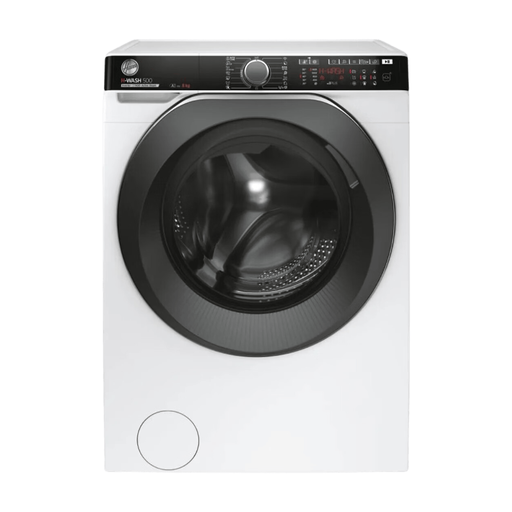 No image available
HWP 48AMBC7/1-S, 8 kg
The capacity is a useful comparison point for regular weekly loads; the description mentions Auto Care for different fabrics and load sizes.
8 kg; 1400 rpm; energy rating A.
Joybuy
 No image available
Midea MF110W80BA10/W-NL, 8 kg
The product description lists programmes for mixed loads and a quick wash; check that the load size and fabrics are suitable for the programme you choose.
8 kg; 1400 rpm; 16 wash programmes, including Mixed Load and a 15-minute Quick Wash, according to the product description.
Joybuy
 No image available
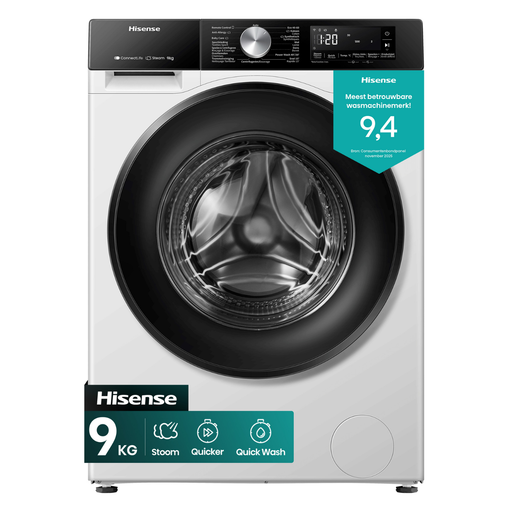
Hisense WF3S9043BW3, 9 kg
The product description lists a Quick 15 programme for anyone comparing quick wash options; check the load limit for this programme.
9 kg; 1400 rpm.
Joybuy
 No image available
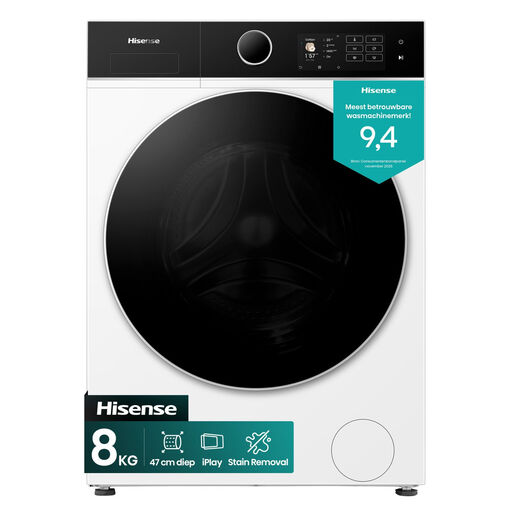
Hisense WF5I8043BWF, 8 kg
The capacity is a useful comparison point for changing weekly loads; also check the programme load limit for the washing you want to do between regular loads.
8 kg; 1400 rpm; inverter motor.
Joybuy
Frequently asked questions
Can all damp school clothes be washed together on eco 40-60?
Not without checking the care labels. The European Commission describes eco 40-60 as being for normally soiled cotton labelled as washable at 40 °C or 60 °C and suitable for washing together; this doesn’t automatically make the programme suitable for every fabric.
What should I do if damp clothes can’t be washed straight away?
Keep dampness to a minimum and make sure the clothes can dry; a washing machine function is no substitute. GGD Leefomgeving advises limiting damp in the home and ventilating. Follow the care label for the garment itself.
What should I check before installation and during maintenance?
Measure the space and follow the installation and maintenance instructions for your chosen model. Milieu Centraal advises running a wash at 60 degrees about once a month to prevent residue and unpleasant smells; always follow the model-specific instructions too.
Does a two-year manufacturer’s guarantee provide full statutory protection in the Netherlands?
No. According to ACM ConsuWijzer, statutory guarantees are separate from commercial guarantees. If a product used normally doesn’t meet the standard you could reasonably expect, the seller must put it right in accordance with the applicable terms. The Dutch government states that there is no fixed statutory guarantee period for all products in the Netherlands.


