What should you look for when buying?
Start with the care instructions and the maximum load for the programme you want to use. Then compare capacity, consumption and the space available with your usual laundry needs.
| What to consider |
What should you check? |
Who is this for? |
| Short programme |
Check the programme duration and maximum load, and see whether the programme suits the care label and level of soiling. |
After a wet journey, I want to be able to use one or a few aprons again quickly, without assuming that every short programme is suitable. Around 36% of consumers prioritise a separate, quick wash for aprons. |
| Fabric care |
Compare the available temperature and spin settings with the instructions on the apron’s care label. |
If my apron has a coating or special finish, I want to be able to match the programme and settings to its care label. Around 29% of consumers prioritise apron care. |
| Capacity and consumption |
Choose a drum capacity to suit your usual household laundry and compare the energy label and eco 40-60 consumption under the same conditions. |
I usually wash aprons with other clothes and want a drum that suits that load, with comparable consumption figures. Around 21% of consumers prioritise efficient household laundry combined with their aprons. |
| Positioning and installation |
Measure the available space and check the connections and installation instructions. |
If the space or connections are a deciding factor, I want to know in advance whether the machine can be installed there easily. Around 14% of consumers give the greatest weight to positioning, installation and aftercare. |
Brands as a point of reference
These models illustrate the specifications and settings you can compare across product ranges; they aren’t a general assessment of the brands.
Beko
The BM3WFU3741W is an example of a front-loading washing machine with a stated short-programme option and a shallow depth.
- Beko lists a rated capacity of 7 kg, a depth of 49,6 cm and a 14-minute Xpress/Super Short programme for this model.
- The programme name and drum capacity don’t mean that a 7 kg load can be washed in 14 minutes. Beko lists a spin noise level of 76 dBA.
AEG
The 6000 ProSense LR6KOLN is an example for anyone comparing load-adaptive settings and household laundry options.
- AEG lists an 8 kg capacity, TimeSave Plus and 47 kWh per 100 eco 40-60 cycles.
- AEG’s stated ProSense adjustment isn’t an independent measurement of a separate apron wash. Also check the maximum depth of 602 mm.
Bosch
The Serie 4 WAN2809XNL is an example of a standard front-loading washing machine with an 8 kg capacity.
- Bosch lists an 8 kg capacity and a maximum spin speed of 1400 rpm for this model.
- Check the specific model’s manual before deciding whether a short wash is suitable.
Miele
The W1 WSB363 WCS PWash&8kg is an example for anyone comparing a quick programme and extra control features.
- Miele lists an 8 kg capacity, a maximum spin speed of 1400 rpm, QuickPowerWash and app control.
- The 49 minutes stated by Miele applies to the specific QuickPowerWash programme; it isn’t a comparison of washing results for every apron.
Washing machines at Joybuy
The models below offer options for short programmes and for washing aprons with your usual household laundry. For each programme, check the maximum load and whether the wash is suitable for the care label.
 No image available
AEG LR73R862 7000 Series, 8 kg, 1600 rpm
An option for washing aprons with your usual household laundry; the product description mentions MixLoad 69 for mixed everyday laundry at 30 °C.
The description lists 42 kWh per 100 eco 40-60 cycles, a steam refresh programme and PreciseWash, which adjusts water use, energy consumption and programme duration to the weight of the laundry, according to the description.
Joybuy
 No image available
Midea MF110W80BA10/W-NL, 8 kg, 1400 rpm
The stated capacity may be useful if you want to wash aprons with other household laundry.
The product description lists 16 programmes and a 15-minute quick wash.
Joybuy
 No image available
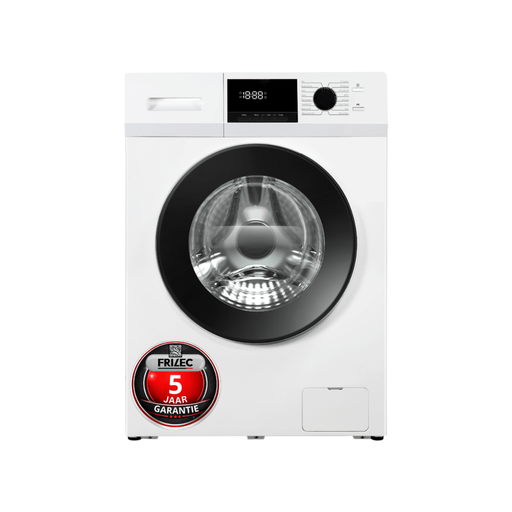
Frilec KOBLENZ8314WA-342, 8 kg
An option to compare if the apron’s care label calls for a specific fabric treatment.
The product description lists a Quick Wash, programmes for delicate fabrics and wool, and adjustable temperature and spin speed.
Joybuy
 No image available
Beko BM3WFU38412CW, 8 kg, 1400 rpm
The product description lists programmes for different fabric types, which may be useful if you also wash other laundry with the apron.
According to the description, Daily Xpress takes 14 minutes and is designed for lightly soiled laundry. Programmes for delicate fabrics, wool and hand washing are also mentioned.
Joybuy
 No image available
TCL FF1006WB0, 6 kg, 45 cm deep
The stated depth of 45 cm may be useful if space for installation is limited.
The title lists a 15-minute Quick Wash programme and energy class B. The product description mentions automatic adjustment to the weight of the laundry.
Joybuy
Frequently asked questions
Can I always wash a wet apron on an outdoor programme?
No, not just because the apron has got wet. Follow the care label and choose the programme, temperature and spin speed to suit the material and finish. The Consumers’ Association explains that wash programmes vary in temperature profile, spin speed and drum movements.
What should I check before using the washing machine for the first time?
Follow the installation instructions to ensure the machine is stable and connected correctly. Bosch recommends removing the transit bolts before use and checking the water supply for leaks.
How can I stop my washing machine from developing an unpleasant smell?
Clean the machine according to the care instructions. The Consumers’ Association recommends running a 60 °C wash regularly to limit bacterial growth in the machine; this doesn’t mean every apron can be washed at 60 °C.
What can I do if a new washing machine turns out to be faulty?
The Dutch government identifies the retailer as your point of contact for a faulty product; depending on the circumstances, you may be entitled to a free repair or replacement.
Does a new washing machine in the Netherlands have to be energy class A?
No. For household washing machines covered by EU energy labelling rules, the scale has run from A to G since 1 March 2021. The European Commission explains the scale; energy class A isn’t a general legal minimum requirement.


