
Renter with limited space for a washing machine
You want to wash ordinary, machine-washable workwear at home, but the width, depth or doorway limits which machines will fit.


Start by measuring the space where the machine will go, the route to get it there, and the room needed to open the door or lid. Then choose a load capacity and programmes suited to your usual sorted workwear wash and the care labels. A top-loader may be a good option if width is the main constraint, while a front-loader will only fit if there’s enough depth and clearance for the door. For protective clothing or items that may be contaminated, follow your employer’s and the clothing manufacturer’s cleaning instructions.
You want to wash ordinary, machine-washable workwear at home, but the width, depth or doorway limits which machines will fit.
You regularly wash separate loads and want to compare the care labels, suitable drum capacity and programmes for your fabrics.
As well as the space available, you’re considering the connections and the potential impact of a leak, for example on the home below yours.
A good fit if: the machine, hoses and open door fit in the available space, and the drum suits your usual load.
Consider: Consumentenbond describes standard front-loaders as about 60 cm wide. Check the depth and space needed to open the door too.
A good fit if: width is the main constraint and there’s enough space above the machine to open the lid.
Consider: According to Consumentenbond, top-loaders are about 40 cm wide, but need clearance above and typically have a maximum capacity of 6 or 7 kg.
A good fit if: you also want to dry clothes electrically and don’t have room for two appliances.
Consider: Consumentenbond reports that a standard washer-dryer takes longer to dry and uses more energy than a new, efficient heat-pump dryer. A washer-dryer won’t solve a lack of width on its own.
| What to consider | What to look for when buying | Which shoppers |
|---|---|---|
| Will the machine fit? | Measure the appliance, the route to its location, and the space needed for the hoses and an open door or lid. | If space is limited, the machine also needs to fit through the doorway and sit in position with the hoses connected. Around 36% of consumers put fitting the machine in their space first. |
| Washing workwear | Check the care labels, the load limits for each programme and which programmes are needed for your fabrics. | If I wash my workwear regularly, I want to know whether the load and wash treatment are suitable for the fabrics and care labels. Around 29% of consumers give suitable workwear washing top priority. |
| Energy and water use for frequent washing | Compare the electricity use per 100 cycles and water use per cycle on the same eco 40–60 basis on the EU label. | If I wash frequently, I want to compare the stated energy and water use for a programme that’s also suitable for my clothes. Around 21% of consumers put energy and water use first. |
| Connections and leaks | Check the water supply, drainage, stable footing and water protection features of the exact model. | If a leak could affect other homes too, I want to check in advance that the connections and installation are suitable. Around 14% of consumers start by considering the connections and how to limit potential water damage. |
Hoses, the door or lid, and the route to the machine’s location all need room too.
Measure the full route and the clearance around the exact model before you order.
The stated maximum capacity is for cotton; delicate or synthetic washes may have a lower load limit.
Weigh a typical workwear load and check the permitted load for the programme and in the instruction manual.
Protective clothing must be cared for according to the applicable cleaning instructions. An eco, steam or hygiene programme does not replace those instructions.
Check the care label and your employer’s and the clothing manufacturer’s instructions before washing protective clothing or items that may be contaminated at home.
Bosch’s freestanding front-loader range in the Netherlands includes the Serie 2 WGE02404NL.
Beko’s front-loader range in the Netherlands includes the BM3WFU3741S.
A top-loader may be worth considering if width is limited.
LG’s front-loader range in the Netherlands includes the F4X1008NWH.
This selection features freestanding front-loaders for a compact space and separate loads of machine-washable workwear. Check the dimensions of the exact model and follow the instructions on the care labels.
 Image unavailable
Could suit anyone looking for a shallow front-loader. Measure the route, connections and space needed to open the door too.
Capacity: 7 kg. Stated depth: 400 mm. The product description lists 16 programmes, including wool and duvet programmes, and a delay start of up to 24 hours. The title mentions a 15-minute quick wash programme.
 Image unavailable
Could suit anyone looking for a machine with limited depth and a drum for smaller loads. Check the clearance needed around the appliance.
Capacity: 6 kg. Stated depth: 45 cm. The title lists a B energy rating, a BLDC inverter motor, steam wash, automatic weighing and a 15-minute quick wash programme. The description mentions programmes for cotton, synthetics, delicates and wool.
 Image unavailable
Could suit anyone looking for a 7 kg front-loader with a range of programmes for separate washes. Compare the programmes with the care labels on your clothes.
Capacity: 7 kg. The title lists an A energy rating, 15 programmes and a 15-minute quick wash programme. The description mentions steam and baby care programmes, among others.
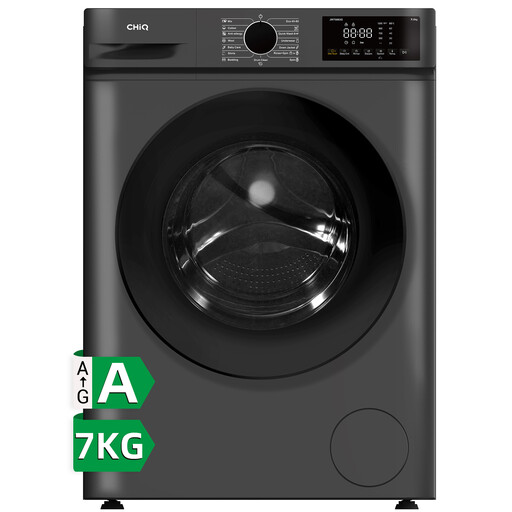 Image unavailable
Could suit anyone looking for a front-loader with a stated depth of 47 cm and a range of wash programmes. Check the full external dimensions.
Capacity: 7 kg. The product information lists a depth of 47 cm, 1200 rpm and 16 programmes, including steam and quick wash programmes.
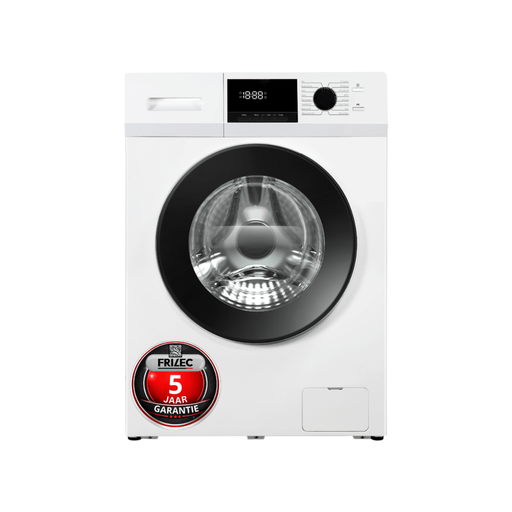 Image unavailable
Could suit anyone looking for an 8 kg capacity and stated water protection. Its 59.5 cm width won’t work in an especially narrow space.
Capacity: 8 kg. Stated width: 59.5 cm. The description lists 1400 rpm, a steam function and Aquastop, as well as several programmes including cotton and delicates. Check the full installation instructions.
No. The word ‘washable’ isn’t enough to answer that for all workwear. Protective clothing must be cared for according to its instructions. If there may have been exposure to hazardous substances or pathogens, ask your employer which cleaning method is required. For ordinary workwear without these risks, follow the care label, fabric type and programme load limits.
Compare the figures on the EU label on a like-for-like basis: electricity use per 100 cycles and water use per cycle are for the eco 40–60 programme. Don’t assume these figures will be the same for another programme needed for your clothes.
It depends on the work involved. According to the Dutch government (Rijksoverheid), you don’t need permission for a change that can be reversed without too much expense, while renovations do require permission. If it’s unclear which category a new connection falls into, discuss it with your landlord beforehand.
Check that the surface is stable and that the connections and water protection features are suitable for the exact model. Consumentenbond recommends cleaning the machine regularly to help prevent odours and blockages, among other things. Follow the instruction manual for maintenance.
No. There’s no fixed time limit for the legal guarantee in the Netherlands. According to the Dutch government (Rijksoverheid), what you can expect from a product depends on the product itself and how it’s used. If a product is faulty, contact the seller, even if any additional guarantee has expired.