
Someone who wears heavily soiled work trousers
You want to know whether a suitable programme can wash your trousers without going against the instructions on the care label.


Choose a washing machine with a programme, temperature and spin speed that suit the care label on your work trousers. Then compare cleaning performance, programme duration, your usual load and the space available. A short programme does not prove that heavily soiled trousers will come out clean. For protective clothing, you should also check first whether the specific instructions allow you to wash it at home.
You want to know whether a suitable programme can wash your trousers without going against the instructions on the care label.
You do your washing before the working week and compare programme duration and spin options, without assuming that a short programme can handle heavy soiling.
You want to preserve their protective properties and follow the care instructions. So first check whether, and how, you can wash the trousers at home.
First, check which type of washing is allowed for your trousers. Then compare programmes, time, capacity and consumption figures for the way you plan to use the machine.
| What to consider | What to look for | Who it’s for |
|---|---|---|
| Cleaning performance | Compare cleaning results for a programme suitable for the fabric, and check the permitted temperature. | If I want to tackle visible work-related dirt, I look for a suitable programme and look beyond its name. Around 29% of consumers make cleaning performance their top priority. |
| The weekend deadline | Check the programme duration for your chosen setting and permitted load, and make sure the care label allows the spin speed. | If my trousers need to be washed and dried before the working week, I allow time for both washing and drying. Around 23% of consumers make the deadline their top priority. |
| Fabric and protection | Follow the instructions for temperature and spinning. For protective clothing, also check the guidance from the manufacturer and your employer. | If my work trousers offer protection, I want to follow the specified care instructions rather than assume that a machine programme will preserve their protective properties. Around 18% of consumers put this first. |
| Suitable capacity | Compare the capacity in kg with your usual laundry load, and check the model’s dimensions against the space available. | Especially if I want to wash work trousers with other laundry, I look for a drum that suits my usual load and the space available. Around 18% of consumers prioritise capacity and space. |
| Energy and water consumption | Compare the figures on the EU energy label for a suitable load size. The label values apply to eco 40-60 and don’t tell you everything about other programmes. | If I want to take my energy and water use into account, I compare label figures on a like-for-like basis. Around 12% of consumers make consumption their top priority. |
The programme duration or a manufacturer’s claim doesn’t automatically tell you what results to expect for the fabric, load and level of soiling on your work trousers.
Compare cleaning results for a suitable programme, and check the conditions and permitted load for a short cycle.
Trousers that protect against a workplace hazard may be personal protective equipment. Unsuitable cleaning could conflict with the specified care instructions.
Check the instructions for those particular trousers and, if needed, agree how to clean them with your employer.
The EU label figures apply to eco 40-60 under the conditions shown. Consumption on another programme may be different.
For a suitable load size, compare the energy and water figures on the label, and check the installation requirements before you buy.
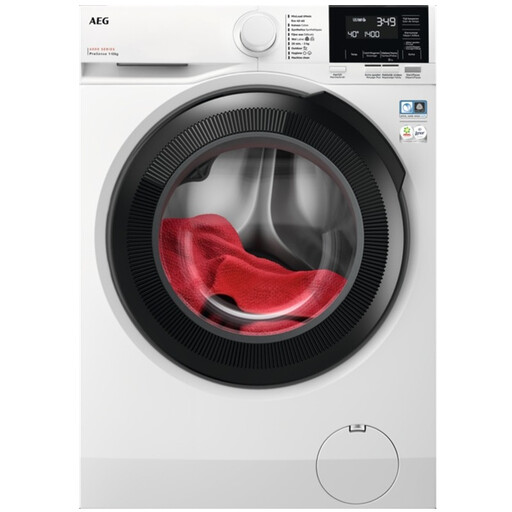
The 8000 PowerCare LR8686UC4 is an 8 kg model with a PowerClean 59 min programme, as described by AEG.
The Serie 6 WGG244ZONL has a capacity of 9 kg and a maximum spin speed of 1400 rpm.
Siemens describes the WM14N206NL as featuring varioSpeed, short programmes and an Outdoor programme.
The WW90CGC04AAEEN is a 9 kg model with an A energy rating and Ecobubble.
These models are intended as a starting point for ordinary work trousers that the care instructions allow you to wash at home. None of the listed programmes, on its own, proves that protective work trousers can be safely washed at home.
 No image available
An option to consider if you’re looking for a short programme for lightly soiled laundry.
The description lists Quick 15 and Super Speed for a 5 kg load. The programme duration doesn’t prove that heavily soiled work trousers will come out clean.
 No image available
An option to compare if you usually wash larger loads.
The product information lists a TimeSave Plus option for shortening the cycle.
 No image available
An option to compare if you also want to wash mixed everyday laundry.
The description lists a 69-minute MixLoad programme and PreciseWash, which adjusts the wash to the load weight. The stated duration doesn’t prove that heavily soiled work trousers will come out clean.
 No image available
An option to compare if you’re looking for a programme for everyday mixed laundry.
The description lists MixLoad: 69 minutes at 30 °C. According to the description, PreciseWash adjusts settings to the load weight. The stated cycle doesn’t guarantee results for heavily soiled work trousers.
 No image available
An option to compare if you want to look at programmes for different fabrics.
The product information lists ProSense load sensing, adjustable temperature and Quick 15/30. The short cycle alone doesn’t prove that heavily soiled trousers will come out clean.
No. ‘Washable’ doesn’t mean that every cleaning method is suitable for home use. Protective work trousers may be personal protective equipment, so follow the specific garment care instructions and, if needed, agree how to clean them with your employer.
No. According to the European Commission, EU label figures for eco 40-60 apply to normally soiled cotton that is stated as suitable for washing at 40 °C or 60 °C. For other fabrics or levels of soiling, check the care label and choose a suitable programme.
Follow the machine’s installation and operating instructions. Consumentenbond advises, among other things, removing the transit bolts and connecting the water supply and drain. Clean the filter, door seal and detergent drawer as described in the operating instructions.
According to ACM ConsuWijzer, the retailer is responsible for the statutory guarantee and must remedy a product that develops a fault too soon free of charge, in line with the legal requirements. The manufacturer’s warranty doesn’t necessarily mark the end of that right.