
For a small laundry area with limited width
If width is the main constraint, a top-loader may be an option. Check that the lid can open freely and that the connections will fit. AEG lists the LTR6162K as 397 mm wide.


Measure the space, including the hoses and the clearance needed to open a door or lid. A top-loading machine may fit if width is the main limitation and there’s enough room above it; a shallow front-loader is an option if depth is more restricted. Then choose based on your usual laundry load and the trousers’ care label, rather than simply opting for the largest drum capacity.
If width is the main constraint, a top-loader may be an option. Check that the lid can open freely and that the connections will fit. AEG lists the LTR6162K as 397 mm wide.
If there’s enough width for a front-loader but little depth, remember to measure the space needed for the hoses and the open door too. Beko lists the B1W764BB BE at 52 cm deep and the BM3WFU3741S at 49,6 cm.
Match the capacity and programme to your usual laundry load and the care instructions on the garment label. If the trousers are protective workwear, also check your employer’s care and work instructions. Arboportaal describes such clothing as personal protective equipment when it is intended to reduce an occupational risk.
Choose this when: width is the limiting factor and there’s enough room above the machine to open the lid.
The trade-off: the lid needs clearance to open, and you should also compare the drum capacity with your usual laundry load.
Choose this when: there’s enough width, but the available depth is limited.
The trade-off: the stated depth doesn’t include all the space you’ll need; allow room for the hoses and the door to open.
Choose this when: your measurements show that the space can accommodate a deeper model, and your usual laundry load justifies the capacity.
The trade-off: a larger drum isn’t automatically the right choice if you usually wash small loads of work trousers.
| What to consider | What to look for | Who this matters to |
|---|---|---|
| Space and installation | Measure the height, width and depth of the exact model. Allow for hoses, connections and the full clearance needed to open the door or lid. | If I have limited width, I want to know in advance whether the machine will fit and whether the lid or door can open freely. Around 36% of consumers prioritise installation space. |
| Load and programme | Compare the capacity with a typical laundry load and check that a suitable programme is available for the fabric and care label. | I want to wash my usual load of work trousers using a programme that suits the care label. Around 29% of consumers base their choice mainly on load capacity and programmes. |
| Fabric and protection | Read the care label, including instructions for features such as knee pads. For protective clothing or garments that may be contaminated with hazardous substances, ask your employer for the relevant care instructions. | If my work trousers have specific fabric or protection requirements, I want to know which wash is permitted. Around 21% of consumers prioritise keeping their work trousers in good condition. |
| Noise and energy use | Compare the spin noise level and energy label figures for the exact model. The energy consumption figures on the label apply to Eco 40-60 and don’t automatically apply to other programmes. | If the machine is close to my living space, noise and the energy use of the programme I run both matter. Around 14% of consumers prioritise running costs and keeping things quiet. |
Hoses and protruding parts need extra depth. You’ll also need enough clearance to open the door or lid.
Measure the full space needed to use the machine, then compare it with the dimensions and installation instructions for the exact model.
Standardised energy label figures apply to Eco 40-60. That isn’t automatically the right programme for every fabric or level of soiling.
First check which programmes are permitted according to the care label, and use the label figures only for the comparison they’re intended for.
For the Beko BM3WFU3741S, the manufacturer’s information and Joybuy’s listing differ on colour and energy class. The Joybuy description is also unclear on these points.
Confirm the colour, energy information and exact specification before comparing the product details.
Trousers may be designed to protect against an occupational risk or may come into contact with hazardous substances at work. A household wash programme doesn’t prove that such risks have been managed.
For protective clothing or garments that may be contaminated with hazardous substances, check your employer’s care and work instructions.
The LTR6162K is an example of a narrow top-loader for a laundry area where width is the main constraint.
The B1W764BB BE and BM3WFU3741S are 7kg front-loaders with stated cabinet depths of 52 and 49,6 cm respectively.
The WAN2827DNL is a standard front-loader to consider if your measurements show that the space can accommodate a deeper model.
A top-loader is an option to explore when width is the limiting factor.
This selection features AEG front-loaders with a stated capacity of 8 or 10 kg. Choose a model only if it suits your measured space and usual laundry load.
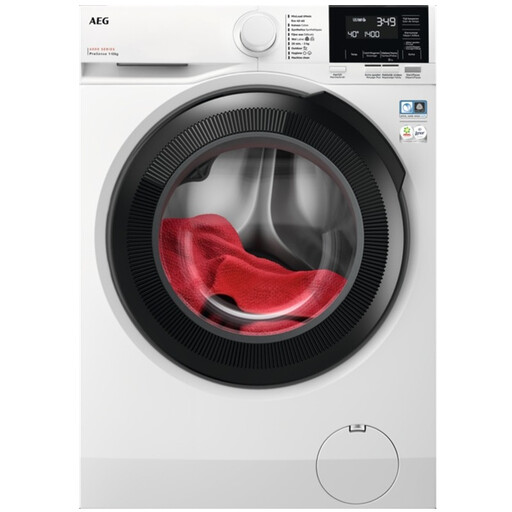 No image available
The stated capacity may be useful if you also wash larger loads alongside your work trousers.
Capacity: 10 kg; spin speed: 1400 rpm; energy class: A; colour: white.
 No image available
The stated capacity may be useful if you also wash larger loads alongside your work trousers.
Capacity: 8 kg; spin speed: 1600 rpm; energy class: A; colour: white.
 No image available
The stated capacity may be useful if you also wash larger loads alongside your work trousers.
Capacity: 8 kg; spin speed: 1400 rpm; energy class: A-40%; colour: white.
 No image available
The stated capacity may be useful if you also wash larger loads alongside your work trousers.
Capacity: 8 kg; spin speed: 1400 rpm; energy class: A; colour: white.
No image available
The stated capacity may be useful if you also wash larger loads alongside your work trousers.
Capacity: 8 kg; spin speed: 1600 rpm; energy class: A-30%; colour: white.
No. The label figures for this programme apply to normally soiled cotton that can be washed at 40 or 60 °C according to the garment label. For other materials, types of soiling or care requirements, check the label and choose a suitable programme.
Follow the instructions for installation and connections, and remove the transit bolts before use. Also check that the hoses and the open door or lid will fit in your laundry area.
There isn’t a single yes-or-no answer for every pair of work trousers. Arboportaal describes protective workwear as personal protective equipment when it is intended to reduce an occupational risk. If there’s a risk of exposure to hazardous substances or specific protection is required, ask your employer or occupational health service for instructions before washing the clothes at home.
Possibly. According to the Dutch government, statutory consumer rights in the Netherlands don’t have a fixed time limit; what you could reasonably expect from the washing machine and the cause of the fault are important. An extended warranty doesn’t replace your statutory rights.