
For people with a narrow alcove
If width is the main constraint, compare the external dimensions of top-loaders and check that there’s enough space above the machine to open the lid.


First, measure whether width, depth or height is the limiting factor in your laundry area. A top-loading machine may be a good option if width is limited, while a shallow front-loader takes up less depth. Then choose a capacity that suits your usual laundry load and compare programmes, energy consumption and spin noise. Check that the lid or door can open and that the connections are accessible. Without measurements of your space, it’s not possible to confirm that any particular model will fit.
If width is the main constraint, compare the external dimensions of top-loaders and check that there’s enough space above the machine to open the lid.
If there’s enough width but little depth, a shallow front-loader may be worth considering. Remember to allow space in front of the machine and for the hose connections too.
If you usually wash only a few towels, you can choose a drum capacity to suit your typical total laundry load and check which programmes are suitable.
Choose this option if: width is especially limited and you can open the lid freely above the machine. AEG Netherlands lists the LTR6162K as 397 mm wide, while Whirlpool Netherlands gives the TW 6521S SENSE WASH BE a width of 40,0 cm.
Bear in mind: these models are around 90 cm high and approximately 60 cm deep, so a narrow width won’t necessarily solve a height or depth problem.
Choose this option if: you have around 60 cm of width available but limited depth, with enough space in front of the machine for the door. Haier lists the HW70-BP14357TU1 as 595 mm wide and 468 mm deep.
Bear in mind: the cabinet depth doesn’t tell you how much room you’ll need for the hoses, connections and open door together. The stated capacity is 7 kg.
Choose this option if: your space can accommodate a standard machine and you can wash towels with other laundry that’s suitable for washing together according to the care labels.
Bear in mind: the Dutch Consumers’ Association (Consumentenbond) gives typical dimensions of around 85 cm high and 60 cm wide for a standard front-loader. These guide dimensions don’t confirm that a specific model will fit your alcove.
| Consideration | What to look for | Who is this important to? |
|---|---|---|
| Fit and opening | Measure the width, depth and height. Also check the space needed for the door or lid to open and the installation instructions for the exact model. | If my alcove is tight, I want to know that the machine will not only fit but can also be opened. Around 31% of consumers put fit first. |
| Capacity | Compare the load capacity with your usual total laundry load and check which programmes are available for it. | If you usually wash only a few towels, you’ll want to avoid choosing a much larger drum than you regularly need. Around 25% of consumers prioritise small loads. |
| Consumption | Compare energy and water figures on the same labelling basis, and consider the programmes you actually use. | When doing laundry regularly, I want to be able to take electricity and water consumption into account. Consumption is the top priority for around 19% of consumers. |
| Spin noise | Compare the stated noise emissions of the exact models. Spin speed alone isn’t a measure of noise. | If the laundry area is close to a living space, noise during the spin cycle may be an important factor. Around 13% of consumers prioritise spin noise. |
| Installation and service | Check the available connections, installation requirements and who to contact if something goes wrong. | If I want to know in advance what’s involved in connecting the machine and getting help after purchase, I also check the retailer and the instructions. Installation and service are the main concern for around 12% of consumers. |
A machine may be slim but still too tall or deep for the space available. The lid or door could also hit a shelf, wall or other object.
Measure the available width, depth and height separately. Also check the clearance needed to open the machine and follow the installation instructions for the exact model.
A large load capacity isn’t automatically an advantage if you usually only partly fill the drum. The capacity should suit the total amount of laundry you typically wash.
Choose a capacity to suit your usual laundry load, and only combine textiles that can be washed together according to their care labels.
Milieu Centraal says that towels usually don’t need to be washed at 60 °C. A higher temperature may use more energy, although specific hygiene needs may call for a different approach.
Choose the temperature according to how soiled the towels are, the circumstances and the care label, rather than simply because they’re towels.
Installation arrangements and commercial extended warranties are not the same as your statutory rights if a product is faulty. The Dutch government (Rijksoverheid) lists free repair or replacement as possible rights when a product has a defect.
Before ordering, check the terms for delivery, installation, removal of your old machine and service. Keep the installation instructions for your specific model too.
With the LTR6162K, AEG offers a 6 kg top-loader for spaces where width is the main constraint.
With the TW 6521S SENSE WASH BE, Whirlpool offers a 6,5 kg top-loader for a narrow space.
With the HW70-BP14357TU1, Haier offers a 7 kg front-loader for spaces where depth is the main constraint.
This selection features AEG front-loaders for anyone who can fit a standard washing machine in their laundry area. Check the external dimensions and the clearance needed for the door to open on the exact model.
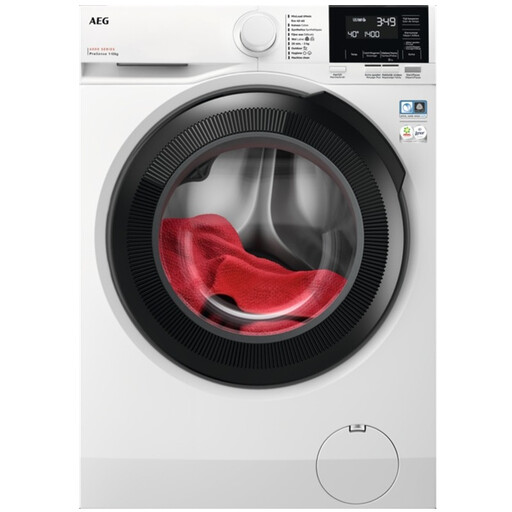 No image available
A front-loader for anyone looking for a model with a 10 kg capacity and enough room for both the machine and the door to open.
Capacity: 10 kg. Spin speed: 1400 rpm. Energy class A. ProSense Load Sensing. Energy consumption: 51 kWh per 100 Eco 40-60 cycles.
 No image available
A front-loader for anyone looking for an 8 kg capacity and able to check that there’s enough room for the machine and the door.
Capacity: 8 kg. Spin speed: 1600 rpm. PreciseWash with Load Sensing and a MixLoad programme. Energy consumption: 42 kWh per 100 Eco 40-60 cycles.
 No image available
A front-loader for anyone considering an 8 kg capacity and able to leave enough room for the door to open.
Capacity: 8 kg. Spin speed: 1400 rpm. Energy consumption: 47 kWh per 100 Eco 40-60 cycles. PreciseWash with load sensing.
 No image available
A front-loader for anyone looking for an 8 kg capacity. Before choosing, check that both the machine and the open door will fit in your laundry area.
Capacity: 8 kg. Spin speed: 1400 rpm. Energy class A. ProSense Load Sensing. Energy consumption: 47 kWh per 100 Eco 40-60 cycles.
No image available
A front-loader for anyone looking for an 8 kg capacity and able to measure the space needed for both the machine and the door in advance.
Capacity: 8 kg. Spin speed: 1600 rpm. PreciseWash with load sensing and a MixLoad programme. Energy consumption: 42 kWh per 100 Eco 40-60 cycles.
No, 60 °C is usually unnecessary for normally soiled towels. Milieu Centraal says that towels can usually be washed at a lower temperature. Follow the care label and take any specific hygiene needs into account.
Measure the available width, depth and height, and check that there’s enough room to open the door or lid. Allow for connections and hoses, and compare the measurements with the installation instructions for the exact model.
Choose a capacity to suit your usual total laundry load, rather than just one small load of towels. The Dutch Consumers’ Association (Consumentenbond) recommends taking the capacity you need into account when choosing. Only combine laundry if the care labels allow it.
No, the programme name doesn’t confirm that every load is washed at 60 °C. The Dutch Consumers’ Association (Consumentenbond) describes Eco 40-60 as a programme for normally soiled laundry. Check the care label and your model’s manual.
Check the connections and follow the installation instructions for the model you’ve bought, including removing the transit bolts before first use. Also make sure the door or lid can open freely.