
Renters with a shallow laundry space
Measure the full space, including room for the door to open and existing connections. The Consumentenbond points out that you also need to allow for hoses and the door.


First, measure the entire space, including room for hoses and the door to open. Then choose a drum size that suits your usual cotton wash. Milieu Centraal stresses that drum capacity should suit your household, while the Consumentenbond also recommends allowing space for hoses and the door. If depth is limited, a slimline front-loader may fit. A top-loader can be a better choice if width or door clearance is an issue. Choose a standard front-loader only if it fits completely, including its connections and door movement.
Measure the full space, including room for the door to open and existing connections. The Consumentenbond points out that you also need to allow for hoses and the door.
Choose a drum size that suits your usual cotton wash, rather than automatically opting for a larger capacity than your load requires. Milieu Centraal recommends choosing a drum capacity that suits your household.
If you live close to the machine or have neighbours nearby, compare the stated spin noise level and make sure the machine is installed securely. Bosch Nederland recommends installing the machine according to the instructions.
Best if: depth is limited and there is room to open the door at the front.
Consider: the stated machine depth is not necessarily the full installation depth you need. Allow for hoses and clearance, as the Consumentenbond recommends.
Best if: width or space for a forward-opening door is the main issue.
Consider: the top needs to be clear so you can open the machine. Also check the capacity of the model you choose.
Best if: the machine, door movement and connections all fit within the available space.
Consider: a front-loader may be too deep for a tight space; Bosch Nederland lists the WGE02404NL as 588 mm deep.
| What to consider | What should you check? | Who is this important for? |
|---|---|---|
| Fitting and connecting | Measure the width, height and depth. Allow for the door swing, hoses and existing connections. | If I need to install the machine in a shallow space in a rented home, I want to be sure the door, hoses and connections will fit. Around 33% of consumers put installation first. |
| Towel load | Weigh a typical sorted load and compare it with the cotton capacity; follow the care labels. | I want to wash my usual cotton towels in a suitable load without choosing a drum larger than I need. Around 27% of consumers prioritise their towel load. |
| Noise and stability | Compare the stated spin noise level and check whether you can level the machine. | If the machine is close to my living space, I want to know how much noise it makes during the spin cycle and whether I can install it securely. Around 20% of consumers put noise at the top of their list. |
| Energy and water consumption | Compare the label information for the eco 40-60 programme, bearing in mind that other programmes may differ. | I want to compare consumption, but also understand what the label information is based on. Around 20% of consumers focus most on energy and water consumption. |
A machine may fit within the cabinet measurements but still leave too little room for hoses or an open door. In a rented home, any alterations to the property are a separate matter, too.
Measure the entire space and check the connections. According to the Rijksoverheid, whether you need permission depends on the nature of the alteration. Assess the specific work before carrying it out.
The energy label describes the eco 40-60 programme; it does not automatically tell you what another towel programme uses or does. Energielabel.nl explains that the label information does not apply to other programmes.
Choose the temperature and programme based on the fabric care label and your laundry needs. Don’t use the label figures as a guide to other programmes.
The stated capacity applies to a cotton wash. The right capacity depends on the load you usually wash.
Weigh a typical sorted load and compare it with the cotton capacity, as the Consumentenbond recommends.
The Haier X5 HW70-BP14357TU1 is an example of a freestanding 7kg front-loader for a space where depth is limited.
The BM3WFU3741W is a freestanding 7kg front-loader to compare if the depth of your laundry space is a key constraint.
The Serie 2 WGE02404NL is a 7kg front-loader to consider if you have room for a less shallow machine.
These Joybuy products are for anyone looking for a freestanding front-loader. Compare the stated capacity and dimensions with your usual towel load and the space available.
 No image available
A standard front-loader to compare if 8 kg suits your usual cotton load.
The product information lists a cotton programme, 1400 rpm, a spin noise level of 74 dB and dimensions of 84,7 × 59,6 × 57,2 cm.
 No image available
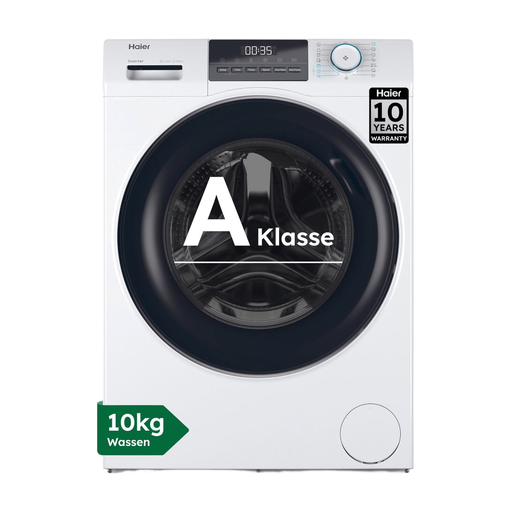
Compare this model if a 10 kg capacity suits your usual cotton load and the machine fits in the available space.
The product information lists 1400 rpm and a spin noise level of 70 dB.
 No image available
A freestanding front-loader with a cotton programme to compare with your towel load.
The product information lists 1400 rpm, a spin noise level of 76 dB and 15 programmes; the energy label rating is C.
 No image available
A slimline front-loader to compare if depth is limited and 7 kg suits your laundry load.
The product information lists a design depth of 400 mm, a cotton programme, 16 programmes and an adjustable spin speed of 800 to 1400 rpm. Remember to allow room for hoses and door movement when planning the installation.
 No image available
A compact model to compare if a 6 kg capacity suits your usual towel load.
The product title lists a depth of 45 cm. Remember to allow for the space needed for hoses and door movement when checking the fit.
Measure the space at several points and allow room for hoses, ventilation and the door when open. Then check the water outlet, tap and suitable power connection against the installation manual for your chosen model.
No. First follow the care label and choose a suitable programme. Milieu Centraal recommends 60 °C in certain situations, not as a general rule for every towel wash. Eco 40-60 also doesn’t mean the water actually reaches 60 °C.
Follow the manual for your chosen model, remove the transit bolts before use and make sure the machine is level. Check for leaks after connecting it. The Consumentenbond also recommends running a programme at 60 °C or higher at least once a month.
According to the Rijksoverheid, you don’t need permission for a minor alteration that can be undone without much expense; you do need permission for a renovation or major change. Before starting work, check whether your specific alteration to the pipework, drainage or electrics falls into either category. Installing a machine using existing connections is a different situation.
In the Netherlands, the seller is your point of contact for your statutory guarantee. According to the Rijksoverheid, there is no fixed statutory period. Consider what paid-for extra cover offers beyond your existing rights.