
Small everyday laundry loads
As the seasons change, you have extra towels to wash, but your everyday loads are still small. Milieu Centraal recommends choosing a drum capacity that suits your household.


Don’t buy a larger washing machine just for one extra load of towels. First, weigh a typical sorted cotton load and see whether your current machine can handle it. The Consumers’ Association of the Netherlands points out that the stated load capacity applies to cotton, so choose a capacity that suits the laundry you wash regularly. Check the care labels and compare consumption figures on the same EU energy label; Eco 40-60 is not automatically the same as a cotton programme at 60 °C.
As the seasons change, you have extra towels to wash, but your everyday loads are still small. Milieu Centraal recommends choosing a drum capacity that suits your household.
You often wash larger, sorted loads and want the drum capacity to match what you actually wash. The Consumers’ Association of the Netherlands points out that the stated maximum load capacity applies to cotton.
For your laundry, choosing the right programme may matter more than finding the one with the lowest consumption. The Consumers’ Association of the Netherlands and Milieu Centraal emphasise that the care label and your circumstances determine which programme is suitable.
When to choose it: Choose this if you have the space and its load capacity suits your usual sorted cotton wash.
Trade-off: A larger drum makes sense only if you use that capacity regularly.
When to choose it: Consider a top-loader if a standard front-loader won’t fit; remember to measure the space needed to open the lid, too.
Trade-off: The space available is more important here than one extra load of towels.
When to choose it: Consider one if you want to wash and tumble-dry your laundry and don’t have room for two appliances.
Trade-off: LG lists an 8 kg wash capacity and a 5 kg drying capacity for the W4X1085NWB; check each capacity separately.
When to choose it: If your current machine can handle your everyday laundry and the towels can be washed according to their care labels, there’s no need to replace it just for a seasonal peak.
Trade-off: Match the load and programme to what you actually wash.
| What to consider | What should you check? | Who is this important to? |
|---|---|---|
| Avoid buying a machine that’s too large for small loads | Weigh a typical load and compare it with the cotton load capacity; measure the available space, too. The Consumers’ Association of the Netherlands explains that the maximum load capacity applies to cotton. | I usually wash small loads and don’t want to buy a larger drum for a one-off seasonal peak. Around 24% of consumers share this priority. |
| Room for larger cotton loads | Weigh a typical large load and check the maximum load capacity, the drum opening and the appliance’s external dimensions. | If I regularly wash larger, well-sorted cotton loads, I want enough room without basing my choice solely on a seasonal peak. Around 18% of consumers need this capacity for their regular laundry. |
| A suitable programme for specific hygiene needs | Check the care label and whether there’s a suitable cotton programme at the required temperature, or an appropriate hygiene programme. The Consumers’ Association of the Netherlands distinguishes between Eco 40-60 and a standard cotton programme at 60 °C. | If I have specific hygiene needs, I want to be able to match the programme to my laundry and its care label. Around 23% of consumers make this a priority. |
| Purchase price and running costs | Compare the figures on the same type of EU energy label. The European Commission explains that the label shows consumption based on Eco 40-60; this is not a measurement for every programme. | I want to consider both the purchase price and the cost of running the machine. Around 23% of consumers focus on comparing costs over the appliance’s lifetime. |
| A machine that fits your space | Measure the height, width, depth and clearance needed to open it, and check the installation instructions for the exact model. | I can only choose a model once I know it will fit the space available and that the door or lid can open properly. Around 12% of consumers have this space requirement. |
One occasional pile of towels says little about the loads you wash for the rest of the year. The Consumers’ Association of the Netherlands recommends matching the load capacity to your usual sorted cotton laundry.
Weigh a typical load before choosing a capacity; don’t base your decision solely on the biggest peak.
The programme name doesn’t mean the water actually reaches 60 °C. The Consumers’ Association of the Netherlands points out that the measured temperature may be lower than 60 °C.
Follow the care label. If you have specific hygiene needs, choose another suitable programme, provided the label allows it.
LG lists an 8 kg wash capacity and a 5 kg drying capacity for the W4X1085NWB. This means a full wash load may not fit into a single drying cycle.
Check the two capacities separately and allow for the smaller drying load.
According to the Dutch government, the Netherlands has no fixed statutory two-year guarantee period; your statutory rights depend, among other things, on what you can reasonably expect from the product.
If there’s a fault, ask the retailer how it will be dealt with and keep your proof of purchase. Any additional guarantee is separate from your statutory rights.
LG’s Dutch product information lists both the F4X1008NWH, an 8 kg front-loader, and the W4X1085NWB, a washer-dryer.
The Bosch Serie 6 WGG244FONL is a freestanding front-loader with a stated load capacity of 9 kg.
The Siemens iQ500 WU14UT20NL is another front-loader to compare, with a stated load capacity of 8 kg.
Miele lists a load capacity of 9 kg and a spin speed of 1400 rpm for the W1 WWD380 WCS PWash&Steam&9kg.
This selection includes washing machines with a stated load capacity of 8 or 9 kg, as well as washer-dryers. Compare the wash capacity with your usual sorted cotton load; for a washer-dryer, check the separate drying capacity too.
 No image available
A useful point of comparison for regularly washing larger cotton loads; compare its stated capacity with the weight of your usual laundry.
 No image available
Its stated capacity gives you a useful point of comparison for your usual sorted cotton laundry.
If you use a steam programme, follow the warning in the product description and don’t open the door while it’s running, as hot steam may escape.
 No image available
A washer-dryer to compare if you also want to tumble-dry your laundry and need a single appliance.
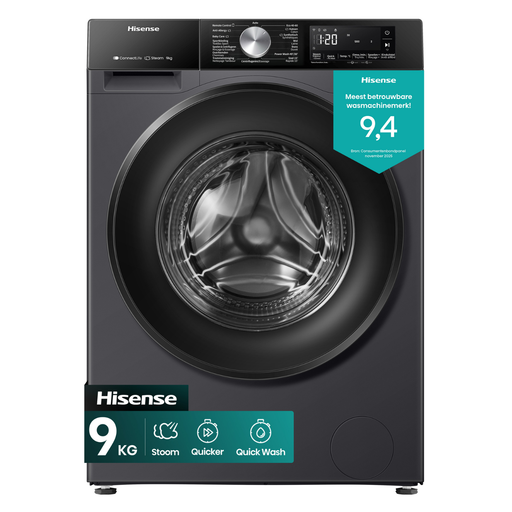 No image available
Compare its load capacity with the larger cotton loads you wash regularly; the stated capacity isn’t a reason to overfill your usual loads.
 No image available
A washer-dryer to compare if you also want to tumble-dry your laundry; make sure each drying load stays within the lower drying capacity.
Sort and weigh what you usually wash in one load. The Consumers’ Association of the Netherlands says the stated maximum load capacity applies to cotton; remember to consider the space available for the machine too.
No, not just because the seasons are changing. Check the care label first, then consider how soiled the towels are and whether you have specific hygiene needs. The Consumers’ Association of the Netherlands makes clear that Eco 40-60 is not the same as a standard cotton programme at 60 °C.
Check the wash and drying capacities separately, as the drying capacity may be lower. For example, LG lists an 8 kg wash capacity and a 5 kg drying capacity for the W4X1085NWB.
The label shows, among other things, the energy rating and consumption figures based on Eco 40-60. According to the European Commission, EU energy labels for household washing machines and washer-dryers have used the A to G scale since 1 March 2021; the label values aren’t measurements for every programme.
Yes. In the Netherlands, the old-for-new scheme applies to household appliances when you buy a new appliance of a similar type. According to the Dutch government, the retailer must take the old appliance free of charge; for online purchases, the stated drop-off or collection procedure applies.