What should you look for when choosing?
First check the programme for used tea towels, then choose a drum capacity based on your shared laundry, and finally compare energy use and noise levels.
| What to consider |
What to look for |
Who is this important for? |
| Washing tea towels |
Check the manual to see whether the standard programme can be set to 60 °C. Don’t rely on Eco 40-60 alone. |
If I want to wash used tea towels at the recommended temperature, I check the standard programme on the exact model. Around 36% of consumers put hygienic washing first. |
| Suitable drum capacity |
Compare the stated capacity with your usual shared loads, and measure the space where the machine will go. |
If I want to avoid a drum that’s usually too large for our laundry, I consider what my housemates typically collect together. Around 29% of consumers prioritise a suitable capacity. |
| Energy and water use |
Compare kWh per 100 cycles and water per cycle using the same Eco 40-60 label basis. These figures don’t show the consumption of a standard 60 °C wash. |
If I want to compare energy and water use between machines, I look at figures based on the same label standard. Around 21% of consumers put energy and water use first. |
| Noise in the laundry area |
Compare the stated dB level during spinning and consider how close the machine is to living and sleeping areas. |
If my housemates live close to the machine, I want to know how much noise it’s rated to make during the spin cycle. Around 14% of consumers put noise first. |
Washing machines at Joybuy
These models have a stated capacity of 8 or 9 kg. Compare this with your usual shared loads, and check the manual for the exact model to see whether a standard programme can be set to 60 °C.
 No image available
Samsung WW90DG6U25LE, 9 kg
An option to compare if you regularly wash larger loads together.
Stated capacity: 9 kg; spin: 1400 rpm and 72 dB; cotton programme and delay-start function listed.
Joybuy
 No image available
Midea MF110W80BA10/W-NL, 8 kg
An option to compare if your shared loads are usually suited to a stated capacity of 8 kg.
Stated capacity: 8 kg; spin: 1400 rpm and 72 dB; the description lists 16 programmes, steam, a delay-end function and the option to add laundry.
Joybuy
 No image available
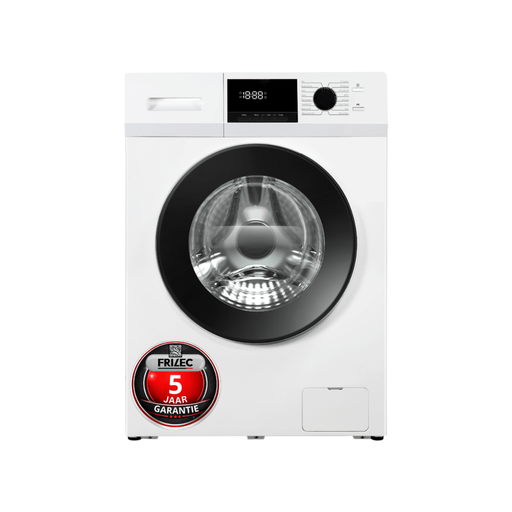
Frilec KOBLENZ8314WA-342, 8 kg
An option to compare if you usually wash smaller loads together.
Stated capacity: 8 kg; A energy rating; spin: 1400 rpm and 76 dB; a cotton programme with adjustable temperature for each programme is listed.
Joybuy
 No image available
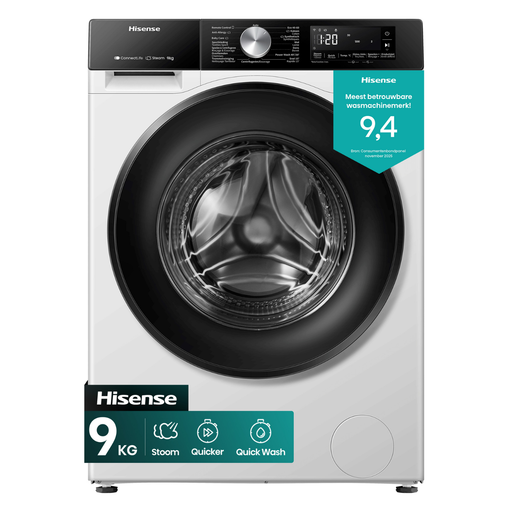
Hisense WF3S9043BW3, 9 kg
An option to compare if you regularly wash larger loads together.
Stated capacity: 9 kg; spin: 1400 rpm; the description lists 15 programmes, a steam function, delay start and the option to add laundry.
Joybuy
 No image available
Beko BM3WFU38412CW, 8 kg
An option to compare if your usual shared loads suit a stated capacity of 8 kg.
Stated capacity: 8 kg; A energy rating; spin: 1400 rpm and 76 dB; cotton programme listed.
Joybuy
Frequently asked questions
Is Eco 40-60 the same as washing at 60 °C?
No. The programme name doesn’t guarantee that the machine reaches 60 °C during the cycle. The Consumers’ Association of the Netherlands explains that Eco 40-60 does not necessarily reach 60 °C; the Netherlands Nutrition Centre recommends washing used tea towels at 60 °C. Check the standard programme on the exact machine.
What does the energy label tell me about washing tea towels?
The label shows, among other things, energy use per 100 cycles and water use per cycle, based on Eco 40-60. These figures don’t directly show the consumption of your standard 60 °C wash.
What should I check before the washing machine is installed?
Compare the external dimensions of the exact model with the space available, and check what delivery and installation services are offered before ordering. Also consider the stated spin noise level if others live close to the machine.
What warranty applies to a washing machine in the Netherlands?
Alongside any commercial warranty, you have statutory rights if a product doesn’t perform as you could reasonably expect under normal use. ACM ConsuWijzer explains that there isn’t simply one fixed two-year period that applies to every washing machine; contact the seller if a product is faulty.
Is an energy label required for a new washing machine?
An energy label is required for household washing machines covered by Dutch and European labelling rules. The European Commission describes the scale from A to G; the labelling requirement doesn’t mean you’re legally required to buy an A-rated machine.


