Who should consider this choice?

Housemates sharing laundry

You want a drum that suits your usual shared load. Wash fabric napkins according to their own care labels. Milieu Centraal and the Consumentenbond advise against choosing a washing machine that’s too large if you can’t fill it sufficiently.

Residents with limited laundry space

You need to be able to position the machine safely, and consider the spin noise if it will be close to your living or study area. Measure the route to the installation space too, and check the connections you’ll need.

Housemates making a joint decision

You’ll want to agree in advance who will arrange the purchase and who will be the point of contact if anything goes wrong. Also check the seller’s delivery and installation terms.

What should you look for?

What to consider What should you check? Who is this important for?
Washing napkins Check the fabric and care label, and make sure the programme and temperature are suitable. If I want to wash reusable napkins with other items, I want to follow the care label. Around 29% of consumers put suitable washing for napkins and kitchen linen first.
Drum capacity Weigh a typical load and compare it with the stated capacity. Consider whether housemates usually wash together. We often do our laundry together as housemates, so the drum needs to suit our usual shared load. Around 23% of consumers value capacity for that load above all else.
Energy and water use Compare kWh per 100 cycles and water per cycle on the EU energy label. Also consider the programme and how often you wash. When I do laundry regularly, I want to be able to compare the stated energy and water use. Around 18% of consumers make this their top priority.
Positioning and noise Measure the available space and access route. Check the connections, spin noise and type of water protection. If the machine is close to where I live or study, its dimensions and spin noise matter. Around 18% of consumers start by considering where the machine will go and how quiet it is.
Purchase and service Check who will place the order, what’s included with delivery and installation, and who to contact if anything goes wrong. If we’re choosing a machine together, I want to be clear on the arrangements and where to get help if something goes wrong. Around 12% of consumers make this their first consideration.

Common buying mistakes

  • Choosing a drum based on the number of napkins

    A larger machine won’t make better use of its capacity if your usual laundry load is small.

    Weigh a typical student-house load before comparing models with different capacities.

  • Applying advice for dishcloths to every table napkin

    Fabrics and care labels can vary. The Voedingscentrum recommends washing used dishcloths, kitchen towels and tea towels at 60 °C. This isn’t a general washing instruction for all fabric napkins.

    Check the napkins’ care labels, then choose a suitable programme and a permitted temperature.

  • Looking only at the energy label rating

    The rating alone doesn’t tell you how much a particular programme uses or how long it takes.

    Compare consumption per 100 cycles, water use per cycle and programme duration on the same label basis.

  • Assuming delivery includes installation and full water protection

    Delivery and installation arrangements, and the water protection provided, can vary by order and model.

    Before you buy, check the connections, installation terms and type of water protection included with your chosen model.

Brands to consider

Beko

The Dutch models BM3WFU3741W and BM3WFU38412CW are examples of 7kg and 8kg front-loading washing machines.

  • Beko Netherlands lists a depth of 49,6 cm for the 7kg BM3WFU3741W and 54,6 cm for the 8kg BM3WFU38412CW. Compare these measurements with your available space and room for hoses.
  • These are model specifications, not an independent assessment of washing performance or reliability.

AEG

The AEG 6000 ProSense LF628600 is an 8kg front-loader worth comparing if you’re looking for a feature that adjusts the wash to the load.

  • According to AEG, ProSense measures the load on this model and adjusts the wash time, energy use and water consumption.
  • This is the manufacturer’s description, not an independent comparison or proof that small loads are as efficient as full loads.

Bosch

The Bosch WAN2809XNL from Series 4 is an 8kg front-loader that you can use as a comparison point for a shared load.

  • Bosch Netherlands lists a capacity of 8 kg and a maximum spin speed of 1400 rpm.
  • Compare the product details with the programmes you need and the way you’ll use the machine. The model specifications alone aren’t an independent assessment of performance.

Washing machines at Joybuy

These models include 7kg and 8kg washing machines for smaller loads or laundry that housemates genuinely wash together.
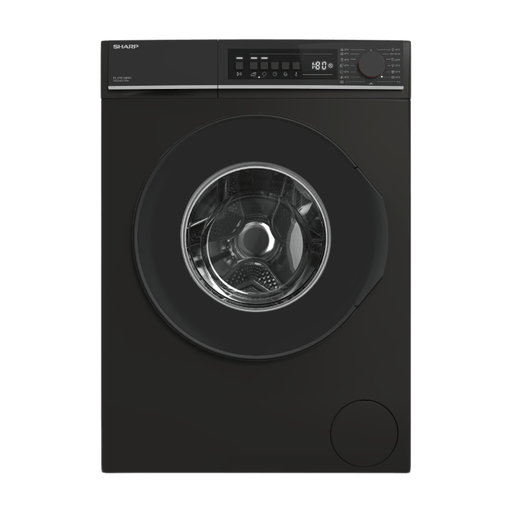
SHARP ESNFB714BBNACB washing machine, 7 kg, black

SHARP ESNFB714BBNACB, 7 kg, black

Could suit a smaller shared laundry load if 7 kg matches what you usually wash.

7 kg capacity, 1400 rpm, energy rating A and 99 kWh per 100 cycles.

Lists 15 wash programmes.

View at Joybuy

Midea MF110W80BA10/W-NL washing machine, 8 kg

Midea MF110W80BA10/W-NL, 8 kg

This capacity is designed for households that can regularly fill the drum with a suitable shared load.

8 kg capacity, 1400 rpm and energy rating A; lists 42 kWh per 100 cycles and 72 dB during the spin cycle.

Lists 16 programmes, including cotton, wool, Eco 40–60 and extra rinse.

View at Joybuy
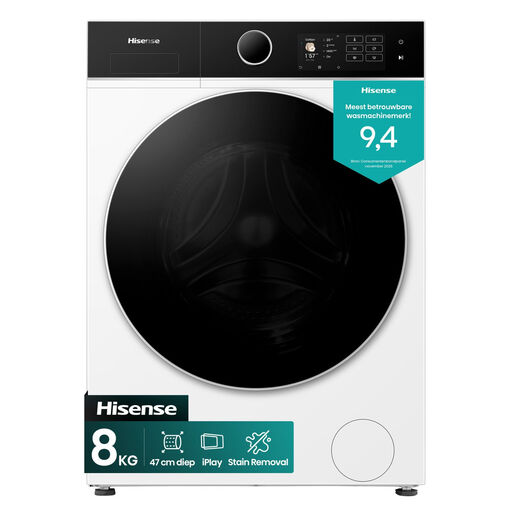
Hisense WF5I8043BWF washing machine, 8 kg

Hisense WF5I8043BWF, 8 kg

The stated depth may be useful to know if installation space is limited. Remember to measure the connections and access route too.

8 kg capacity, 1400 rpm and a stated depth of 47 cm.

The product specifications list 38 L of water per cycle and 0,331 kWh on Eco 40–60.

View at Joybuy

Candy GD 48B9-S washing machine, 8 kg

Candy GD 48B9-S, 8 kg

Could suit regular shared laundry if the stated capacity matches your usual load.

8 kg capacity, 1351 rpm and energy rating A; lists 69 dB during the spin cycle.

The product specifications list 33 kWh per 100 Eco 40–60 cycles and 40 L of water per cycle.

View at Joybuy

Beko BM3WFU3741S washing machine, 7 kg, silver

Beko BM3WFU3741S, 7 kg, silver

Could suit smaller loads if 7 kg matches your household’s usual laundry.

7 kg capacity, 1400 rpm, energy rating C and 76 dB(A) during the spin cycle.

The programme information lists cotton, wool, Eco 40–60 and Hygiene+, among others. A half-load option is also mentioned.

View at Joybuy

Frequently asked questions

Do fabric table napkins always need to be washed at 60 °C?

No, not based on advice for other kitchen linen. Check the napkins’ care labels first. The Voedingscentrum recommends washing used dishcloths, kitchen towels and tea towels at 60 °C. This isn’t a general washing instruction for all fabric table napkins.

Is Eco 40–60 the same as a regular wash at exactly 60 °C?

No, don’t automatically treat Eco 40–60 as the same as a selected hot hygiene programme. According to the European Commission, this programme is intended for normally soiled cotton laundry that the care label says can be washed at 40 °C or 60 °C. For a particular load, also follow the care label and the washing machine’s manual.

What should you check before installing a washing machine in a student house?

Measure the machine and the route to its position, and check the floor, water supply, drainage and earthed socket. Ask the seller in advance whether positioning the machine is included with delivery.

How do you compare washing machine consumption?

Compare the stated energy use per 100 cycles and water use per cycle on the same label basis. Also consider the programme, load and how often you wash. These factors all affect consumption in practice.

Who should you contact in the Netherlands if a washing machine breaks down too soon during normal use?

Contact the seller. According to ACM ConsuWijzer, if a product is faulty despite being used normally, the seller must provide an appropriate free solution, such as a repair or replacement.
