
Housemates who do their washing together
You want a drum that suits the loads you actually combine, so its capacity fits your laundry routine. Milieu Centraal also recommends using an eco programme when washing a full drum.


Choose the drum capacity based mainly on how much laundry your housemates actually combine for each wash. A larger drum isn’t automatically more convenient if it’s often used for small loads. Also compare the dimensions, spin noise, and energy and water figures on the energy label. For cotton socks, Eco 40-60 is only suitable if the care label allows it; according to the Consumers' Association, the programme isn’t suitable when laundry needs to be washed at a hygienically high temperature.
You want a drum that suits the loads you actually combine, so its capacity fits your laundry routine. Milieu Centraal also recommends using an eco programme when washing a full drum.
You want to follow the care label on your cotton socks and know when Eco 40-60 is suitable for normally soiled cotton, without confusing it with a hot hygiene wash. The Consumers' Association explains the limits of this programme.
You’re mindful of spin noise, the available space and the water-protection features of the specific model. The Consumers' Association points out that both the type of noise and the type of water protection matter.
Start with the usual shared load and the available space, then compare the programmes, noise levels and figures on the energy label.
| What to consider | What should you look for? | Who should pay particular attention? |
|---|---|---|
| Capacity and space | Compare the cotton load capacity with the amount your housemates usually combine. Measure the available space too, and check that the drum opening is easy to reach. | If I want the drum to suit the number of housemates who actually wash together, I look at the shared load. Around 33% of consumers put capacity first. |
| Programme for socks | Read the care label and check that the model has a suitable cotton programme. Use Eco 40-60 only for normally soiled cotton that the care label says can be washed at 40 or 60 °C. | I want to choose a programme for cotton socks that follows the care label, and be able to distinguish between a regular wash and a hot hygiene wash. Around 27% of consumers give their choice of programme the highest priority. |
| Noise and water protection | Compare the spin noise and, where available, check information about the type of noise. Check the water-protection features of the exact model and measure the space. | If the laundry room is next to bedrooms, I want to consider noise and the possible consequences of a leak in a shared building. Around 20% of consumers put quiet, safe installation first. |
| Consumption and delivery | Compare the energy label’s consumption in kWh per 100 cycles and its water consumption. Also check the delivery and installation terms for your chosen location. | If I expect the machine to run often, I want to factor in its ongoing energy and water consumption and find out in advance what delivery and installation involve. For around 20% of consumers, these usage and purchase considerations come first. |
The percentages give a broad breakdown of the main purchase considerations in this guide; they aren’t measured market shares or survey results.
A large drum isn’t automatically the right choice if housemates usually wash small, separate loads. The Consumers' Association warns that consumption isn’t adjusted precisely for smaller loads, and that laundry may not come as clean in an underfilled drum.
Base the capacity on the amount of cotton laundry your housemates usually combine for each wash. The stated load capacity applies to cotton laundry.
The programme name doesn’t mean the laundry is washed at 60 °C. The Consumers' Association measured temperatures of 20 to 50 °C with this programme and says it isn’t suitable when a hygienically hot wash is needed.
Check the care label first and choose only a programme that’s suitable. If a hot wash is needed, use a suitable programme if the care label allows it.
A stated noise level doesn’t tell you everything about the type of noise. Water protection also varies between models; a general claim doesn’t show what protection the model you’ve chosen offers.
Compare the available noise information, consider where the machine will go, and check which water-protection features apply to the exact model.
The Dutch Bosch Serie 4 WAN2809XNL is a useful reference point for comparing machines for shared laundry.
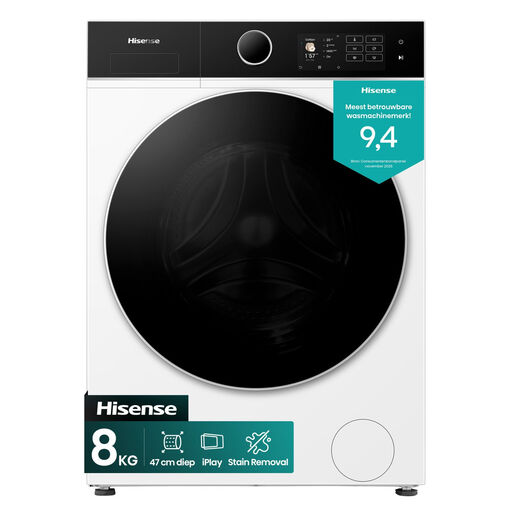
The Dutch 6000 ProSense LF628600 is an 8 kg model to compare if load sizes vary from one wash to another.
The Dutch LG F4X1008NWH is an 8 kg front-loading washing machine to compare for its programmes and dimensions.
This selection includes washing machines with an 8 or 9 kg drum capacity, aimed at households that share laundry loads.
 No image available
The 9 kg capacity may suit housemates who combine their laundry; match the capacity to the loads you actually wash.
1400 rpm; energy label A; NL/FR control panel.
 No image available
The 8 kg drum capacity is a useful reference point for shared laundry; compare it with the amount your housemates usually combine.
1400 RPM; 16 wash programmes.
 No image available
An 8 kg capacity may be useful when housemates combine their laundry; also check that the dimensions suit your laundry room.
1400 RPM; inverter motor; white.
 No image available
The stated 8 kg capacity may suit combined loads; check whether it matches the household’s usual load size.
1351 RPM; energy label A; 16 programmes.
 No image available
The 8 kg drum capacity is a useful comparison point for housemates who combine their laundry; check that it suits the shared load.
1400 rpm; EnergySpin; ProSmart Inverter Motor; energy label A.
No, only if the socks are normally soiled and the care label allows washing at 40 or 60 °C. The Consumers' Association notes that the programme doesn’t necessarily reach 60 °C and isn’t suitable when laundry needs to be washed at a hygienically high temperature. In that case, choose a suitable cotton or hygiene programme if the care label allows it.
Measure the available space and check the connection, delivery and installation requirements, as well as the water-protection features of the exact model. The Consumers' Association points out that moving a washing machine can be difficult and that water-protection systems vary.
Agree who will take care of maintenance and follow the model’s care instructions. The Consumers' Association recommends regularly running a genuinely hot programme at 60 °C to limit bacterial growth in the machine; Eco 40-60 isn’t a substitute.
According to ACM ConsuWijzer, online purchases generally come with a statutory 14-day cooling-off period after delivery. A product must also meet what you can reasonably expect of it; if it’s faulty, the seller is responsible for providing an appropriate solution. Check the exceptions and returns terms that apply to your specific purchase.
The Dutch Government describes energy labelling for products including washing machines as compulsory. Use the energy and water figures on the label to compare models; the labelling requirement doesn’t mean you can only buy a particular label class.