
Housemates who wash towels together
Choose a drum that suits your usual shared cotton load; the stated capacity applies to cotton washing. (Consumentenbond)


Choose the drum capacity based on the number of towels your housemates usually wash together, rather than simply how many people live there. A larger drum can be useful for full shared loads, but makes less sense if everyone does small washes. Then compare the energy label, spin noise and available space. Milieu Centraal says that normally soiled towels usually do not need to be washed at 60 °C as standard.
Choose a drum that suits your usual shared cotton load; the stated capacity applies to cotton washing. (Consumentenbond)
Compare the energy and water consumption on the label, and consider whether residents can realistically use the programmes on which those figures are based. (European Commission, Milieu Centraal)
Consider the dimensions, spin noise and a stable installation. Also think about the potential impact of a leak. (Consumentenbond)
Suitable for: housemates who regularly combine their towels in one load, but do not need a larger drum for their usual load or available space.
Trade-off: a large shared towel load may still need to be split across several washes.
Suitable for: a household that actually saves up larger shared cotton loads and has enough room for the machine and its connections.
Trade-off: if you do lots of small, separate washes, the extra capacity may not be worth much.
Match the load capacity to your usual towel wash: the capacity shown on the label applies to cotton washing (Consumentenbond). To compare energy and water use, check the figures on the EU energy label. These include energy consumption per 100 cycles and water consumption per cycle (European Commission, Dutch Government).
| What to consider | What to look for | Who should pay particular attention? |
|---|---|---|
| Capacity | Note the size of your usual dry towel load and compare it with the cotton load capacity and drum opening. | If we wash towels together, I want a drum that suits the load without automatically choosing the largest. Around 36% of consumers prioritise capacity for combined towel loads. |
| Consumption and programmes | Compare kWh per 100 eco cycles and litres per cycle on the EU label; also check whether the programme duration fits your laundry schedule. | I want to know how electricity and water costs add up when we share the washing. Around 29% of consumers prioritise purchase and running costs. |
| Noise and installation | Compare the stated spin noise in dB and check that the machine can be installed securely and level. | If the machine is near a living or sleeping area, I want to take noise and vibrations into account. Around 21% of consumers prioritise peace and quiet at home. |
| Dimensions and leaks | Measure the space and access route; check the tap, drain, floor and leak protection on the exact model. | In a cramped laundry room, I want to make sure the machine will fit and consider the consequences of a leak. Around 14% of consumers prioritise installation and leak prevention. |
The stated capacity applies to cotton washing, and a larger capacity is not necessarily the right choice if housemates usually do small, separate loads.
Base your choice on your usual shared towel load and the space available.
According to Milieu Centraal, normally soiled towels usually do not need to be washed at such a high temperature.
Follow the care label and choose a temperature that suits the circumstances; do not make exceptions the rule.
Hose protection, a base sensor and overflow protection do not necessarily guard against the same types of leaks. (Consumentenbond)
Check which protection features the exact model has and consider the impact of a leak in the installation location.
The washing machine needs to fit through the access route to its installation location and be connected securely there.
Check in advance what delivery includes, and whether delivery to the laundry area, installation and removal of the old appliance have been arranged.
The BM3WFT3841W is an 8kg model you can compare for capacity, depth and energy label figures.
The F4X1009NWK is a 9kg example for a household that genuinely washes larger loads together.
The Serie 6 WGJ23400NL is an 8kg example with a maximum spin speed of 1400 rpm.
The 6000 ProSense LF628600 is an 8kg example for anyone comparing machines for varying load sizes.
These Joybuy models offer 8 or 9 kg capacities for washing towels in shared loads.
 No image available
A 9kg front-loader to consider if housemates wash larger towel loads together.
Energy label A; 44 kWh per 100 cycles; 72 dB during the spin cycle; 600 × 550 × 850 mm.
The product information lists a delay start and a Super Speed programme for 5 kg.
 No image available
An 8kg front-loader to compare with your usual shared towel load.
Energy label A; 42 kWh per 100 cycles; 72 dB during the spin cycle; depth 475 mm.
The product information lists a delay end time of 0–24 hours and AquaStop leak protection.
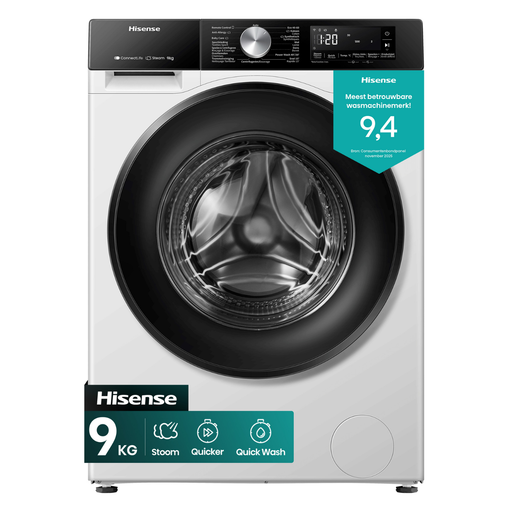 No image available
A 9kg front-loader to consider if you regularly have larger shared towel loads.
33 kWh per 100 cycles; 39 litres per cycle; 72 dB during the spin cycle; 59,5 × 59 × 84,5 cm.
The product information lists a delay start and end time.
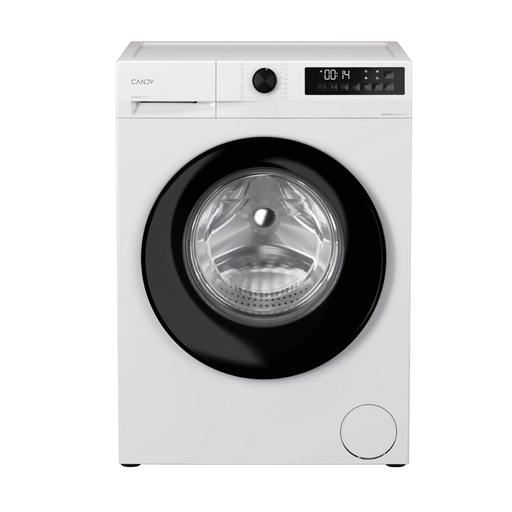 No image available
A 9kg front-loader to compare if housemates wash towels together.
Energy label A; 40 kWh per 100 cycles; 42 litres per cycle; 69 dB during the spin cycle; depth 601 mm.
The product information lists a delay start of up to 24 hours and a spin speed of 1351 rpm.
 No image available
An 8kg front-loader to compare with your usual shared towel wash.
Energy label A; 47 kWh per 100 cycles; 76 dB during the spin cycle; depth 54,6 cm.
The product information lists OptiSense load detection, which adjusts water, energy and programme duration to the load.
No. According to Milieu Centraal, normally soiled towels usually come clean at a lower temperature too. A hot wash may be appropriate in certain circumstances; follow the care label as well.
Measure the installation space and check the access route, a stable floor, the tap and the drain. Agree in advance what delivery and installation include.
The EU energy label includes energy consumption per 100 cycles and water consumption per cycle, based on the prescribed testing method (European Commission). Actual consumption depends on how you use the machine.
Report the problem to the retailer. According to the Dutch Government, the retailer must resolve the issue with a faulty product or contact the manufacturer.
Yes. According to the Dutch Government, when you buy a new appliance, a shop must take back a similar old appliance. Agree in advance how it will be removed from the installation location.