Choose a washing machine based on the weight of a typical sorted load and the space available, rather than simply the number of people sharing the house. Weigh a typical load, and check the energy label, spin noise and space for connections. Milieu Centraal says ordinary towels usually do not need to be washed at 60 °C; the Voedingscentrum recommends washing used kitchen towels and tea towels at 60 °C.
Who is this buying guide for?
Housemates who wash clothes together
If you wash towels and other suitable laundry together, it makes sense to choose a drum capacity that suits your usual shared load. Milieu Centraal and the Consumentenbond stress that the load itself matters, not just the size of the household.
Housemates with limited laundry space
If the machine is going in a cramped shared space, its overall dimensions, the floor beneath it and spin noise are all important considerations. The Consumentenbond points out that both the noise level and the type of noise matter.
Housemates who do their own small loads
If you usually wash towels separately, look for a capacity that suits those smaller loads. The Consumentenbond notes that the stated load capacity applies to cotton laundry.
What should you look for when buying?
Start with the laundry you actually wash together, then decide which requirements around energy use, installation and the type of towels or cloths matter most.
| Consideration |
What to look for when buying |
Who this matters most to |
| Suitable drum capacity |
Weigh a typical sorted load and compare it with the maximum load capacity for cotton and the machine’s overall dimensions. |
When we combine our laundry, I want the drum to suit our usual load. Around 33% of consumers in this situation prioritise capacity. |
| Electricity and water use |
Compare the energy label and consumption on the same programme basis; also check that your usual load is a good fit for the drum. |
If I do laundry regularly, I want to be able to factor in electricity and water use. Around 25% of consumers in this situation put consumption first. |
| Installation, noise and water protection |
Measure the available space and access routes; compare spin noise and check the model’s flooring requirements, connections and water protection features. |
If the machine is near bedrooms or in a shared space, I want to minimise disruption and installation risks. Around 25% of consumers in this situation give this top priority. |
| Washing towels and cloths appropriately |
Check the care labels and temperature settings; distinguish between ordinary towels and used kitchen towels and tea towels. |
If the towels and cloths I wash are the main factor in my choice, I want to be able to adjust the temperature to suit the laundry. Around 17% of consumers in this situation prioritise this. |
The Consumentenbond notes that the maximum load capacity applies to cotton laundry. Milieu Centraal and the Voedingscentrum give different advice for ordinary towels and used kitchen towels and tea towels; always follow the care labels too.
Common mistakes
-
Choosing a large drum based on the number of housemates
A machine may be too large for the loads that people in the house usually wash together. Milieu Centraal and the Consumentenbond recommend matching the capacity to the laundry that actually goes in the drum.
Weigh a typical sorted load before choosing a capacity.
-
Washing all towels and cloths in the same way
The same temperature advice does not necessarily apply to ordinary towels and used kitchen towels and tea towels.
Follow the care label. Milieu Centraal says ordinary towels usually do not need to be washed at 60 °C, while the Voedingscentrum recommends washing used kitchen towels and tea towels at 60 °C.
-
Measuring only the space where the machine will go
The machine also needs to fit through the route to the laundry area and stand securely on the available flooring.
Check the access routes, connections and flooring before choosing a model, and find out what installation requirements apply.
-
Assuming a quiet setting means less disturbance during the spin cycle
A feature’s name alone does not tell you how much noise the machine makes while spinning. The Consumentenbond points out that the type of noise is relevant too.
Compare the noise information for the exact model and consider where the bedrooms and workspaces are.
Brands and models to consider
Inventum
The Dutch Inventum VWM8010W is an 8 kg front-loading washing machine to consider if it suits the weight of your usual shared load.
- Inventum lists a 1400 rpm spin speed, a delay start and a quiet setting for this model.
- A quiet setting does not prove that the machine will make little noise in every room; check the model specifications and installation requirements.
Bosch
The Bosch Serie 6 WGJ23400NL is a Dutch 8 kg front-loader to compare with other models that offer a suitable capacity.
- Bosch lists a maximum spin speed of 1400 rpm for this model.
- Bosch says the actual maximum speed may be lower if the load is unbalanced; check the information for this model.
Beko
The Beko BM3WFT3841B1 is a Dutch 8 kg front-loader with stated dimensions that may be useful if space is limited.
- Beko lists a depth of 54,6 cm, a spin noise level of 76 dBA and a cotton and Hygiene+ programme for this model.
- A programme name alone does not guarantee a hygienic result for every load; take the laundry and conditions of use into account.
Samsung
The Samsung WW90CGC04AAEEN has a 9 kg capacity. Consider it if your usual shared load makes good use of the larger drum.
- Samsung lists an A energy label and EcoBubble for this model.
- Samsung’s energy-saving comparison is with earlier models from the brand; it is not an independent comparison with all alternatives.
Miele
The Miele WEG895 WPS is a Dutch 9 kg front-loader with automatic dosing. Consider it if both the capacity and this feature suit your household.
- Miele lists automatic dosing and a maximum spin speed of 1400 rpm for this model.
- A larger capacity will not necessarily be suitable if housemates usually do separate small loads of towels.
Washing machines at Joybuy
These Joybuy washing machines are for anyone looking for a front-loader for shared laundry. Match the capacity to the loads you actually wash together.
 No image available
Samsung WW90DG6U25LE, 9 kg
The capacity may suit larger loads washed together; weigh your usual load before choosing a larger drum.
The product name lists 9 kg and 1400 rpm.
View at Joybuy
 No image available
Midea MF110W80BA10/W-NL, 8 kg
The 8 kg capacity is worth comparing if it suits the loads your housemates wash together.
The product name lists 8 kg, 1400 RPM and 16 wash programmes.
View at Joybuy
 No image available
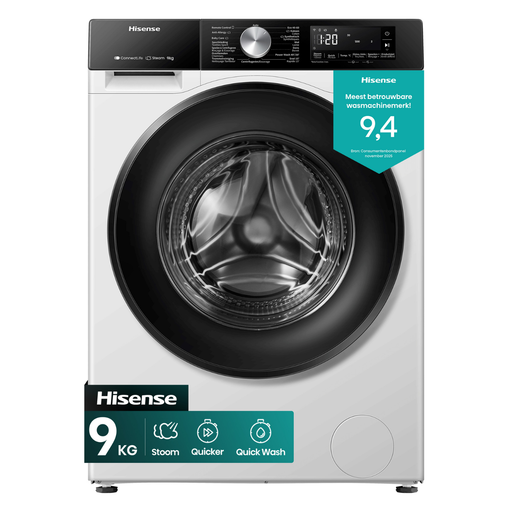
Hisense WF3S9043BW3, 9 kg
This capacity may be worth considering if you regularly combine larger loads; check that those loads are right for the drum.
The product name lists 9 kg and 1400 RPM.
View at Joybuy
 No image available
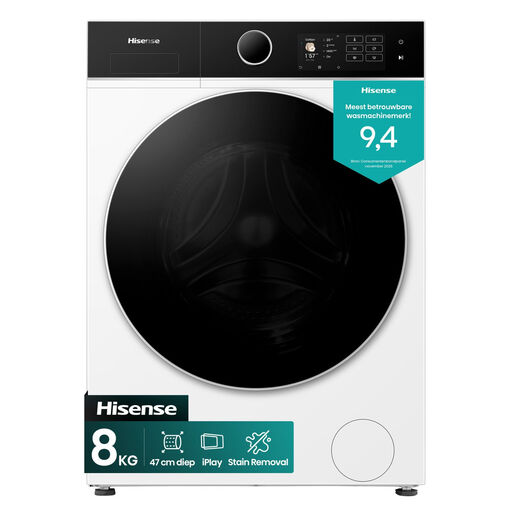
Hisense WF5I8043BWF, 8 kg
An 8 kg machine may suit shared loads that fit within this capacity; compare it with the laundry you actually wash.
The product name lists 8 kg, 1400 RPM and an inverter motor.
View at Joybuy
 No image available
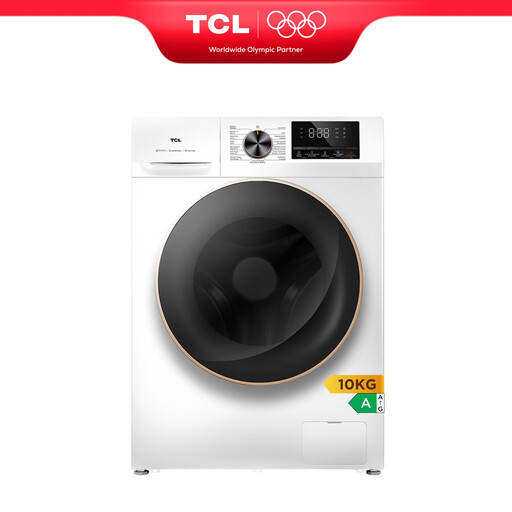
TCL FP1210WA0, 10 kg
The 10 kg capacity is worth comparing if you regularly have large shared loads.
The product name lists 10 kg, Steam Wash, Quick Wash 15 mn, Child Lock and Delay End.
View at Joybuy
Frequently asked questions
Do towels in a student house always need to be washed at 60 °C?
No. Milieu Centraal says ordinary towels usually do not need to be washed at 60 °C. The Voedingscentrum does recommend washing used kitchen towels and tea towels at 60 °C. Always follow the care label too.
How do you choose a drum size if housemates do their laundry separately?
Weigh a typical sorted load rather than adding up the number of people in the house. The Consumentenbond notes that the stated load capacity is the maximum for cotton laundry; a smaller load may be suitable for other fabrics.
What should you check when connecting a washing machine?
Check the water supply, drain and a suitable earthed socket. Remove the transit bolts before use and level the machine on a firm, flat surface. Check the installation requirements in advance.
Is two years the standard legal warranty period for a washing machine in the Netherlands?
No. According to the Dutch government, there is no fixed legal warranty period in the Netherlands; you are entitled to a product that meets what you can reasonably expect from it. If something goes wrong, contact the retailer. Normal wear and tear or damage caused by your own actions does not automatically mean repairs will be free.


