
Anyone washing small towel loads
You regularly wash a few towels at a time and want a drum that suits a typical load. The Consumers' Association warns that load detection cannot fully compensate for a drum that's too large.


Choose the drum capacity to suit the size of your usual sorted towel load, rather than opting for the largest capacity available. The Consumers' Association recommends choosing a machine to match what you usually wash. Load detection can adjust consumption for a smaller load, but it cannot fully compensate for a drum that's too large. So compare the cotton and Eco 40-60 programmes, rinsing options and installation dimensions too.
You regularly wash a few towels at a time and want a drum that suits a typical load. The Consumers' Association warns that load detection cannot fully compensate for a drum that's too large.
You usually wash small loads, but sometimes have more towels or cotton items to wash. Compare the drum capacity with the machine's small-load adjustment and the programmes available on the specific model.
First, check that the machine will fit, along with the doorway and the space needed around it. The Consumers' Association notes that top-loading machines are narrower than front-loading models. If you choose a top-loader, make sure there's also room above the lid.
| What to look for | What should you check? | Who is this most relevant to? |
|---|---|---|
| Suitable capacity | Weigh a typical sorted towel load and compare it with the cotton capacity. The Consumers' Association recommends allowing about 2 kg of spare capacity when taking the measurement, to accommodate larger items. | If I usually wash just a few towels, I want a drum that suits the load rather than relying on load detection alone. Around 33% of consumers give suitable capacity top priority. |
| Washing and rinsing | Check the cotton programme, temperature settings and whether you can select an extra rinse. Eco 40-60 does not guarantee a 60 °C wash; the Consumers' Association reports that tested machines were less effective at rinsing detergent out on this programme. | If I want to wash towels appropriately and rinse them well, I'll check the programme and care label. For around 27% of consumers, cleaning towels is the top priority. |
| Energy and water use | On the EU energy label, compare energy use per 100 cycles and water use per cycle on the same Eco 40-60 basis. These figures are not a measure of how much your small towel load will use. | If I wash frequently, I want to factor in energy and water use without assuming that the label figures match my own consumption. Around 20% of consumers prioritise ongoing running costs. |
| Drying and time-saving features | Check the maximum spin speed and any programme-specific limitations, as well as the duration of the exact model's programmes. | If I put towels in the tumble dryer after washing, I'll look at the spin speed and programme duration. For around 13% of consumers, drying and time-saving factors are decisive. |
| Space and connections | Measure the space where the machine will go and the route to get it there, including room for the door or lid to open. Also check the water supply, drainage and installation requirements. | If I need to know whether the machine will fit at home, I'll compare the dimensions and connection options before choosing a model. Around 7% of consumers put installation and connections first. |
According to the Consumers' Association, consumption is not adjusted very precisely for smaller loads. A drum that is not properly filled may also be less effective at cleaning.
Weigh a typical sorted towel load and compare it with the cotton capacity before opting for extra capacity.
The programme name refers to the type of cotton laundry, not a guaranteed actual temperature. Follow the care label and, if you have a specific hygiene requirement, choose a suitable programme as set out in the model's manual.
Follow the care label and, if you have a specific hygiene requirement, choose a suitable programme as set out in the model's manual.
The route into your home, space for the door or lid, connections and a stable position all affect whether the machine will work for you. Installation requirements may vary between orders.
Measure the route and the space where the machine will go, then check which delivery and installation services are available before buying.
The 6000 ProSense models reviewed are front-loaders with an 8 kg capacity.
The Serie 4 WAN2809XNL reviewed combines an 8 kg cotton capacity with small-load features and a shorter programme option.
The W1 WSA123 WCS 8kg Active reviewed is a front-loader with a cotton programme and AddLoad.
The WW80CGC04AAEEN from the EcoBubble 5000 series is described as an 8 kg front-loader with a steam programme and app control.
This selection of Joybuy products focuses on front-loaders with load detection for small and varying laundry loads.
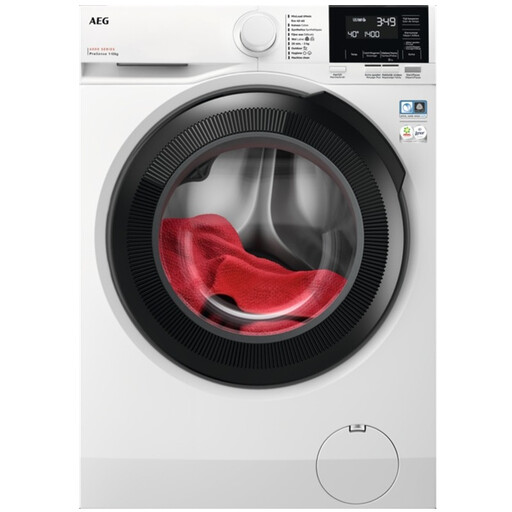 Image unavailable
An option if you alternate between small loads and larger towel washes, and want load detection.
The product description lists ProSense and TimeSave Plus. According to the description, ProSense adjusts the time, water and energy use to the measured load.
The product name lists 10 kg, 1400 rpm and energy class A.
 Image unavailable
Suitable if you're looking for a front-loader for varying loads and want to compare the stated load adjustment with the standard cotton programmes.
The product description lists PreciseWash, which adjusts the settings to the weight of the load.
The product name lists 8 kg, 1600 rpm, ProSteam and energy class A.
 Image unavailable
A front-loader to consider if you often wash small loads and sometimes larger ones, and want to include load adjustment in your comparison.
The product description lists load sensing, which adjusts the settings to the weight of the load.
The product name lists 8 kg, 1400 rpm and PreciseWash.
 Image unavailable
An option to compare if you're looking for an 8 kg front-loader with an adjustment for varying loads.
The product description says that ProSense adjusts the time, water and energy use based on the load.
The product name lists 8 kg, 1400 rpm and energy class A.
Image unavailable
Worth comparing if you're looking for an 8 kg front-loader for small and varying loads.
The product description lists PreciseWash with load sensing, which adjusts the settings to the weight of the load.
The product name lists 8 kg, 1600 rpm and ProSteam.
No. According to Milieu Centraal, this is not necessary for towels in most cases. Follow the care label; if you have a specific hygiene requirement, you may need a different suitable programme. Eco 40-60 does not guarantee an actual temperature of 60 °C.
No. The European Commission describes Eco 40-60 as a programme for normally soiled cotton that can be washed at 40 or 60 °C according to the care label. The Consumers' Association says the actual temperature varies between machines. Check the manual if you need a programme at a specific temperature.
Weigh a typical sorted towel load and compare it with the cotton capacity. The Consumers' Association recommends allowing about 2 kg of spare capacity when taking this measurement, to accommodate larger items and prevent them from getting bunched up.
Check that the machine will fit, along with the route to its final position, and look at the connections, stable positioning and installation requirements. The Consumers' Association also recommends removing the transit bolts before use, levelling the machine and following the manual for the model you've chosen.
Yes. Compare like with like: the label shows energy use per 100 cycles and water use per cycle for Eco 40-60. These figures don't automatically reflect the consumption of a small towel load or a different programme.