
Someone with a narrow laundry space
Your first priority is to check that the machine fits, with enough room for the hoses and an open door or lid. Consumentenbond also recommends measuring this clearance.


First, measure the space, allowing for hoses and a fully open door or lid. Then choose a drum size that suits your usual cotton load. A top-loading machine may be a good option if width is the main constraint; if depth is limited, a shallower front-loader could fit. Choose a washer-dryer only if you want to dry clothes electrically and don’t have room for a second appliance. If you do, check its separate drying capacity too.
Your first priority is to check that the machine fits, with enough room for the hoses and an open door or lid. Consumentenbond also recommends measuring this clearance.
You’ll want to choose a drum size that suits your usual cotton load, rather than an unusually large wash. According to Consumentenbond, the stated load capacity applies to cotton.
A washer-dryer could be useful, but you’ll need to consider its drying capacity and energy consumption. Consumentenbond points out that a washer-dryer takes up less room than two separate appliances.
First, measure the width, depth and clearance needed to open the door or lid. Then compare the load capacity with a typical cotton load and decide whether you want to dry clothes in the machine too.
| Buying consideration | What to check | Who is this important for? |
|---|---|---|
| Will it fit? | Measure the space and check there’s room for hoses, ventilation and a fully open door or lid. | If my laundry space is narrow, I want to be sure the machine will still fit once connected and when I’m loading it. Around 29% of consumers put the available space first. |
| Cotton load capacity | Compare the cotton load capacity with a typical sorted load; check the maximum load for other programmes separately. | For my usual cotton wash, I want a drum size that suits what I normally wash in one go. Around 22% of consumers make a suitable cotton load their top priority. |
| Drying without a second appliance | For a washer-dryer, check both the washing and drying capacities, and compare the drying performance on the energy label. | If I don’t have room for a separate tumble dryer, I want to know whether the washer-dryer can dry my laundry too. Around 21% of consumers prioritise drying without a second appliance. |
| Programme for different types of clothing | Follow the care labels and check that the exact model has a suitable programme; don’t assume cotton and technical jackets have the same care instructions. | When my laundry includes both cotton and a technical waterproof layer, I want to be able to follow the right instructions for each item. Around 14% of consumers let different clothing care labels guide their choice. |
| Energy use in everyday operation | Compare models using the same label basis and, for a washer-dryer, check the figures for both washing and drying. | If I use the machine often, I want to compare the stated energy use for washing and, if applicable, drying. Around 14% of consumers make energy use their main priority. |
Hoses, ventilation and an open door or lid also need room. A machine may appear to fit on paper but prove impractical to install or use every day.
Measure the space and the route to it, and check the installation instructions for the exact model.
If the door or lid can’t open fully, loading is more difficult and it may not be possible to connect the machine.
LG lists the LG W4X1085NWB as having an 8 kg washing capacity and a 5 kg drying capacity. So a wash load that’s within the washing limit won’t necessarily fit in the machine for one drying cycle.
For every washer-dryer, compare both capacities and check whether the clothing care label allows tumble drying.
Some items may need to be dried separately or require an additional drying cycle.
A water-repellent or technical jacket may have different washing and drying instructions from a cotton garment.
Follow the care label on each item. Patagonia’s instructions for technical waterproof jackets don’t automatically apply to every waterproof layer.
A larger drum isn’t automatically the right choice if you usually wash small loads. Milieu Centraal recommends checking the spin-drying performance first, and then the spin speed.
Choose a load capacity that suits your usual wash and compare the label information for washing and, if needed, drying.
If you often wash small loads or use the electric drying function on a standard washer-dryer, it may take more time or energy.
According to AEG Netherlands’ product specifications, the AEG LTR6363A is a top-loader measuring 397 mm wide, with a 6 kg load capacity.
Beko Netherlands lists the BM3WFU38412CW as a front-loader measuring 60 cm wide and 54,6 cm deep, with an 8 kg load capacity.
Bosch Netherlands lists the WAN2827GNL as having an 8 kg load capacity, a width of 598 mm and a depth of 590 mm.
LG Netherlands lists the W4X1085NWB as having an 8 kg washing capacity and a 5 kg drying capacity.
These product picks focus on shallow front-loaders and a washer-dryer for spaces with limited room.
 No image available
This front-loader could suit you if you’re looking for a model with an 8 kg load capacity; check the available depth and connection space before choosing.
The product name lists an 8 kg capacity, 1400 rpm and 16 wash programmes.
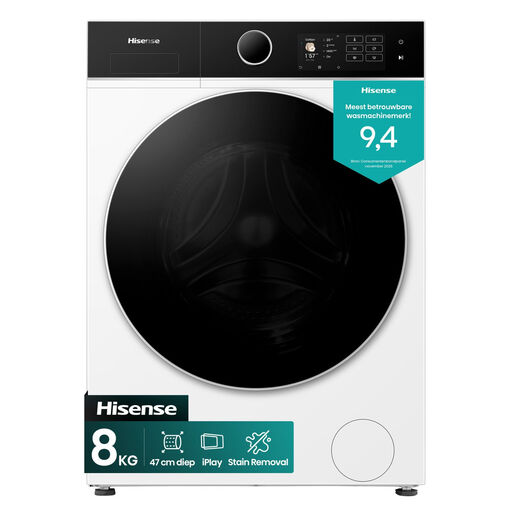 No image available
This front-loader is worth considering if you’re looking for an 8 kg capacity; check that its dimensions suit your laundry space.
The product name lists an 8 kg capacity and 1400 rpm. The product information advises against washing thick waterproof fabrics due to the risk of an unbalanced load during spinning.
 No image available
A washer-dryer could be a good option if you want to wash and dry clothes in one appliance and don’t have room for a separate tumble dryer.
The product name lists an 8 kg washing capacity and a 6 kg drying capacity. A wash load above the drying capacity can’t be dried in one go.
 No image available
This shallow front-loader is worth a look if you need a smaller load capacity and have limited depth available.
The product name lists a depth of 45 cm, a 6 kg capacity and a B energy label.
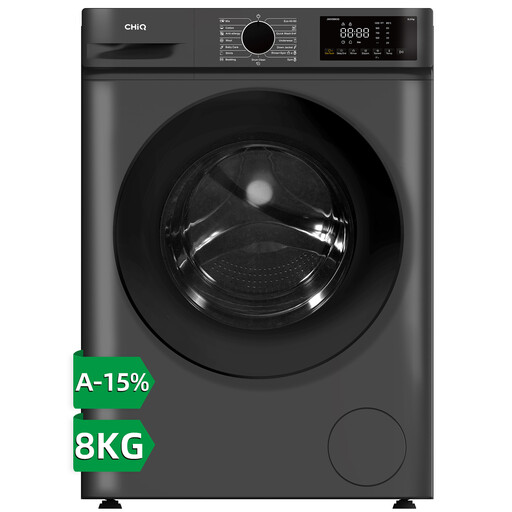 No image available
A front-loader with an 8 kg capacity could suit a typical cotton load of that size; check the exact depth and energy label before you decide.
The product name lists an 8 kg capacity and 1400 rpm.
Choose a load capacity that suits a typical sorted cotton wash. According to Consumentenbond, the stated maximum load capacity applies to cotton; other programmes may have a lower maximum load. So don’t base your choice on an unusually large wash.
Only if the installation instructions for the exact model allow it and there’s enough room for connections, ventilation and the door or lid to open. Measure the route to the space where the machine will go too.
Follow the care label on the specific jacket; a technical or water-repellent waterproof layer won’t necessarily have the same washing and drying instructions as cotton. Patagonia’s guidance for technical waterproof jackets isn’t a general rule for all waterproof layers.
Compare the stated energy use on the same label basis and, for a washer-dryer, check the drying information too. Use the amount of detergent recommended on the packaging and follow the manufacturer’s maintenance instructions; Consumentenbond notes that using too much detergent can cause a build-up of dirt.
No. New household washing machines must carry the applicable EU energy label, with a scale from A to G. The requirement to display a label doesn’t mean you can only buy an A-rated model. Compare the label information for the specific model.