
Buyers with a narrow laundry area
Measure not only the available width, but also the depth, height and space needed to open the door or lid.


If width is your main constraint, a top-loader may fit; if depth is the issue, compare slimline front-loaders. Allow space for the lid or door to open and for the hoses, and choose a capacity that suits your usual washing. If you need to wash pillowcases hygienically, the name Eco 40-60 alone doesn’t mean the laundry reaches 60 °C.
Measure not only the available width, but also the depth, height and space needed to open the door or lid.
Follow the pillowcase care label and check which programme is suitable when a hygienic wash is needed.
Choose a capacity that suits the loads you usually wash, including when you wash pillowcases with other items.
A good fit when: width is limited, but there’s room above the machine to open the lid.
Bear in mind: the lid needs clearance above the machine, so the top can’t be used as a worktop and the machine won’t fit beneath a worktop.
A good fit when: there’s enough width and space in front of the door, or you’re looking for a machine with a shallower depth.
Bear in mind: the door needs space to open; also check how much room is needed for the hoses and connections.
| What to consider | What to look for when buying | Who should pay particular attention? |
|---|---|---|
| Space and positioning | Measure the width, height and depth; allow space for the hoses and for the lid or door to open. | I want to be sure the machine will fit and remain practical to use; for around 36% of consumers, fitting it into the available space is the main concern. |
| Wash programme | Follow the care label and check whether there’s a 60 °C cotton programme or a suitable hygiene programme. | If I want to wash pillowcases with care, I check the label and programme first; around 29% of consumers prioritise the wash treatment. |
| Capacity | Compare the capacity with your usual cotton load and check the maximum load for the programme you’ve chosen. | I want a drum that suits the washing I usually do, without choosing an unnecessarily large one; for around 21% of consumers, load size determines their choice. |
| Energy use and installation | Compare energy labels on the same programme basis and check what’s included with delivery and installation. | I want to know in advance what energy use the label describes and what installation includes; around 14% of consumers pay the most attention to this. |
The percentages show which of these considerations is the main concern for consumers in this specific small-laundry-area situation; they are not Dutch market shares or survey results. Consumentenbond points out that the stated capacity refers to a cotton wash, and that you need to allow space for connections and for the door to open. The European Commission describes Eco 40-60 as suitable for normally soiled cotton that can be washed at 40 or 60 °C according to the care label.
A machine may fit within the available width but still leave too little room for the hoses or to open the lid or door.
Measure the entire space and check the external dimensions and clearance required for the exact model.
The programme name doesn’t guarantee that the laundry will be washed at 60 °C. The care label determines which treatment is suitable.
Check the label and see whether the model offers a standard 60 °C cotton programme or a suitable hygiene programme.
The stated capacity doesn’t automatically apply to every programme. Product information for a Whirlpool model also lists different capacities.
Compare the capacity with your usual washing and, if the model information conflicts, confirm which version is being offered.
AEG makes top-loaders for anyone short on width. The dimensions and capacity below apply to the LTR7573A and not necessarily to other AEG models.
The TW 622S FRESHCARE BE is a top-loader worth considering when width is limited.
The Bosch WGE02406NL is a front-loader for a laundry area with enough width and space in front of the door.
The TCL FF0610WB0 is a front-loader worth considering if a shallow depth is important.
These selected products are AEG front-loaders with different stated capacities and features. Before buying, check that the available width and depth, space in front of the door and connections are suitable for the exact model.
 No image available
The stated capacity is worth considering if you wash pillowcases with other items.
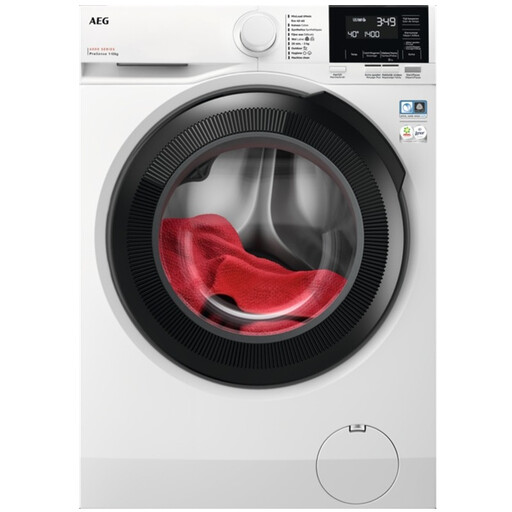
The product title lists 10 kg and 1400 rpm. The product description mentions ProSense, which weighs the load and adjusts the wash time, water and energy use. As a front-loader, this model needs space in front of the door and room for hoses and connections.
 No image available
Compare this model if you’re looking for a front-loader with a stated capacity of 8 kg and a dedicated hygiene wash programme.
The product title lists 8 kg and 1600 rpm; the product description mentions PreciseWash and a Hygiene Steam programme. Check the care label and allow space in front of the door and for the connections.
 No image available
The stated capacity may be useful if you wash pillowcases with other items; check the load limit for your chosen programme.
The product title lists 8 kg and 1400 rpm. The product description mentions PreciseWash, Hygiene Steam and ProSteam. Check the care label and allow space in front of the door and for the connections.
 No image available
Consider this model if you want to compare a front-loader with a stated capacity of 8 kg and a specified depth.
The product title lists 8 kg and 1400 rpm; the product description gives a depth of 57,7 cm and mentions an Anti-Allergy Vapour programme at 60 °C. Check the care label and allow space in front of the door and for the connections.
No image available
The product description mentions a MixLoad programme for mixed loads, which may be useful if you wash pillowcases with other items.
The product title lists 8 kg and 1600 rpm. The description mentions PreciseWash and a 69-minute MixLoad programme at 30 °C. Check the programme load limit and allow space in front of the door and for the connections.
No, check the care label first. Eco 40-60 is intended for normally soiled cotton that can be washed at 40 or 60 °C according to the label. For a hygienic wash, Consumentenbond suggests using a standard 60 °C cotton programme or a suitable hygiene or allergy programme as an alternative.
Check the water supply and drain, an earthed socket, a stable position and the installation instructions for the exact model. Also measure the space needed for the hoses and for the door or lid to open. Consumentenbond advises checking before you buy what’s included with delivery and installation.
Compare EU energy labels on a like-for-like basis: the stated energy use refers to the specified eco programme, not necessarily every programme. Consult the manual for maintenance advice. Milieu Centraal also recommends running a 60 °C wash periodically to help prevent detergent and dirt residues from building up.
If a product breaks sooner than you could reasonably expect with normal use, the seller is responsible under ACM ConsuWijzer; the legal guarantee doesn’t have a fixed two-year time limit. According to the Dutch Government, when a private individual buys a new appliance, the retailer must take back a similar old appliance free of charge, including for online purchases.