
People who regularly wash small loads
You often wash just a few garments at a time and are looking for a drum capacity or load adjustment that suits your needs.


Choose the drum capacity to suit your usual household laundry, then check that the programmes and settings on the exact model are appropriate for the care label on your garments. Milieu Centraal and the Consumers’ Association advise choosing a drum capacity that suits your usual wash; load adjustment, a quick programme and delicates settings each meet different needs. According to the European Commission, the eco 40–60 programme is intended for suitable, normally soiled cotton and does not automatically indicate how a small or quick wash will perform.
You often wash just a few garments at a time and are looking for a drum capacity or load adjustment that suits your needs.
You want to choose a programme, temperature and spin setting to suit the care label on technical cycling clothes or reusable period underwear.
You want to be able to reuse a few suitable, lightly soiled items quickly and are checking the conditions for using a quick programme.
Start with a drum capacity that suits your usual household laundry, then compare the load options and programme settings that matter for your garments.
| What to consider | What should you check? | Who is this important for? |
|---|---|---|
| Small loads | Compare the stated drum capacity with a typical household wash; check whether the model has load adjustment or a specific small-load option. | If I usually wash just a few items at a time, I want a drum that also suits my regular laundry. Around 33% of consumers prioritise suitability for small loads. |
| Fabric care | Check whether the temperature and spin speed can be adjusted, and whether the programme is suitable for the load and its care label. | The care instructions for my cycling clothes or period underwear matter more to me than a general programme name. Around 27% of consumers prioritise suitable fabric care. |
| Consumption when washing frequently | Compare energy and water figures on the same label basis; don’t treat eco 40–60 as a prediction for every quick or delicates programme. | I want to compare consumption when I wash frequently, without assuming label figures apply to my small loads. Around 20% of consumers prioritise understanding usage and consumption. |
| Quick programmes | Check the maximum load and permitted settings for the quick programme on the exact model. | When I need a few suitable items again quickly, I want to know when a quick cycle is intended for that purpose. Around 20% of consumers prioritise being able to reuse items quickly. |
The maximum drum capacity doesn’t tell you how much laundry you usually wash at once. Milieu Centraal and the Consumers’ Association advise choosing a capacity that suits your usual wash.
Weigh a typical household wash, then decide which drum capacity and small-load options suit the way you do your laundry.
Programmes can vary in temperature, spin, drum movement and permitted load. Castelli and Modibodi provide care advice for their own garments, so a quick cycle isn’t automatically suitable for every item.
Compare the care label on the specific garment with the settings and load limit for the programme you’ve chosen.
The European Commission describes eco 40–60 as being for normally soiled cotton that can be washed at 40 °C or 60 °C according to its textile information. This basis does not automatically describe the consumption of another programme or a small load.
Compare energy labels on the same basis and check model-specific figures for the programmes you actually plan to use.
The Bosch WGH24405NL is a useful reference if you want to compare a dedicated single-item option with sports and quick programmes.
The 8 kg AEG LF628600 is a useful reference if load adjustment is a factor in your choice.
The 9 kg Beko B3WM49410W2 is a useful reference if a quick programme and separate fabric-care programmes are relevant to you.
The Miele WEA135 WCS 8kg Active is a useful comparison if an 8 kg drum and stated eco figures are important to you.
These Joybuy products range from a compact mini washing machine to household models with different drum capacities and listed programmes. Always check the programme load limit and care label for your garments.
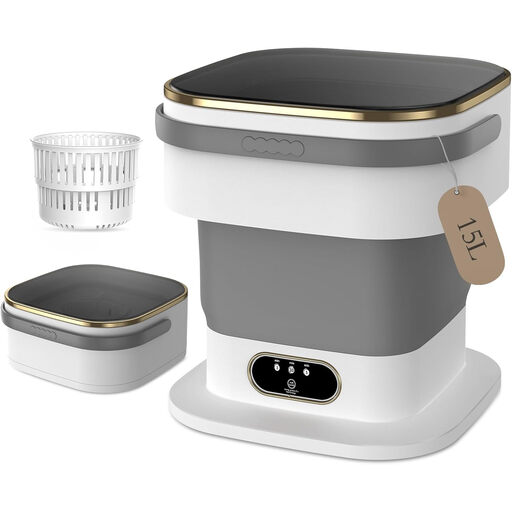 No image available
This compact model is designed for small laundry loads; check that its capacity and programmes suit the items you want to wash.
Listed features: 15 L, 3 wash modes and a spin-dryer basket.
 No image available
An option to compare if, alongside small loads, you’re also looking for a household washing machine with a stated capacity of 8 kg.
The product name lists 16 wash programmes and a spin speed of 1400 rpm.
 No image available
The stated capacity may be relevant if you want to combine small loads with your usual household laundry; consider it alongside the size of your typical wash.
The product name lists a depth of 400 mm and One-Touch Speed Wash; check the programme settings and maximum load.
 No image available
A stated capacity of 6 kg may be a useful comparison if you want a drum size that suits both your usual laundry and smaller loads.
The product name lists a depth of 45 cm, Auto Weight and Quick Wash 15 min.; check the permitted load and settings for this cycle.
 No image available
The stated capacity of 7 kg gives you a useful comparison if you’re looking for a machine for household laundry as well as small loads.
The product name lists 15 programmes and Quick Wash 15 min.; check that the permitted load and settings are suitable for the care label.
No. According to the European Commission, eco 40–60 is intended for normally soiled cotton that can be washed at 40 °C or 60 °C according to its textile information. Follow the care label for your garments; the programme name isn’t general approval for delicate fabrics.
Milieu Centraal advises running a 60 °C wash once a month to remove soap and dirt residues. Use laundry that can be washed at that temperature, and follow your machine’s manual too; don’t wash delicate garments at 60 °C for machine maintenance.
A product must perform as you can reasonably expect when used normally. ACM ConsuWijzer states that if a washing machine breaks down too soon, the retailer is responsible for providing an appropriate solution free of charge; there isn’t one fixed statutory guarantee period for every washing machine.
For a private individual’s old, similar appliance, the Dutch government’s old-for-new scheme applies: the retailer must take it back and cannot charge for doing so. In practice, you can hand it over at delivery or arrange a later collection or return option.
Measure the available space and compare it with the dimensions of the exact model. Before choosing the machine, also check the installation manual for the required water supply and drainage.