If width is your main constraint and there’s enough clearance above the machine, a top-loader is a sensible option to consider, as top-loaders are usually narrower than front-loaders. If you have around 60 cm of width, compare front-loaders too, checking their depth and the space needed in front of the door. Choose a capacity that suits your usual wash load, and follow the care label for table napkins: an eco programme or steam function won’t necessarily suit every fabric or stain.
Who is this choice relevant to?
People with a narrow laundry area
You’re looking for a machine that fits, but can also be used with its door or lid fully open. The Consumers’ Association points out that top-loaders are generally narrower than front-loaders; with a top-loader, you’ll need to leave clear space above the machine.
People who wash reusable table napkins
You want to treat the fabric and any stains appropriately. Check the care label and the programme instructions; advice for washing-up cloths doesn’t automatically apply to table napkins.
People with small wash loads
You wash a small amount of laundry at a time and want to choose a capacity that suits a typical load of items that can be washed together. Milieu Centraal recommends choosing a drum capacity that suits your household.
What should you look for when choosing?
| What to consider |
What should you check? |
Who is this important to? |
| Space and access |
Measure the width, height and depth; also check the clearance needed for the door or lid and the hoses. |
I want the machine to fit and be easy to load without anything getting in the way. Around 36% of consumers put fitting the machine in the available space at the top of their list of buying concerns. |
| Fabric and stains |
Follow the care label and compare suitable programmes and temperature settings. |
I want to treat table napkins in line with the instructions for the fabric and the type of soiling. This is the main consideration for around 29% of consumers. |
| Capacity |
Compare the capacity in kg with your usual load and the programmes you need. |
I want the drum capacity to suit the small loads I usually wash. Around 21% of consumers say the right capacity is their main buying concern. |
| Connections and energy use |
Check the model’s manual, the available connections and the energy consumption using the same label basis. |
I want to check in advance whether it’s practical to connect the machine where I plan to put it, and how much energy it uses on the stated eco cycle. This is the main buying concern for around 14% of consumers. |
The percentages offer a general indication of which concern may take priority in this particular buying situation; they are not measured market shares. Several considerations may be important to the same consumer.
Common buying mistakes
-
Confusing ‘narrow’ with ‘shallow’
A shallow front-loader can still be around 60 cm wide. A top-loader will usually save you width, but needs clear space above the machine.
Measure the laundry area at several points and check the exact model’s external dimensions, as well as the space needed for the door, lid and hoses.
If the machine can’t be installed, you may face extra transport costs or modification work.
-
Assuming the maximum capacity is right for every wash
The maximum capacity doesn’t tell you how much you usually wash. If the drum capacity doesn’t suit your needs, energy use per amount of laundry may be higher.
Work out the size of your usual load of items that can be washed together, then compare it with the machine’s capacity.
-
Assuming an eco label or steam function guarantees stain removal
An energy label value relates to a specific cycle. A steam function or product claim alone doesn’t prove that food stains will come out of your table napkins.
Start with the care label and compare suitable programmes. Only rely on test results if they relate to the exact model and a relevant test condition.
-
Confusing the manufacturer’s guarantee with your statutory rights
A manufacturer’s guarantee and your statutory consumer rights aren’t the same thing. An extended guarantee may offer little extra if its terms don’t give you any additional rights.
Check the terms of an extended guarantee separately, and contact the retailer first if the product is faulty.
An extended guarantee may be an unnecessary expense if it doesn’t give you any additional rights.
Brands to consider
AEG
AEG offers models including the LTR6162K top-loader, designed for a narrow space with clearance above the machine.
- AEG lists the LTR6162K as 397 mm wide, with a 6 kg capacity, energy rating B and energy consumption of 48 kWh per 100 eco cycles.
- Its maximum depth is 599 mm, and the top lid needs to remain accessible. AEG says ProSense adjusts the cycle to the load, but this isn’t an independent comparison of washing results.
Whirlpool
The TW 622S FRESHCARE BE top-loader is worth considering when space is tight widthways.
- Whirlpool lists the model as 40 cm wide and 60 cm deep.
- The product title gives a capacity of 6.5 kg, while the technical specification states 6 kg. Check the product information sheet for the version being offered.
Beko
The B1W764BB BE is a front-loader to compare if you have around 60 cm of width but limited depth.
- Beko lists this model as 60 cm wide and 52 cm deep, with a 7 kg capacity and energy rating A.
- At 60 cm wide, this model won’t fit a space that’s narrower than 60 cm. Beko says SteamCure treats stains, but this doesn’t independently prove better results on your napkins.
Bosch
The WGE02406NL is a 7 kg front-loader to compare if a standard front-loader width will fit.
- Bosch lists this model’s dimensions as 848 × 598 × 588 mm and its capacity as 7 kg.
- At 598 mm wide, this model is less suitable if you only have a space around 40 cm wide.
Joybuy washing machines for a small laundry area
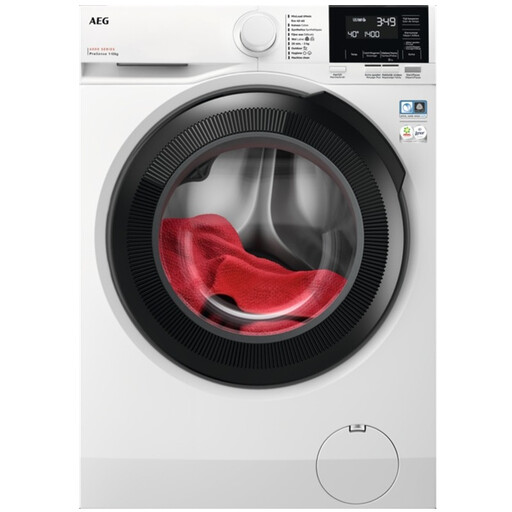
This selection at Joybuy features AEG front-loaders. Compare the stated width and depth with your laundry area, and choose a capacity that suits the load you usually wash.
 No image available
AEG LR63R144 6000 Series, 10 kg
A front-loader with a stated capacity of 10 kg; compare this with your usual wash load before choosing.
Dimensions: 847 × 597 × 660 mm. Energy rating A; 51 kWh per 100 eco 40-60 cycles. Stated spin speed: 1400 rpm.
The product information lists a ProSense load sensor; check that the dimensions and door clearance suit your space.
View at Joybuy
 No image available
AEG LR73R862 7000 Series, 8 kg
This front-loader has a stated capacity of 8 kg; decide whether that suits your usual load.
Dimensions: 847 × 596 × 602 mm. Energy rating A; 42 kWh per 100 eco 40-60 cycles. The MixLoad programme is listed as taking 69 minutes at 30 °C. Stated spin speed: 1600 rpm.
The product information lists PreciseWash as a feature that adjusts settings based on the load. Check that the depth and door clearance are suitable.
View at Joybuy
 No image available
AEG LR73S840 7000 Series, 8 kg
A front-loader with a stated capacity of 8 kg; compare this with your usual load of items that can be washed together.
Dimensions: 847 × 596 × 572 mm. Stated spin speed: 1400 rpm.
The product information lists PreciseWash as a feature that adjusts settings based on the load. Check the available depth and the space needed for the door.
View at Joybuy
 No image available
AEG LF61R840 6000 Series, 8 kg
This front-loader has a stated capacity of 8 kg; check whether that suits the loads you usually wash.
Dimensions: 847 × 596 × 577 mm. Energy rating A; 47 kWh per 100 eco 40-60 cycles. Stated spin speed: 1400 rpm.
The product information lists a ProSense feature that adjusts settings based on the load. Check the depth and the clearance needed for the door.
View at Joybuy
No image available
AEG LR73S862 7000 Series, 8 kg
A front-loader with a stated capacity of 8 kg; compare the capacity with your usual wash load.
Dimensions: 847 × 596 × 602 mm. Energy rating A; 42 kWh per 100 eco 40-60 cycles. The MixLoad programme is listed as taking 69 minutes at 30 °C. Stated spin speed: 1600 rpm.
The product information lists PreciseWash as a feature that adjusts settings based on the load’s weight. Check that the machine fits in your laundry area with enough room to open the door.
View at Joybuy
Frequently asked questions
Is eco 40-60 automatically the right programme for table napkins?
No. Choose a programme based on the care label, fabric and level of soiling. The EU uses eco 40-60 as the label basis for suitable cotton laundry; the label doesn’t describe the energy use or results of every other programme.
Should table napkins always be washed at 60 °C?
Not without taking the material into account. Check the care label and follow its instructions. The Netherlands Nutrition Centre recommends washing used washing-up and tea towels at 60 °C; this advice doesn’t automatically apply to every table napkin.
What should I measure before buying a washing machine for a small laundry area?
Measure the available width, height and depth, allowing for the hoses and the space needed for a door or top lid. Compare these measurements with the specifications and installation instructions for the exact model.
What should I check before connecting the washing machine?
Check the floor, water supply, drain and connections against the instructions for the exact model. Remove the transit bolts before using the machine and make sure it’s level. If you plan to put it in a bathroom, have the electrical installation assessed.
In the Netherlands, does my guarantee automatically end after two years?
No. According to the Dutch government, there’s no fixed statutory guarantee period in the Netherlands: you can expect a product to work properly for a reasonable length of time. Contact the retailer if there’s a problem; a manufacturer’s guarantee or extended guarantee may offer additional cover.


