Who is this advice for?

Housemates who wash separately

You wash your own T-shirts and want a drum that suits your usual load. Weigh it before choosing a capacity; Milieu Centraal and the Consumers’ Association recommend choosing a drum that is neither too large nor too small.

Housemates who combine their washing

You regularly wash suitable cotton clothes together. Choose the capacity based on those combined loads, not just the number of people in the house. Milieu Centraal and the Consumers’ Association stress that the drum should suit both your household and your laundry load.

People living close to the laundry area

You may hear the spin cycle in an adjoining room, so you’ll also want to consider the stated noise level, where the machine will go and any agreements about when to do the washing. The Consumers’ Association lists noise and installation as factors to compare when choosing a washing machine.

What should you look for?

A suitable capacity for separate washing

Choose this if: housemates usually wash separately or rarely have large combined loads. Weigh a typical load and choose a capacity you can make regular use of.

Bear in mind: a larger capacity is not automatically more efficient for small, separate washes.

More capacity for combined washing

Choose this if: you regularly combine suitable cotton washing and can fill the drum with a larger load.

Bear in mind: care labels, colours and the space the machine takes up all affect how practical it is to wash items together.

What to consider What should you check? Who should pay particular attention?
Drum size Weigh a typical separate or combined load and compare it with the stated capacity. Check the external dimensions too. If my main concern is making sure my usual cotton washing fits the drum properly, I weigh a typical load. Around 29% of consumers give a suitable capacity their highest priority.
Energy and water use Compare kWh per 100 Eco 40-60 cycles and litres per cycle on the same programme basis. These figures do not automatically apply to every programme. If I do laundry regularly in a shared house, I want to factor in consumption across recurring washes. Around 24% of consumers prioritise energy and water use.
Spin noise Compare the stated spin noise levels of the exact models and consider where the machine will go and when you might use it. Actual noise also depends on the home and how the machine is installed. If my room is close to the laundry area, I want to take the noise during the spin cycle into account. Around 18% of consumers consider peace and quiet at home their main buying concern.
Cotton programmes and scheduling Check that the programmes suit the care labels and level of soiling, and look at the maximum load for each programme. Don’t rely on the programme name alone. If I need to plan separate washes with different care labels, suitable programmes matter to me. Around 17% of consumers give programmes and scheduling top priority.
Installation and leak protection Measure the space and clearance, check the tap and drain, and find out what type of water protection the exact model has. If my installation space is tight or a leak could cause extra problems there, I want to assess the space and protection in advance. Around 12% of consumers prioritise these factors.

Common buying mistakes

  • Choosing capacity based on the number of housemates

    Sharing a house doesn’t necessarily mean that everyone combines their washing. For cotton laundry, the important thing is that the drum suits the load you actually wash.

    Weigh a representative separate or combined load and work out how often you wash together before choosing the capacity.

  • Assuming Eco 40-60 is a fixed washing temperature

    The programme name doesn’t guarantee that the washing is actually done at 40 or 60 °C. The Consumers’ Association describes it as a programme for normally soiled cotton whose care label allows washing at 40 or 60 °C.

    Follow the care label and choose a programme that suits the fabric and how soiled it is.

  • Assuming all types of water protection work in the same way

    Hose protection, overflow protection and a base sensor don’t all respond in the same way. The right protection depends in part on where the machine will go and the potential consequences of a leak.

    Check the protection on the exact model and compare it with your home’s needs.

Brands to consider

Bosch

The Bosch Serie 4 WAN2827DNL is a front-loader with a stated capacity of 8 kg, making it a useful comparison for anyone looking for a specific capacity.

  • Bosch lists a reload function and dimensions of 845 × 598 × 590 mm for this model.
  • AquaStop is listed as ‘No’ for the WAN2827DNL; check the features of the exact model.

LG

The LG F4X1008NWH is a front-loader with a stated capacity of 8 kg and optional ThinQ controls.

  • LG lists app and steam functions for this model.
  • Consider whether these features suit your shared laundry routine; their presence alone doesn’t tell you which machine is right for you.

Siemens

The Siemens iQ300 WM14N27DNL is a front-loader with a stated capacity of 8 kg, and its model-specific water protection may be worth considering.

  • Siemens lists aquaStop and dimensions of 845 × 598 × 590 mm for this model.
  • This information applies to the WM14N27DNL and not automatically to other Siemens models.

AEG

The AEG 7000 ProSteam LR73844 is an 8 kg option to compare if a steam refresh function would be useful alongside cotton programmes.

  • AEG gives figures of 28 kWh per 100 eco cycles and 42 litres per eco cycle for this model.
  • These are stated figures for the specified programme basis, not for every T-shirt wash. Check the full model number too.

Washing machines at Joybuy

These models offer different capacities and programmes to compare with your usual separate or combined cotton loads.
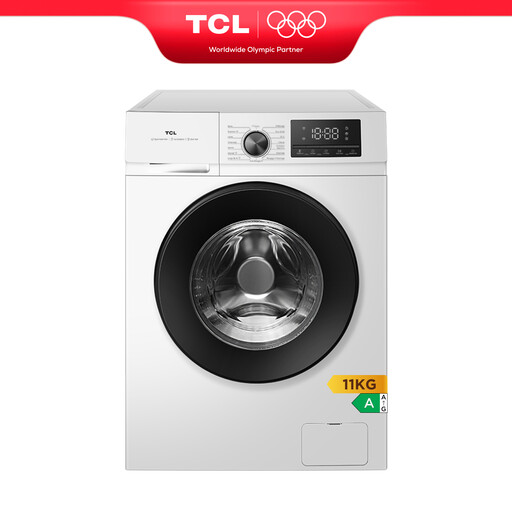
TCL FF2411WA2NL washing machine, 11 kg

TCL FF2411WA2NL, 11 kg

The stated capacity is an option to compare with the weight of a combined load.

The product name lists a BLDC inverter motor, Magic Flow, a 15-minute Quick Wash, an add-items-during-the-cycle function and an energy rating of A. Check that a short programme suits the laundry and how soiled it is.

View at Joybuy

Midea MF110W80BA10/W-NL washing machine, 8 kg

Midea MF110W80BA10/W-NL, 8 kg

The stated capacity can be compared with a typical separate or combined load.

The product description lists Cotton and Eco 40-60 programmes, 42 kWh per 100 cycles, 72 dB during the spin cycle and an AquaStop function. Check the programme description and the protection offered by the exact model.

View at Joybuy

Candy GD 48B9-S washing machine, 8 kg

Candy GD 48B9-S, 8 kg

The stated capacity gives you a starting point for comparison with your usual laundry load.

The description lists Cotton and Eco 40-60 programmes, 33 kWh per 100 Eco 40-60 cycles and 69 dB(A) during the spin cycle. The product name lists 1351 rpm, an energy rating of A and a steam function.

View at Joybuy
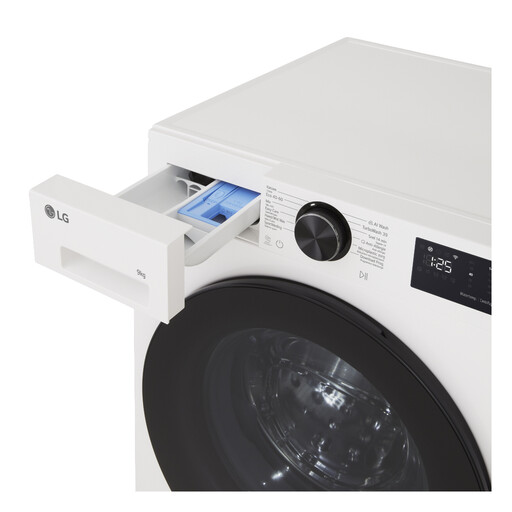
LG F4X5009TWB washing machine, 9 kg

LG F4X5009TWB, 9 kg

Before choosing a larger drum, compare the 9 kg capacity with the weight of your usual loads.

The product specifications list 29 kWh per 100 wash cycles and 71 dB. The description mentions AI Wash, TurboWash 360 and control via the ThinQ app; TurboWash 360 is listed with a programme duration of 39 minutes.

View at Joybuy

Beko BM3WFU38412CW washing machine, 8 kg

Beko BM3WFU38412CW, 8 kg

The stated capacity of 8 kg can be compared with a typical separate or combined load.

The description lists Cotton and Eco 40-60 programmes, 47 kWh per 100 cycles, 47 litres of water per cycle and 76 dB(A) during the spin cycle. The product name lists 1400 rpm and an energy rating of A. It also mentions a 14-minute Daily Xpress programme; check that it’s suitable for your laundry.

View at Joybuy

Frequently asked questions

Should housemates buy a larger drum because they live with more people?

Not necessarily. If everyone washes separately, weigh a typical individual load; if you combine your washing, weigh a representative combined load. Milieu Centraal and the Consumers’ Association recommend choosing a capacity that suits the laundry you can actually wash.

Can every cotton T-shirt go in an Eco 40-60 wash?

No. Use Eco 40-60 for normally soiled cotton if the care label allows washing at 40 or 60 °C. The programme name doesn’t guarantee that the wash will actually reach 40 or 60 °C; follow the label and choose a programme suited to how soiled the clothes are.

What should you check before installing a washing machine?

Measure the space and check that the tap, drain and power supply are suitable. Follow the installation instructions for the exact model, including guidance on transit bolts, and check in advance what delivery and installation include.

How can you keep a washing machine fresh when it’s shared?

Agree on who will measure out detergent and take care of maintenance. Milieu Centraal recommends, among other things, running a wash at 60 °C periodically to remove soap and dirt residue; also follow the maintenance instructions for your chosen model.

Do you need permission to install a connection in a rented home in the Netherlands?

It depends on the alteration. According to the Dutch government, you don’t need permission for minor changes that can be reversed without too much expense, but you do for a renovation or more substantial alteration. Check in advance what needs to be changed in the property and, if necessary, agree this with your landlord.
