
A family with stained uniforms
Wants to tackle stains after the school week, while paying attention to programmes, pre-treatment and care labels. The Consumentenbond also advises using the care label to choose the temperature and programme.


Start by checking the care labels and weighing a typical sorted load. Then choose a drum capacity and programmes that suit it. A quick programme or steam function isn’t automatically suitable for every full load or heavily soiled uniform wash. Compare energy information on a like-for-like basis, and check the dimensions, installation and service too.
Wants to tackle stains after the school week, while paying attention to programmes, pre-treatment and care labels. The Consumentenbond also advises using the care label to choose the temperature and programme.
Wants to match the drum capacity to the amount of uniforms and other clothing that can actually be washed together. Milieu Centraal recommends choosing a drum capacity that suits your household.
Has limited time before the next school day and compares the actual programme duration, permitted load and fabric care, rather than relying on the name of a quick programme alone.
First, weigh a typical load and sort it by colour and fabric type. Then compare the capacity, programmes and label information that match what you actually wash.
| Priority | What to look for when buying | Who is this important for? |
|---|---|---|
| Tackling stains | Check that the programme and temperature suit the fabric and care label; allow for pre-treatment. | If uniforms are often stained, I want a suitable way to wash them without assuming one programme will remove every stain. Around 26% of consumers in this buying context put stain removal first. |
| The right drum capacity | Weigh a typical sorted load and compare it with the load capacity; the maximum applies to cotton. | When the weekend laundry pile is full, I want to know how much washing can really go in the machine at once. Around 21% of consumers focus mainly on choosing the right capacity for their sorted washing. |
| Getting the washing done in time | Check both the duration and permitted load for the quick programme, and make sure it suits the fabric and level of soiling. | If the uniforms need to be clean before the next school day, I want to be able to estimate how long a suitable wash will take. Around 21% of consumers prioritise turnaround time. |
| Looking after fabrics | Check that the machine has programmes and settings to suit the different care labels. | When uniforms are made from different fabrics, I want to be able to care for them according to their individual washing instructions. Around 16% of consumers put fabric care first. |
| Comparing energy use | Compare the EU label on a like-for-like basis and match the drum capacity to the loads you usually wash. | For regular washes, I want to assess energy use on a comparable basis without assuming the label value applies to every programme. Around 16% of consumers focus mainly on energy use. |
The stated maximum load capacity applies to cotton. Uniforms may have different care instructions, so you can’t always wash the whole pile together.
Weigh a typical load after sorting it by colour and fabric type. Then compare the capacity with the load permitted for the relevant programmes.
Programme duration and permitted load vary from one programme to another. Stubborn stains may also need pre-treatment.
Check the manual for the exact model to see which fabrics and load sizes are suitable, and how long the programme takes.
Pre-treatment or a second suitable programme may take extra time.
EU label information for washing machines is based on eco 40-60 and doesn’t automatically show the energy use of quick wash or delicates programmes.
Compare label values on a like-for-like basis, and check separately which programmes are suitable for the uniforms.
Dimensions, the delivery route, installation and disposal of the old machine are separate practical considerations.
Measure the space and delivery route before buying, and check what delivery and installation include. Also check the terms for taking away your old appliance when you buy a new one; under Dutch rules, the retailer must take back a similar old appliance.
Installation may be offered separately, and terms vary by retailer.
The Dutch-market Serie 6 WGG244FSNL is a 9 kg front-loading washing machine with AquaStop. It may be worth considering if its capacity and dimensions suit your typical washing load and available space.
The Dutch-market LR8686UC4 from the 8000 PowerCare range has an 8 kg capacity and is worth comparing if you’re interested in a quick wash option.
The Dutch-market EcoBubble 5000 WW90CGC04AAEEN is a 9 kg model to include in your comparison, for example if you’re also looking into washing at lower temperatures.
According to Miele, the Dutch-market W1 WEG888 WCS PWash&TDos&Steam combines a 9 kg capacity with automatic dosing, a quick programme and a steam function.
This Joybuy selection includes 8 and 9 kg front-loading washing machines with listed options for quick programmes or different fabrics. Check the permitted load, programme duration and care instructions for each model.
 No image available
An option to compare if you’re looking for a 9 kg model for sorted washing and programmes for different fabrics.
The product name lists AI Ecobubble™, SuperSpeed, Wi-Fi, SmartThings and energy class A.
 No image available
This version may suit anyone comparing an 8 kg model with options for mixed fabrics.
The product name lists ProSteam, PreciseWash and energy class A-30%. The MixLoad 69 programme is described as being for mixed fabrics at 30 °C; check that this setting suits the care labels. ProSteam is a refresh programme, not a full wash.
 No image available
A 9 kg model to compare if you want to wash a larger sorted load and need programmes for different fabrics.
The product name lists energy class A and an NL/FR control panel.
 No image available
An option to compare if you’re looking for an 8 kg model with programmes for different fabrics.
The product name lists 16 wash programmes and energy class A-10%. The Quick 15’ programme is listed as being for lightly soiled everyday laundry; don’t assume that the same short cycle is suitable for more heavily soiled uniforms.
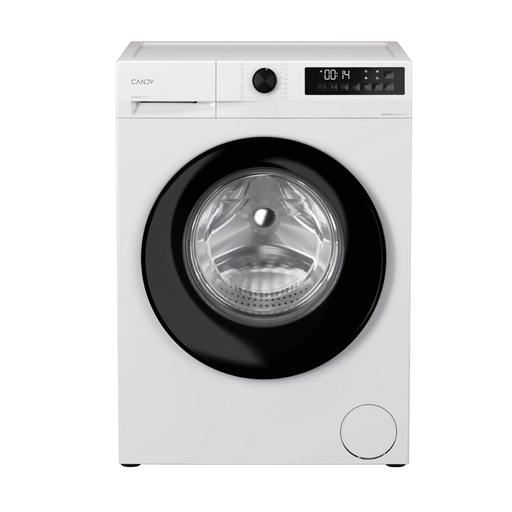 No image available
This 9 kg model is worth comparing if you want to weigh up different programmes for your usual sorted washing.
The product name lists energy class A and 16 wash programmes.
First, sort by colour and fabric type, then weigh what you’d normally wash together. The maximum load capacity applies to cotton; a smaller load may be more suitable for delicates or synthetics.
No. The European Commission describes eco 40-60 as being for normally soiled cotton that can be washed at 40 °C or 60 °C according to its care label. For other fabrics or care instructions, follow the garment’s care label and choose a suitable programme.
Measure both the space where the machine will go and the delivery route, consult the installation manual, and check in advance what delivery and installation include. Make sure the floor is stable, and weigh up water-protection features against the potential consequences of a leak where the machine will be installed.
Follow the machine’s maintenance instructions. Milieu Centraal recommends running a wash at 60 °C about once a month to help prevent residue and smells; this doesn’t mean you can wash the uniforms themselves at that temperature.
According to the Dutch government, you’re entitled to a product that works properly, but there’s no fixed statutory warranty period for all products in the Netherlands. If a product is faulty, contact the retailer. When you buy a new washing machine, the retailer must take back a similar old appliance free of charge under the old-for-new scheme, including for online purchases.