First, measure whether width, depth or the space needed to open the door or lid is the limiting factor. A top-loader may fit where a front-loader is too wide, while a slim-depth front-loader can save space front to back. For example, AEG Netherlands lists the AEG LTR6363A as 397 mm wide and 599 mm deep; Haier lists the HW70-BP14357TU1 as 595 mm wide and 468 mm deep. Then choose a capacity that suits your usual laundry loads, and follow the care labels on school uniforms. GINETEX explains the temperature and gentle-wash symbols on these labels.
Who is this choice relevant to?
Families with a narrow laundry area
First, work out whether width or depth is the limiting measurement. A top-loader and a slim-depth front-loader solve different space problems; also check that the lid or door can open fully. AEG Netherlands and Haier publish the external dimensions of specific models.
Families who wash school uniforms frequently
Match the capacity and programmes to your usual loads. Check the care label on each garment rather than assuming one programme is suitable for every uniform. GINETEX explains the symbols for temperature and gentle washing.
Families weighing up running costs
Compare the information on the energy label and consider it alongside your loads and programmes. Milieu Centraal recommends choosing a drum capacity that suits the laundry you usually wash; a larger capacity is not automatically more efficient for the way you use your machine.
What should you consider when choosing?
Narrow top-loader
Choose this option if: width is the main constraint and there is room above the machine to open the lid. AEG Netherlands lists the LTR6363A as 397 mm wide, with a capacity of 6 kg.
Bear in mind: according to AEG Netherlands, this model is 599 mm deep, so narrow does not necessarily mean slim-depth.
Slim-depth front-loader
Choose this option if: there is enough width for a front-loader, but depth is limited. Haier lists the HW70-BP14357TU1 as 468 mm deep; Beko lists the BM3WFU3741S as 49,6 cm deep.
Bear in mind: the listed widths of these models are 595 mm and 60 cm respectively. Also check the clearance needed for the door and connections.
Standard-size front-loader
Choose this option if: your laundry area has enough space and your usual loads justify a larger drum. Bosch lists the WAN2827DNL as having a capacity of 8 kg.
Bear in mind: the listed depth of this Bosch model is 590 mm. Milieu Centraal recommends matching drum capacity to your usual loads.
Measure the available space, then decide which practical consideration matters most for your household.
| What to consider |
What to look for when buying |
Who should pay particular attention? |
| Space and installation |
Compare the external dimensions with the available space and access route; also check the installation manual for the exact model’s door clearance and connection requirements. |
If space is tight, I want to know whether width or depth is the issue and whether I can open the machine easily every day. Around 31% of consumers prioritise whether an appliance will physically fit. |
| Garment care and washing routine |
Read the care labels and check which programme, temperature and cycle duration are suitable for each fabric and load. |
When school uniforms need to be clean in time, I want a suitable programme without assuming that a quick cycle is right for every garment. Around 25% of consumers prioritise care instructions and their day-to-day laundry routine. |
| Capacity |
Compare the stated capacity in kg with the loads you usually sort and wash, and check the manual for any programme restrictions. |
I want a drum that suits what we normally wash together, not just the occasional large load. Around 19% of consumers mainly choose a capacity that suits their regular laundry loads. |
| Energy use and running costs |
For the exact models, compare the energy label rating, kWh per 100 cycles and water consumption per cycle on the same label basis. |
If I’m weighing up running costs against the purchase price and size, I want to compare label information without assuming it applies to every programme I use at home. Around 13% of consumers prioritise this consideration. |
| Spin noise |
Compare the noise level for the same stage on the EU energy label, and follow the installation instructions for removing transit bolts and levelling the machine. |
With a laundry area close to the living space, I want to know how loud the spin cycle is according to the label and reduce vibrations by installing the machine correctly. Around 12% of consumers make spin noise their main consideration. |
Common buying mistakes
-
Assuming ‘narrow’ and ‘slim-depth’ mean the same thing
A top-loader may take up little width and still be deep. According to AEG Netherlands, the AEG LTR6363A is 397 mm wide and 599 mm deep; Haier lists the HW70-BP14357TU1 as 595 mm wide and 468 mm deep.
Measure the laundry area and access route, and check both the external dimensions and the clearance needed to open the door or lid.
-
Assuming a larger drum is automatically more efficient
Maximum capacity does not tell you how much laundry you usually wash at a time. Milieu Centraal recommends choosing a capacity that suits your usual loads.
Base your choice on the everyday loads you sort and wash, rather than just the highest number of kilograms.
-
Choosing based on the model name alone
The model name alone does not confirm all the features of the version you intend to buy.
Before buying, check that the model number matches the product information, energy label and version of the appliance being offered.
Brands to consider
AEG
The LTR6363A is a top-loader to consider when width is the limiting factor.
- AEG Netherlands lists this model as 397 mm wide, with a capacity of 6 kg.
- The listed depth is 599 mm; also allow enough clearance above the machine to open the lid.
Haier
The HW70-BP14357TU1 is a front-loader to consider when depth is the main constraint.
- Haier lists this model as 595 mm wide and 468 mm deep, with a capacity of 7 kg.
- It is still 595 mm wide, so check that it fits and that there is enough room for the door.
Beko
The BM3WFU3741S is a 7kg front-loader to include when comparing models with limited depth.
- Beko Netherlands lists this model as 49,6 cm deep, with programmes for delicate fabrics and shirts, among others.
- The listed width is 60 cm. Compare energy label information on the same basis rather than treating a programme claim as a general saving.
Bosch
The WAN2827DNL offers a point of comparison for a standard-size front-loader with a capacity of 8 kg.
- Bosch Netherlands lists dimensions of 845 × 598 × 590 mm (h × w × d) and an add-laundry function.
- With a listed depth of 590 mm, this model is not the right choice if your laundry area can only accommodate a noticeably slimmer appliance.
Washing machines at Joybuy
These front-loaders are for households looking for a suitable capacity and, depending on the model, a slimmer depth or programmes for different types of laundry.
 Image not available
AEG LF61R840, 6000 Series
A front-loader for households that also wash larger loads.
The product name lists a capacity of 8 kg, 1400 rpm and energy class A.
View at Joybuy
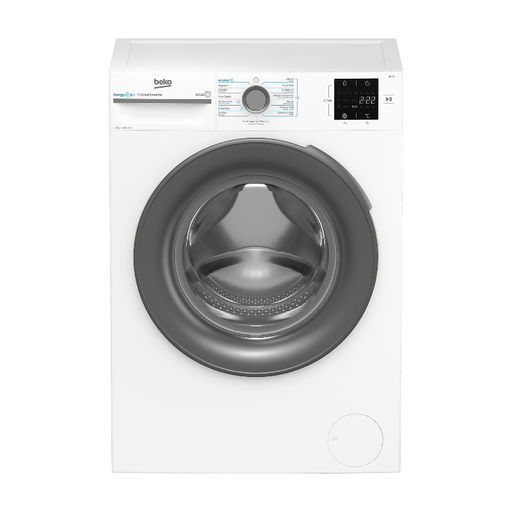 Image not available
Beko BM3WFU3741S
A front-loader with programmes for different types of laundry. Always check the care label on school uniforms.
The product name lists 7 kg, 1400 rpm and 15 wash programmes.
View at Joybuy
 Image not available
Coocaa Galaxy A3 Series F702A3AВC0
A front-loader for a smaller laundry area. Check the external dimensions and door clearance before installation.
The product name lists 7 kg, steam wash, 15 programmes and a 15-minute quick-wash programme.
View at Joybuy
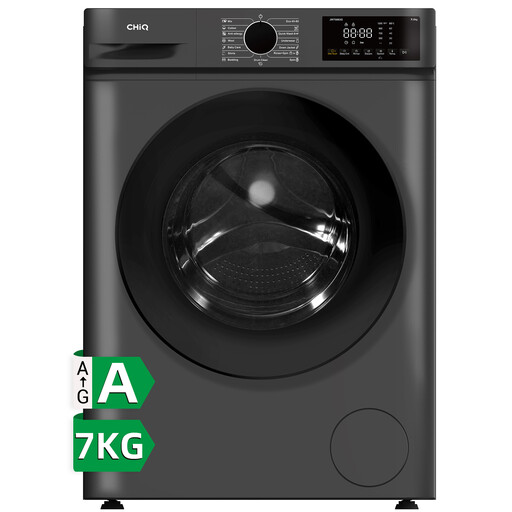 Image not available
CHiQ JW75883G
A front-loader with programmes for different types of wash. Let garment care labels guide you to the right setting.
The product name lists 7 kg, 1200 rpm and 16 programmes.
View at Joybuy
 Image not available
TCL FF1006WB0 Slim
A front-loader for anyone looking for a smaller capacity and a limited stated depth.
The product name lists 6 kg, a depth of 45 cm, energy class B and a 15-minute quick-wash programme.
View at Joybuy
Frequently asked questions
Can all school uniforms be washed on the same quick programme?
No, check the care labels first. According to GINETEX, the number in the wash symbol indicates the maximum washing temperature; one or two bars mean a gentler wash is required. Then check the manual to see which fabrics and loads are suitable for the machine programme.
How can I tell if a washing machine will fit in my small laundry area?
Compare the external dimensions of the exact model with the available space, and measure the access route too. Also check that the door or top lid can open freely and that there is room for connections.
Does energy class A mean every school-uniform wash is equally efficient?
No. The European Commission states that the EU energy label shows, among other things, energy use per 100 cycles and water use per cycle, measured on the prescribed label basis. Your chosen programme and load may differ, so compare information for exact models on the same basis.
What can I do if the washing machine vibrates during the spin cycle?
Follow the installation instructions for the exact model. AEG Support lists transit bolts that have not been removed and a machine that is unstable or not level as possible causes of vibration and movement.
Is a larger drum always the most practical choice for a family?
Not necessarily: choose a capacity that suits the loads you usually wash. Milieu Centraal advises against buying an oversized washing machine; the maximum capacity does not tell you how much you normally wash at a time.


