What should you look for when buying?
Start by weighing a typical dry weekly load and comparing it with the drum capacity. Then check the permitted load for each programme and whether it is suitable for the fabrics listed on the care labels.
| What to consider |
What should you check? |
Who is this important for? |
| Capacity for the weekly wash |
Weigh a typical dry load and compare it with the stated drum capacity; also check the limits for other programmes. |
If you want to wash your usual weekly laundry in suitable loads, focus on what you actually put in the drum. Around 33% of consumers rank suitable weekly capacity as their top priority. |
| Uniforms in different fabrics |
Read the care labels and check that the mixed or synthetics programme you choose suits the fabrics and the amount of laundry. |
If your uniforms have different care instructions, first find out which items can be washed together. Around 27% of consumers put fabric suitability and effective cleaning first. |
| Quick programme |
Check the maximum load, permitted fabrics and conditions for the specific programme. For example, Bosch lists a maximum load of 3.5 kg for SuperKort 30' on the WUU28T20NL. |
If you only need to wash a few suitable uniform items between regular washes, check whether the quick programme can handle that load. Around 20% of consumers prioritise speed for an extra wash like this. |
| Energy use and installation |
Compare energy labels on a like-for-like basis, measure the installation space and delivery route, and ask which installation tasks are included. |
If you want to take energy use and practical installation into account, check both the label and the space available. Around 20% of consumers put running and installation costs first. |
Consumentenbond notes that a mixed programme can usually handle around half the stated capacity in kilograms. The 3.5 kg limit quoted for SuperKort 30' is a Bosch specification for the WUU28T20NL, not a general limit for quick programmes. The energy label compares standardised data for eco 40-60; that figure does not automatically reflect the energy use of a mixed or quick programme.
Washing machines at Joybuy
These Joybuy products are suited to a regular weekly wash, with smaller or mixed loads in between. Before choosing, check the load limits and conditions for the programmes you plan to use.
 No image available
Samsung WW90DG6U25LE, 6000 Series
Suited to anyone who wants to combine a larger weekly load with separate quick programmes; check the maximum load for each programme.
9 kg capacity; 1400 rpm; Quick 15 min; SuperSpeed for 5 kg; energy class A.
View at Joybuy
 No image available
Bosch WGB2440BFG Serie 8
Worth considering if you run small or mixed loads as well as your weekly wash; check the load limit for each individual programme.
9 kg capacity; 1400 rpm; A energy label; NL/FR control panel; Mini Load and Mix/Speed programmes.
View at Joybuy
 No image available
Midea MF110W80BA10/W-NL
Could suit anyone looking for an 8kg machine with a separate mixed laundry programme; check which fabrics and load sizes are allowed.
8 kg capacity; 1400 rpm; 16 wash programmes; Mixed Load; 15-minute Quick Wash.
View at Joybuy
 No image available
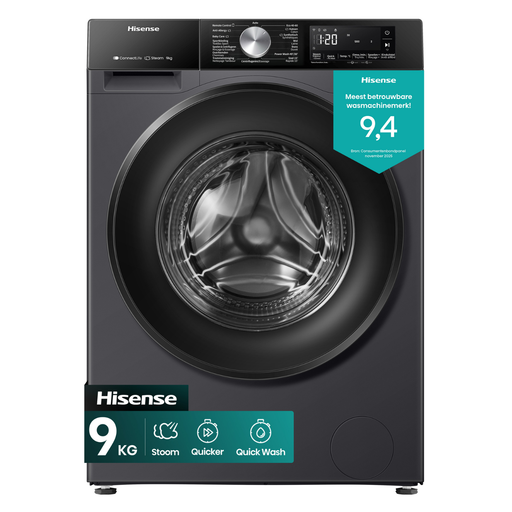
Hisense WF3S9043BB3
An option for anyone who wants to combine a larger weekly wash with a quick programme for a small load; check the conditions for Quick 15.
9 kg capacity; 1400 rpm; Quick 15 for small loads.
View at Joybuy
 No image available
Beko BM3WFU38412CW
Could suit mixed fabrics and smaller washes; according to the product information, the 14-minute Daily Xpress programme is designed for lightly soiled laundry.
8 kg capacity; 1400 rpm; Mixed Load; Synthetics; 14-minute Daily Xpress for lightly soiled laundry.
View at Joybuy
Frequently asked questions
Can you wash all your school uniform items together on the mixed programme?
Only if the care labels and colours allow it. Consumentenbond describes the mixed programme as suitable for compatible cotton, linen and synthetic fabrics; its maximum load is usually lower than that of the cotton programme. Check your machine’s manual for the exact limit.
Does eco 40-60 mean that the wash always reaches 60 °C?
No. Eco 40-60 is designed for normally soiled cotton laundry that can be washed at 40 or 60 °C according to its care label. Consumentenbond has measured a range of maximum temperatures in the machines it tested. Follow the care label, and choose a suitable programme for laundry that needs to be treated at 60 °C.
What should you check when installing and maintaining your machine?
Measure the installation space and delivery route, check the connection and follow the installation instructions, including removing the transit bolts before use. Consumentenbond recommends leaving the door open to dry after use, among other things; also clean the detergent drawer and door seal regularly.
Does a two-year manufacturer’s warranty mark the limit of your rights in the Netherlands?
No. ACM ConsuWijzer distinguishes between a manufacturer’s or seller’s warranty and your statutory guarantee rights. If a product does not do what you could reasonably expect during normal use, the seller is responsible for providing an appropriate solution. There is no single fixed statutory lifespan that automatically applies to every washing machine.
What energy label rules apply to a new washing machine?
Washing machines sold in the Netherlands must have an energy label. The European Commission uses an A to G scale for household washing machines and specifies the eco 40-60 cycle for this product group. Use the label details as a standardised comparison, not as a guarantee of how much energy your own mixed or quick wash will use.


