What should you look for when buying?
Start by considering how much washing you usually do in one load. Then compare the load limit for a quick wash between loads and the features that matter for the machine’s location.
| What to consider |
What should you look for? |
Who is this most important for? |
| Clean, fresh washing |
Compare programmes suitable for the fabrics in question and follow the care labels. Also check whether you can select an extra rinse if that’s relevant to your washing. |
If I wash different fabrics and potentially soiled school clothes together, I want to choose a programme that matches the care labels. Around 31% of consumers put clean, fresh washing first. |
| Suitable drum capacity |
Weigh a representative week’s washing and check the maximum load for the programmes you use most often. Milieu Centraal recommends matching drum capacity to the usual amount of washing. |
For a week’s accumulated washing, I want enough room without routinely choosing a larger drum than I need. Around 25% of consumers give suitable capacity for a weekly load their highest priority. |
| Quick wash between loads |
Check the duration and permitted load for the short programme on the exact model. The Consumentenbond stresses that this type of programme isn’t always designed for a full drum. |
If a school uniform or PE top is needed again soon, a short cycle is only useful if the load size and level of soiling are suitable. Around 19% of consumers put a quick wash between loads at the top of their list. |
| Electricity and water use |
Compare the figures on the EU energy label on a like-for-like basis. The label gives consumption for the standardised eco programme; this doesn’t automatically predict the consumption of every other cycle. |
With frequent washes, I want to take consumption into account without assuming that one figure on the label applies to every programme. Around 13% of consumers consider consumption their main priority. |
| Space and noise |
Measure the available space and check the external dimensions and clearance needed for connections. Compare the noise level and spin performance, not just the maximum spin speed. |
If the machine is in a confined space or runs near living areas, I want to know whether it will fit and suit the location. Around 12% of consumers give space or noise their highest priority. |
Washing machines at Joybuy
This selection includes freestanding washing machines with a stated capacity of 8 or 9 kg. Some models also list a short programme for smaller loads.
 No image available
Samsung WW90DG6U25LE, 9 kg
Could suit a larger week’s washing; the stated Super Speed load is 5 kg, which is less than the nominal capacity.
The product name lists a spin speed of 1400 rpm, AI Ecobubble, Super Speed, Wi-Fi with SmartThings and energy class A. Quick 15 is also listed; check the load limit for the programme you want.
View at Joybuy
 No image available
Midea MF110W80BA10/W-NL, 8 kg
Could suit a typical 8 kg week’s washing. Quick 15 is listed for a small, lightly soiled load between washes. Check the permitted load for this cycle.
The product name lists an 8 kg capacity, 1400 rpm, 16 programmes and Steam Sanitization.
View at Joybuy
 No image available
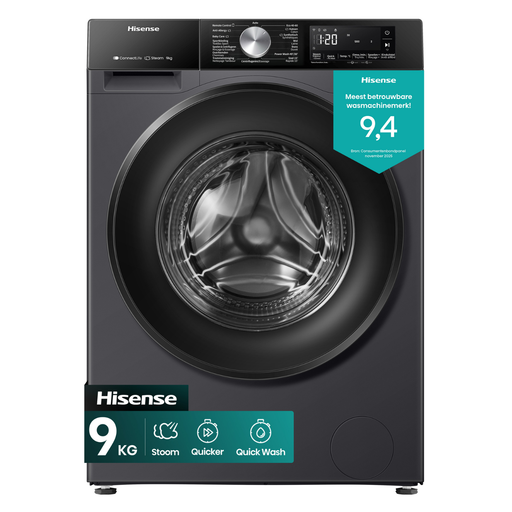
Hisense WF3S9043BB3, 9 kg
Could suit a larger week’s washing. Quick 15 is listed for small loads, not as a replacement for a full drum.
The product name lists a spin speed of 1400 rpm and energy class A. Steam Wash and Power Wash 49' are also listed; check that the programme’s load limit suits your washing.
View at Joybuy
 No image available
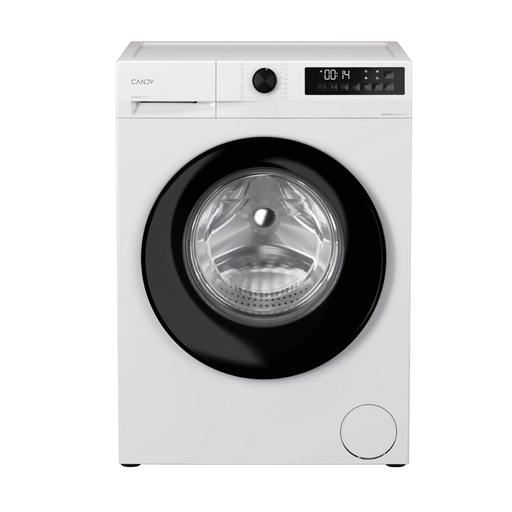
Candy GD 49B8-S, 9 kg
Could suit a larger week’s washing; the product information lists short cycles from 14 minutes. Check the load limit and duration of the programme you want to use.
The product name lists a spin speed of 1351 rpm, energy class A and 16 washing programmes.
View at Joybuy
 No image available
Candy GD 48B9-S, 8 kg
Could suit a typical 8 kg week’s washing. Short cycles from 14 minutes are listed; check the programme’s load limit for the clothes you need to wash.
The product name lists a spin speed of 1351 rpm, energy class A and a steam function. A spin noise level of 69 dB(A) is also listed for this model.
View at Joybuy
Frequently asked questions
Is a quick programme suitable for a whole pile of school clothes?
Not necessarily. Check the maximum load for the specific programme and choose one to suit the fabric and level of soiling. The Consumentenbond notes that special programmes often can’t handle a full drum.
How do you decide whether 8 or 9 kg is right for your week’s washing?
Weigh a representative week’s washing and compare it with the stated drum capacity and the load limits for the programmes you use. Milieu Centraal recommends choosing a drum capacity to match the amount of washing in your household.
Does a better energy label mean every programme washes more efficiently?
No. The EU energy label for household washing machines uses data from the eco programme and doesn’t automatically tell you how much every other cycle consumes. For Eco 40-60, the Consumentenbond also describes a trade-off between consumption, cleaning and rinsing compared with the cotton programme used for comparison.
What should you check before connecting your washing machine?
Check the location, make sure the floor is stable, and check the water supply, drainage and earthed socket. Remove the transit bolts in line with the manual for your chosen model, then check the connections for leaks. These are Bosch installation instructions; for other models, consult the relevant manual.
Are you always entitled to only two years’ statutory warranty in the Netherlands?
No. According to the Dutch government, the Netherlands has no fixed statutory warranty period: a product should last for a period that’s reasonable for that product and the circumstances. If a product is faulty, contact the retailer.


