
Anyone with a narrow laundry space
Measure the width, the space in front of a front-loader and the clearance above a top-loader. The Consumentenbond also points out that a top-loader won’t fit under a worktop.


Choose a top-loader if width or the space in front of the machine is your main constraint and there’s room to open the lid fully. Choose a shallow front-loader if depth is the issue. Match the load capacity to your usual full wash load, and measure the space needed for the door, lid and hoses too. A washer-dryer is worth considering if you want to dry clothes by machine but don’t have room for two appliances. Milieu Centraal says that washing and drying separately uses less energy overall when you do have space for both.
Measure the width, the space in front of a front-loader and the clearance above a top-loader. The Consumentenbond also points out that a top-loader won’t fit under a worktop.
If a front-loader fits width-wise but the space is shallow, measure the clearance for the hoses and an open door too. The Consumentenbond highlights this clearance alongside the appliance dimensions.
If you wash pillowcases with other suitable items, you can match the load capacity to your usual full load. Milieu Centraal recommends choosing a drum capacity that suits your household.
Choose this option: if width or the space in front of the machine is limited, and the top lid can open freely.
Bear in mind: you’ll need clear space above it; according to the Consumentenbond, a top-loader won’t fit under a worktop.
Choose this option: if there’s enough width for a front-loader but depth is limited.
Bear in mind: a compact appliance won’t solve the problem if the alcove is too narrow; you’ll still need room for the door and connections.
Choose this option: if you also want to dry clothes by machine and don’t have room for a separate washing machine and tumble dryer.
Bear in mind: if two separate appliances will fit, Milieu Centraal says they use less energy overall than a washer-dryer.
The percentages show which purchase consideration matters most to consumers when making this choice.
| Purchase consideration | What should you check? | Which consumers is it relevant for? |
|---|---|---|
| Will the machine fit in the space? | Measure the alcove and check the appliance dimensions, how far the door or lid opens, and the space needed for connections. | If the alcove is tight, I want to know whether the machine will fit with the hoses connected and the lid open; around 36% of consumers rank the available installation space as their top purchase priority. |
| Is the load capacity right for your washing? | Estimate your usual full wash load and check the maximum load for the programmes you use. | If you mainly do small loads, you’ll want the capacity to suit your full load; around 29% of consumers give the right load capacity top priority. |
| Is there a programme suitable for your pillowcases? | Check the care label and consult the manual for the available programmes and temperatures. | If the fabric or a particular hygiene requirement determines your choice of programme, you’ll want to know what the care label and machine allow; around 21% of consumers prioritise the programme and temperature. |
| Do you need drying in the same appliance? | Compare consumption on a like-for-like programme basis and check the washing and drying capacities. | If space is limited and you want to dry clothes by machine, you’ll need to weigh this against energy use; around 14% of consumers prioritise drying in one appliance or energy consumption. |
A top-loader can save space mainly in terms of width and the space in front of the machine. A shallow front-loader is designed for spaces where depth is limited. These dimensions solve different problems.
Measure the available width, height and depth, and check the space needed for the door, lid and connections too.
A machine that doesn’t fit may need a different location or an adapted installation.
The programme name doesn’t guarantee that it actually washes at 60 °C. The Consumentenbond reports that the measured temperature can vary between machines.
Check the care label and consult the manual to see whether there’s a suitable separate programme and the temperature you need.
A washer-dryer can take the place of two appliances, but Milieu Centraal says separate appliances use less energy overall when there’s room for both.
Compare the stated energy use on a like-for-like programme basis, and decide first whether you want to dry your pillowcases by machine.
For anyone short on width: AEG Netherlands lists the LTR6363A top-loader as 397 mm wide, with a capacity of 6 kg.
For a shallow space with enough width: Candy Home lists the CO4474TWM6/1-S front-loader as 600 mm wide and 454 mm deep, with a load capacity of 7 kg.
Another shallow front-loader to consider: Beko Netherlands lists the BM3WFU3741W as 60 cm wide and 49,6 cm deep, with a load capacity of 7 kg.
These product picks range from foldable mini washing machines for small loads to front-loaders for larger loads or spaces with limited depth. Check that each model’s stated capacity and dimensions suit your pillowcases and the space you have available.
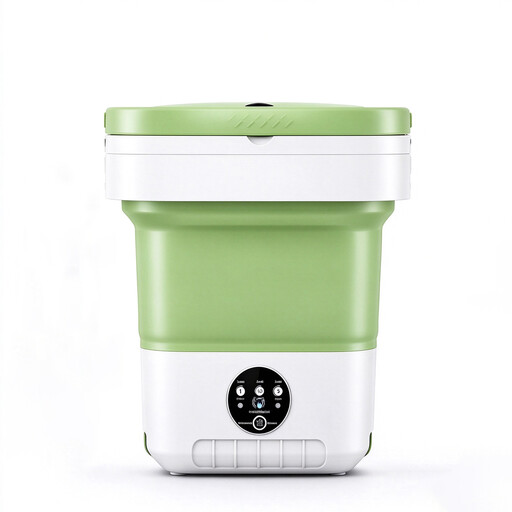 Image unavailable
For small, separate loads when storage space is limited. Check that your pillowcases can be washed in this type of machine according to their care instructions.
12-litre capacity and a maximum load of 1,5 kg. The product name mentions a spin-drying basket.
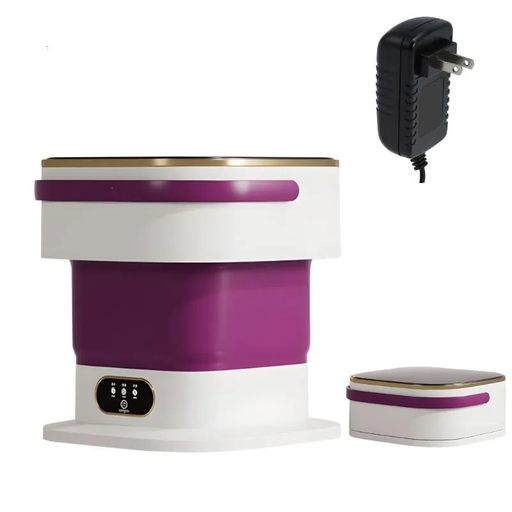 Image unavailable
For small, separate loads when you want to put the machine away after use. Check that your pillowcases are suitable for this type of machine.
15-litre capacity and a maximum load of 1,9 kg. The product name mentions a spin-drying basket.
 Image unavailable
For spaces where depth is the main constraint, with a higher stated load capacity than the mini washing machines.
Stated design depth: 400 mm. Load capacity: 7 kg; 16 wash programmes and a 15-minute quick wash programme.
 Image unavailable
For anyone looking for an 8 kg load capacity with enough depth in the available space. Allow room for the door and connections too.
Stated depth: 57,2 cm. Product information lists 1400 rpm, PreciseWash with load adjustment and a Hygiene Steam function.
 Image unavailable
For anyone looking for an 8 kg load capacity and considering a separate programme for a particular laundry need. Check the fabric care label.
Stated depth: 57,7 cm. Product information lists 1400 rpm, ProSense load detection and Anti Allergy Vapour at 60 °C.
No, not as a rule. Milieu Centraal says a lower temperature is suitable for normally soiled laundry, but notes that 60 °C may be advisable in situations such as an infectious illness or a dust mite allergy. Check the care label first; according to the Consumentenbond, the name Eco 40-60 doesn’t guarantee that the programme actually washes at 60 °C.
As well as the appliance dimensions, measure the space needed for the hoses and to open the door or lid. Make sure the machine is stable and level, and follow the installation instructions for your chosen model. Before buying, check what delivery and installation include.
No. A washer-dryer can save the space taken up by a second appliance, but Milieu Centraal says washing and drying separately uses less energy overall when there’s room for both appliances. If you’re considering a washer-dryer, compare its energy use and capacity for both washing and combined washing and drying.
For purchases in the Netherlands, washing machines must have an energy label with information including energy and water consumption, according to the Dutch government. ACM ConsuWijzer explains that your statutory guarantee applies in addition to any manufacturer’s guarantee, and that the seller is responsible for providing an appropriate remedy at no cost if a product is faulty. There is no single fixed guarantee period for every washing machine. The Dutch government also says that when you buy a similar new appliance, a shop must take your old appliance free of charge, including for online purchases under the stated conditions.