What should you look for when buying?
Start with the care labels on your period products and the programmes that suit them. Then compare the drum capacity with your usual loads. Only consider a washer-dryer if the space available or your need for machine drying makes one relevant.
| Buying concern |
What should you check? |
Who should pay particular attention? |
| Care instructions for absorbent layers |
Check whether the machine offers the required temperature and programme setting; follow the care label on each product. |
If I want to wash period underwear or reusable sanitary pads with other laundry, the programme I choose must suit the products’ care labels. Around 36% of consumers put fabric care first when choosing what to buy. |
| Drum capacity for mixed loads |
Compare the stated drum capacity with your usual weekly laundry and check the machine’s external dimensions too. |
I want a drum that suits my everyday laundry, not just an unusually large load. Around 29% of consumers are primarily looking for a suitable drum capacity. |
| Energy and water consumption |
Compare kWh per 100 cycles and water per cycle on the EU energy label. These figures are based on the standardised label test for the eco 40-60 programme. |
If I do laundry regularly, I want to compare the stated energy and water consumption without assuming that these figures predict usage on every programme. Around 21% of consumers put running costs first when choosing what to buy. |
| Space and appliance type |
Measure the available space and compare it with the external dimensions of the exact model. Also consider whether you need machine drying. |
If space is limited, I want to know whether a washer-dryer would fit the available space better. Milieu Centraal recommends separate appliances if there’s room, because of their energy consumption. Around 14% of consumers put installation and placement first when choosing what to buy. |
Joybuy washing machines for mixed weekly loads
These AEG front-loaders are designed for everyday and mixed weekly loads. Check the settings for each model against the care labels on the period products you use.
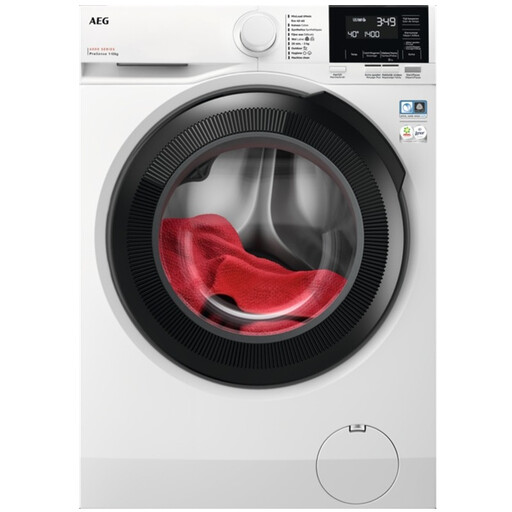 No image available
AEG LR63R144, 6000 series
The 10 kg capacity and stated ProSense load detection are worth considering if you have varying loads and will make use of this drum size.
10 kg; 1400 rpm; A energy rating. The product information mentions ProSense load detection.
View at Joybuy
 No image available
AEG LR73R862, 7000 series
The product information lists a MixLoad programme for mixed laundry; check that its settings suit the care labels on your fabrics.
8 kg; 1600 rpm; A energy rating. MixLoad is listed as a 69-minute programme at 30 °C; PreciseWash adjusts settings according to the load weight.
View at Joybuy
 No image available
AEG LR73S840, 7000 series
The stated ProSense load detection and programmes for different fabrics are useful if you wash a variety of loads.
8 kg; 1400 rpm. The product information lists 16 programmes, including ones for wool and duvets.
View at Joybuy
 No image available
AEG LF61R840, 6000 series
The product information mentions load adjustment and programmes for wool and silk; always check the specific care instructions for your period products.
8 kg; 1400 rpm; A energy rating. The description mentions ProSense load detection.
View at Joybuy
No image available
AEG LR73S862, 7000 series
The product information lists MixLoad for mixed laundry and PreciseWash, which adjusts settings to the load weight.
8 kg; 1600 rpm. MixLoad is listed as a programme at 30 °C.
View at Joybuy
Frequently asked questions
Can I wash period underwear with my regular laundry?
Yes, if the care instructions suit the same load and programme. Libresse recommends rinsing its underwear in cold water first, then washing it at 40 °C with other laundry. AllMatters recommends a maximum of 30 °C and a delicate programme for its products. Follow the care label on the product you own.
Does a washing machine need a steam or hygiene programme for this?
No. Libresse and AllMatters don’t list such a programme as a general requirement in their care instructions. Check whether a standard or delicate programme suits the fabric care label; an extra feature doesn’t automatically make a higher temperature suitable.
Is an energy label compulsory, and what do the consumption figures mean?
An energy label is compulsory for washing machines in the Netherlands. The European Commission explains the A to G scale and lists figures including energy consumption per 100 cycles and water consumption per cycle. These are based on the standardised label test and don’t necessarily reflect the consumption of a delicate programme.
Can my old washing machine be taken away when I buy a new one online?
According to the Dutch government, the free take-back scheme for old appliances also applies to online purchases when a private customer buys a similar new appliance. If the old appliance can’t be collected at delivery, the government outlines alternative ways to have it taken away free of charge.
Do I still have rights in the Netherlands after the manufacturer’s warranty expires?
Yes. According to the Dutch government, the seller must offer a solution if a product doesn’t meet what you could reasonably expect from it. There is no fixed two-year statutory warranty period in the Netherlands; the product’s circumstances and the fault are taken into account.


