
If you wash muddy sports kit
You regularly wash visibly muddy clothes alongside your usual laundry and want to know what the machine can handle, and what you need to remove beforehand. Persil recommends letting mud dry first.


Choose a washing machine with programmes to suit both your sports kit and your usual weekly wash, and check the load limit for each programme. Let mud dry first and brush off loose dirt; a quick or stain-removal programme is no substitute for pre-treatment. A higher capacity does not automatically apply to mixed or synthetic loads.
You regularly wash visibly muddy clothes alongside your usual laundry and want to know what the machine can handle, and what you need to remove beforehand. Persil recommends letting mud dry first.
You alternate between cotton, mixed loads and smaller synthetic loads. The Consumentenbond points out that the stated capacity applies to cotton, so the capacity of the programmes you usually use matters too.
You mainly wash synthetic or technical clothing and want to choose a suitable programme without ignoring the care labels. Siemens emphasises that the right care depends on the material.
First check that the programmes suit the fabrics and types of dirt you wash; then compare capacity, energy use and installation requirements.
| What to consider | What should you check? | Who should pay particular attention? |
|---|---|---|
| Mud and stains | Check that the programme suits the fabric and care label. Brush off dried mud beforehand, as Persil recommends. | If I wash muddy kit, I want to know how to deal with loose dirt without treating the fabric incorrectly. Around 28% of consumers prioritise mud removal. |
| Varying load sizes | Compare your usual loads with the limits for the cotton, mixed and synthetic programmes. According to the Consumentenbond, the stated capacity applies to cotton. | With varied weekly loads, I want enough room for a full wash, but I also want to know what smaller programmes can handle. Around 22% of consumers prioritise having the right capacity. |
| Sports fabrics | Check the recommended settings on the care label and see whether the temperature and spin speed can be adjusted. Siemens points out that care depends on the material. | If I wash technical sportswear, I want to be able to tailor the settings to the fabric. Around 22% of consumers prioritise the care of sports fabrics. |
| Energy use | Compare the EU energy label, including energy use per 100 cycles, on a like-for-like basis. The European Commission describes the labelled cycle; other programmes may use different amounts. | For a regular weekly wash, I want to consider energy use alongside the programmes I actually use. Around 17% of consumers make energy use their main buying consideration. |
| Installation and service | Measure the available space and check the dimensions of the exact model. Also check the terms for installation and removal of your old appliance in advance. | If I’m having a machine installed, I want to know that it will fit and how the practical arrangements work. Around 11% of consumers prioritise installation and service. |
A quick programme is not necessarily suitable for heavily soiled clothes. Loose soil needs a different approach from a lightly soiled load.
Brush off dried mud, follow the care label and check what the programme on the exact model is designed for.
Pre-treatment or an extra wash may take more time.
The stated capacity applies to cotton. The permitted load for mixed or synthetic laundry may be lower.
Before buying, check the load limits for the programmes you use most often.
The energy label provides a standardised basis for comparison; it does not automatically show the energy use of every programme.
Compare labels on the same basis and take into account the programmes and loads you use at home.
Energy use may differ if you choose a programme other than the labelled cycle.
An extended warranty is different from your statutory rights if a product is not as it should be. Conditions also apply to free take-back of an old appliance.
Check what an additional service covers and, if something goes wrong, ask the retailer about your statutory rights. The Dutch government explains the rules in the Netherlands.
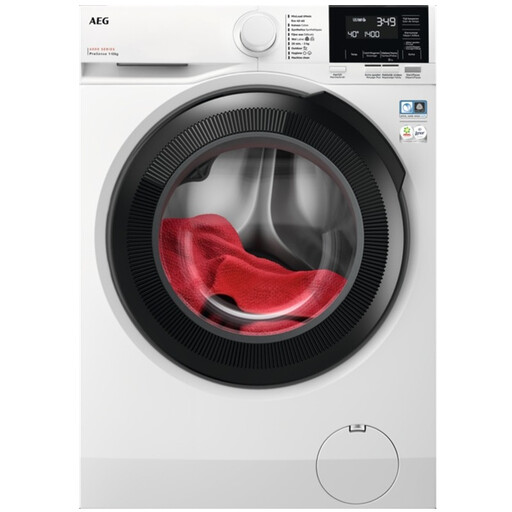
According to AEG, the LR86CB86 is a front-loading machine with an 8 kg capacity from the 8000 PowerCare range.
According to Bosch, the Serie 6 WGG244FSNL has a stated capacity of 9 kg and a maximum spin speed of 1400 rpm.
According to LG, the F4X5009TWB is a front-loading machine with a 9 kg capacity, featuring TurboWash360˚ and Microplastic Care.
According to Siemens, the iQ300 WM14N07CNL has an 8 kg capacity and speedPack L.
This selection focuses on washing machines for varied weekly loads, with capacity and programmes for different fabrics in mind.
 No image available
The listed cotton and synthetic programmes are suited to varied types of weekly laundry.
The product details list a pre-wash programme and a synthetic programme. The stated capacity of 9 kg does not automatically apply to mixed or synthetic loads.
 No image available
The higher stated capacity may suit larger regular weekly loads.
The product details list an A energy rating, ProSense and TimeSave Plus. The 10 kg capacity does not automatically apply to mixed or synthetic programmes.
 No image available
The listed MixLoad feature makes this model worth comparing for mixed weekly loads.
The product details list an A energy rating and ProSense. The stated capacity of 8 kg does not automatically apply to mixed or synthetic programmes.
 No image available
The listed Auto Care feature and care cycles are worth considering if you alternate between different types of laundry.
The product details list an 8 kg capacity and 1400 rpm. The permitted load may vary from programme to programme.
 No image available
The product details list ProSense for varying loads and a steam programme.
According to the product details, the machine has an A energy rating. The stated capacity of 8 kg does not automatically apply to mixed or synthetic programmes.
First brush off any dried mud, then choose a programme that suits the care label. Persil recommends letting mud dry first; cotton and synthetic sportswear do not necessarily need the same treatment.
No, the stated capacity applies to cotton. The Consumentenbond recommends checking the load limit for your chosen programme, as mixed and synthetic laundry may have a different limit.
The EU energy label gives energy-use information on a standardised basis, including energy use per 100 cycles. It does not specify how much energy your sports programme will use; the European Commission explains the basis used to compare labels.
No. According to the Dutch government, there is no fixed statutory warranty period in the Netherlands. You are entitled to a product that meets expectations for as long as can reasonably be expected; if something is wrong, contact the retailer.
When you buy a new, similar appliance for private use, the Dutch take-back scheme applies. According to the Dutch government, the retailer must take back the old appliance free of charge; online purchases are also covered if it is not possible to hand over the old appliance at the time of delivery.