What should you look for when choosing?
Start with the care label and the space available for installation. Then compare programmes, noise and capacity based on the loads you actually wash together.
| Consideration |
What should you check? |
Who is this important for? |
| Mud and programmes |
Check the care label and whether there’s a suitable cotton or synthetic programme, and possibly a prewash or stain option. Let mud dry and gently brush off loose dirt. |
I want to deal with muddy, machine-washable socks without relying on a single feature as a guarantee. Around 37% of consumers put tackling mud at the top of their list when buying. |
| Noise and installation |
Compare the dB(A) spin noise ratings using the same labelling basis, and check the dimensions, connections and that the surface is firm and level. |
If I share a laundry room, I want to be considerate of others when it comes to noise and vibration. Around 27% of consumers give reducing noise disturbance top priority. |
| Wool and merino |
Check the material and care label, and see whether there’s a suitable wool or delicates programme, along with appropriate temperature and spin settings. |
I want to wash delicate socks according to their own care instructions, even if they’re muddy. Around 18% of consumers prioritise looking after delicate fabrics. |
| Capacity and consumption |
Match the drum capacity to the loads you wash together. Compare the label figures for energy use per 100 Eco 40–60 cycles and water use per cycle on the same basis. |
I don’t want to choose a drum that’s much larger than the loads I usually wash with others. Around 18% of consumers put suitable load sizes and consumption at the top of their list. |
Washing machines at Joybuy
Below are Joybuy product options related to this topic, from a compact option for washing socks to freestanding washing machines. Check whether each model’s programmes, capacity and installation suit your socks and shared laundry room.
 No image available
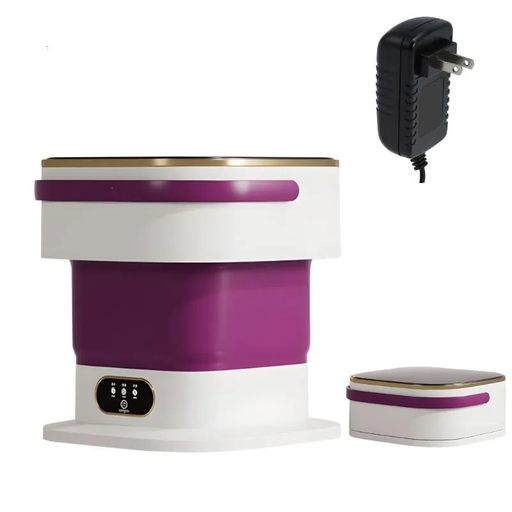
Foldable mini washing machine with spin-dryer basket
This compact model is designed for small loads. Check that its capacity is suitable for the socks you want to wash.
The product details list a 15-litre capacity and a maximum load of 1.9 kg. The title mentions 50 dB, but doesn’t say which part of the cycle this figure relates to.
View at Joybuy
 No image available
Midea MF110W80BA10/W-NL, 8 kg
This model is worth comparing if you have machine-washable cotton or synthetic socks and mixed loads.
The product details list cotton, synthetic and prewash programmes, an extra rinse, and a wool or delicates programme. They also mention 1400 rpm, 72 dB during spinning and load sensing.
View at Joybuy
 No image available
Candy GD 48B9-S, 8 kg
This freestanding model is worth comparing if you want to take an 8 kg capacity and the stated spin noise level into account.
The product details list 1351 rpm, spin noise of 69 dB(A) and energy use of 33 kWh per 100 Eco 40–60 cycles. The ProActive function is described as being for everyday stains, not specifically for mud.
View at Joybuy
 No image available
Beko BM3WFU38412CW, 8 kg
This model is worth comparing if you want to weigh up prewash or a wool or delicates programme for different types of socks.
The product details list a cotton prewash, StainExpert, wool or delicates and an extra rinse. They also list 1400 rpm and spin noise of 76 dB(A).
View at Joybuy
 No image available
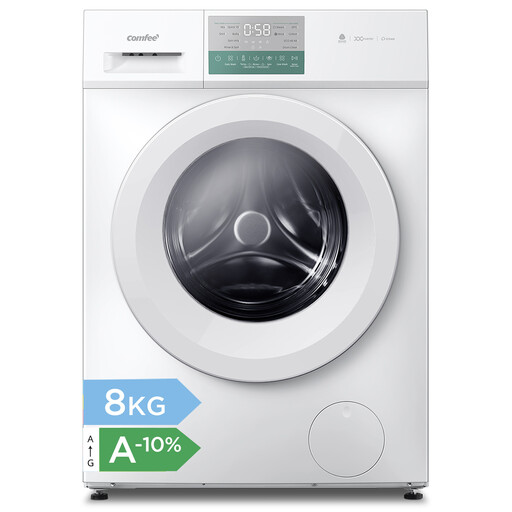
Comfee CFP03EW80W-HR, 8 kg
This model may be worth considering if your socks are machine-washable according to their care labels and you want to compare wool programmes.
The title and product details list an 8 kg capacity. The product details also mention a Woolmark wool programme and a function for adding laundry during a wash.
View at Joybuy
Frequently asked questions
Can I wash muddy socks on Eco 40–60 straight away?
Eco 40–60 is intended for normally soiled cotton that can be washed at 40 °C or 60 °C according to its care label. Let the mud dry first and gently brush off loose dirt. Then choose a programme that suits the socks’ material and care label.
How do I connect a washing machine in a shared laundry room?
Check that the machine can stand on a stable, level surface and that the connections are accessible. Follow the model’s instructions, remove the transit bolts before use and check the water connection for leaks. Agree access and usage times with the other users.
What can I do if the shared washing machine smells musty?
Don’t leave wet laundry in the drum unnecessarily, and follow the machine’s maintenance and detergent-dosing instructions. Milieu Centraal recommends running a 60 °C wash once a month to maintain the machine; this isn’t advice to wash merino socks at that temperature.
What do the energy label and statutory guarantee mean in the Netherlands?
The EU energy label lets you compare figures such as energy use per 100 cycles, water use per cycle and spin noise on the prescribed labelling basis. It doesn’t predict the consumption of every programme you choose. According to the Dutch government, statutory consumer protection applies to products that are fit for purpose, with no fixed statutory guarantee period. If a product is faulty, the retailer is your point of contact.
Does the retailer have to take away my old washing machine?
When you buy a new, similar appliance in the Netherlands, the free ‘old for new’ take-back scheme applies, including to online purchases, according to the Dutch government. Arrange the handover in advance. If the delivery service can’t take the old appliance away straight away, the Dutch government describes other free return options through the online retailer.


