What should you look for?
Narrow top-loader
Choose this option if: width is limited and there’s room above the machine to open the lid. AEG lists the LTR6363A as 397 mm wide, with a capacity of 6 kg.
Bear in mind: the machine can’t go under a worktop and needs clear space above it.
Shallow front-loader
Choose this option if: you have around 60 cm of width available but depth is limited. Candy lists the CO4474TWM6/1-S as 454 mm deep and 600 mm wide.
Bear in mind: cabinet depth alone doesn’t tell you how much room you’ll need for hoses and an open door.
Standard front-loader
Choose this option if: you have enough space and will also use the machine for other laundry. Bosch lists the WGE02404NL as 598 mm wide and 588 mm deep, with a capacity of 7 kg.
Bear in mind: this model needs more depth than the shallow Candy front-loader reviewed here.
| What to consider |
What should you check? |
Who should give this more weight? |
| Space and opening |
Measure the width, depth and height; also check the space needed for the door or lid and connections. |
If I have limited space, I want to be sure the machine will fit and can be opened. Around 34% of consumers prioritise the available installation space. |
| Wash programme for towels |
Check the manual for the exact model for a suitable 60 °C programme, and check the permitted load and the towels’ care labels. |
If several people use the same kitchen towels, I want to be able to follow a washing routine that suits them. Around 33% of consumers prioritise a suitable washing routine for shared towels. |
| Drum capacity |
Compare the capacity with your usual load; compare label values only when they’re based on the same programme. |
If I usually wash small loads, I want a drum that suits them rather than focusing only on the maximum capacity. Around 20% of consumers prioritise a suitable capacity for small loads. |
| Connections and use |
Check the water supply, drainage, earthed socket, stable positioning and space for the hoses. |
If the machine is going in a shared space, I want to know in advance whether the connections and maintenance can be managed easily. Around 13% of consumers prioritise practical shared use and connections. |
The energy label shows the consumption of the eco 40-60 programme; according to Energielabel.nl, its temperature does not exceed 40 °C. So don’t use the label information as a consumption figure for a separate 60 °C programme.
Products related to this topic
These Joybuy products are suited to limited installation space and small loads, from front-loaders to a foldable model. For each version, check the installation space required and whether the programme suits your towels’ care labels.
 No image available
AEG LR73S840 7000 Series, 8 kg
A front-loader to consider if depth is limited; check the full installation space required and the programme for your towels.
Listed depth: 57.2 cm. Capacity: 8 kg. The product name lists 1400 rpm.
Joybuy
 No image available
AEG LF61R840 6000 Series, 8 kg
A front-loader to compare if you’re looking for a model with limited depth; check the dimensions of the installation space and whether the programme is suitable for your towels.
Listed depth: 57.7 cm. Capacity: 8 kg. The product description mentions an Anti Allergy Vapour programme at 60 °C; consult the manual for programme details and the permitted load.
Joybuy
 No image available
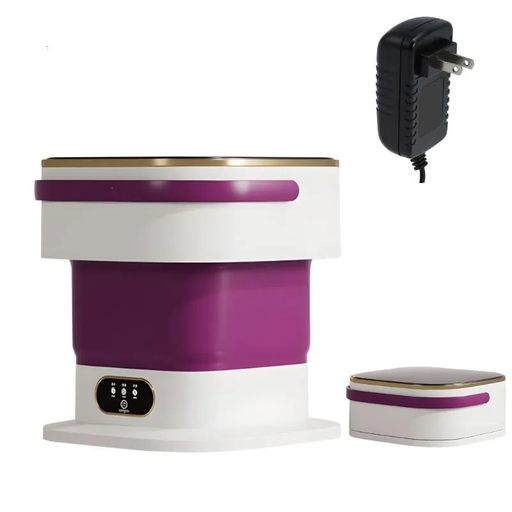
Foldable mini washing machine, purple
This model is designed for very small loads and easy storage; check that the appliance and its available programmes are suitable for your towels.
The product description lists a maximum load of 1.5 kg and a spin-drying basket.
Joybuy
 No image available
Comfee' CFP01EW70W-JD, 7 kg
A freestanding machine to consider if depth is limited; check the measurements of the space where you plan to put it.
Listed depth: 400 mm. Capacity: 7 kg. The product description mentions a Baby Care programme at 60 °C; check the manual for programme details and the permitted load.
Joybuy
 No image available
TCL FF1006WB0, 6 kg
A front-loader to compare if limited depth and a smaller capacity matter to you; also measure the space needed for the connections and door.
The product name lists a depth of 45 cm and energy class B. Capacity: 6 kg.
Joybuy
Frequently asked questions
Is ‘eco 40-60’ enough to prove that shared dishcloths are washed at 60 °C?
No. According to Energielabel.nl, the temperature of the eco 40-60 programme does not exceed 40 °C. If you want to follow the Netherlands Nutrition Centre’s advice, check for a separate 60 °C programme and the towels’ care labels.
What should you look out for when installing a machine in a small shared space?
Check that the floor is level, solid and stable, and that the water supply, drainage and an earthed socket are accessible. Also measure the space needed to open the door or lid. Follow the manual when removing the transit bolts and installing the machine.
How should you use and maintain a washing machine for kitchen towels?
The Netherlands Nutrition Centre recommends changing dishcloths daily, washing used towels at 60 °C and hanging damp towels up to dry. Milieu Centraal also suggests running a 60 °C wash once a month to help prevent residue and unpleasant smells in the machine.
Does Dutch law always provide exactly two years’ guarantee on a washing machine?
No. According to the Dutch government, there is no fixed statutory guarantee period in the Netherlands. You’re entitled to a product that works properly, and what you can reasonably expect depends on factors including the product itself. If a product is faulty, contact the seller.
Do domestic washing machines in the Netherlands need an energy label, and can you return an old machine?
The Dutch government lists washing machines among the appliances that must have an energy label. If a private customer buys a new, similar appliance, the shop must take back the old one free of charge under the old-for-new scheme; this also applies to online purchases.


