Start with the care label, the largest individual piece of bedding and the space available. A capacity in kilograms doesn’t prove that a duvet will fit in the drum. A top-loading machine can be a good option if width is the main constraint, while a shallower or larger front-loader may suit different space and loading needs. Remember to allow for the space and capacity needed to dry the bedding, too.
Who is this choice relevant to?
Households with a narrow space for a washing machine
You want to wash guest bedding at home, but the available width or room to open the door limits your options. A top-loader may fit if there’s enough clearance above it and the bedding fits in the drum.
Households washing large guest loads
You change the bedding on several beds or want to wash a washable duvet, too. Before choosing a larger capacity, compare the size of individual items with the load limit for the programme you plan to use.
Guest accommodation with little drying space
You have limited space for spare bedding or for drying laundry after guests leave. So look beyond washing: consider the drying capacity and whether there’s room for a clothes airer or a second appliance.
What should you consider when choosing?
Narrow top-loader
Choose this when: width is the main constraint, the space above the machine can be kept clear and your largest items fit in the drum.
Trade-off: the lid needs room to open above the machine, and a top-loader can’t go under a worktop. The Consumentenbond gives an approximate width of 40 cm for top-loaders, compared with around 60 cm for standard front-loaders.
Shallower front-loader
Choose this when: a front-loader fits the available width, but depth is limited.
Trade-off: the machine’s cabinet depth isn’t all the space you’ll need; allow for hoses and the door, too. Haier lists dimensions of 595 × 468 × 850 mm (width × depth × height) for the HW80-BP14357TU1.
Larger front-loader
Choose this when: you want to change the bedding on several guest beds at once and have room for the machine and its open door.
Trade-off: a higher capacity doesn’t guarantee that a duvet will fit, and may not be the best choice for small, occasional loads. Haier lists a capacity of 9 kg and a cabinet depth of 501 mm for the HW90-BP14357TU1.
Washer-dryer
Choose this when: there’s no room for a separate tumble dryer either, and you’ve checked the washing and drying capacities separately.
Trade-off: drying capacity may be lower than washing capacity. Miele lists a washing capacity of 9 kg and a drying capacity of 6 kg for the WTW870WPM. Milieu Centraal recommends a separate washing machine and tumble dryer if you have room for both; according to the organisation, together they use less energy than a washer-dryer.
| Consideration |
What to look for |
Which consumers? |
| Positioning |
Measure the space for the machine and check room for connections, the door to open or the lid to lift. |
If the space is tight, I don’t just want to measure the machine; I also want to make sure the door or lid can open freely. This is a priority for around 36% of consumers looking for a machine that fits their space. |
| Large items |
Check the care label, space in the drum and the load limit for the programme. |
I want to know whether my largest piece of bedding is suitable for the machine according to its care label and manual. Around 29% of consumers prioritise suitability for large items. |
| Drying after use |
Compare the drying instructions, available drying space and both capacities of a washer-dryer. |
After guests leave, I want to be able to dry the bedding without needing lots of room for spares or a second appliance. This is the priority for around 21% of consumers. |
| Energy use with varying loads |
Compare the eco 40–60 label and check the model information for other programmes you use. |
With varying load sizes, I want to know how much energy typical loads and programmes use, not just the label rating. Energy use in everyday operation is the priority for around 14% of consumers. Energielabel.nl explains that the washing machine label is based on eco 40–60. |
Common buying mistakes
-
Looking only at the kilogram capacity when washing a duvet
Capacity alone doesn’t tell you whether a duvet will fit in the drum or fall within the programme’s load limit. Bosch Nederland also points out that some materials, including wool and silk, are best not machine-washed.
Check the care label and space in the drum, then consult the manual for the load limit of the programme you want to use.
-
Choosing a top-loader when you need to use the space above it
The lid needs to lift fully. According to the Consumentenbond, you can’t use the top of a top-loader for storage or fit it under a worktop.
Choose this style only if you can keep the space above the machine clear.
-
Confusing washing and drying capacities
According to Miele, the WTW870WPM has a washing capacity of 9 kg and a drying capacity of 6 kg. So you can’t necessarily dry a full wash load in one go.
Compare both capacities and the bedding’s drying instructions. Bear in mind that some laundry may have to wait for the next drying cycle or a place to air-dry temporarily.
-
Assuming the energy label rating applies to every programme
The washing machine energy label is based on eco 40–60, so it doesn’t tell you how much energy other programmes use. Energielabel.nl recommends checking the model information for the programmes you actually use.
Compare the eco 40–60 label and check the manual for details of the relevant programmes, too.
Brands to consider
AEG
The LTR6ECO is an example of a narrow top-loader for spaces where width is limited.
- AEG lists a width of 397 mm, a capacity of 7 kg and a Duvet programme for the LTR6ECO.
- A programme name doesn’t guarantee that every duvet will fit. You’ll also need to leave room above the machine for the lid.
Haier
The X5 front-loaders HW80-BP14357TU1 and HW90-BP14357TU1 illustrate options with stated capacities of 8 kg and 9 kg respectively.
- Haier lists cabinet depths of 468 mm and 501 mm respectively.
- Allow space for hoses and the door as well as the cabinet depth. Check the manual to make sure your bedding can be washed in the machine.
Bosch
The Serie 4 WAN2809XNL is an example of a standard front-loader with an 8 kg capacity.
- Bosch lists dimensions of 845 × 598 × 590 mm and AquaStop for this model.
- Check that the machine fits in the space, including the clearance needed for connections. The water protection description is provided by Bosch and isn’t a comparison with other brands.
Miele
The WTW870WPM is an example of a washer-dryer for situations where there isn’t room for two appliances.
- Miele lists a washing capacity of 9 kg and a drying capacity of 6 kg for this model.
- Drying capacity is lower than washing capacity, so plan your loads around what you can wash and dry in sequence.
Washing machines at Joybuy
Below are washing machines at Joybuy with a range of stated capacities. Check each model’s dimensions, the programme you need and the permitted load to make sure it suits your bedding and laundry space.
 No image available
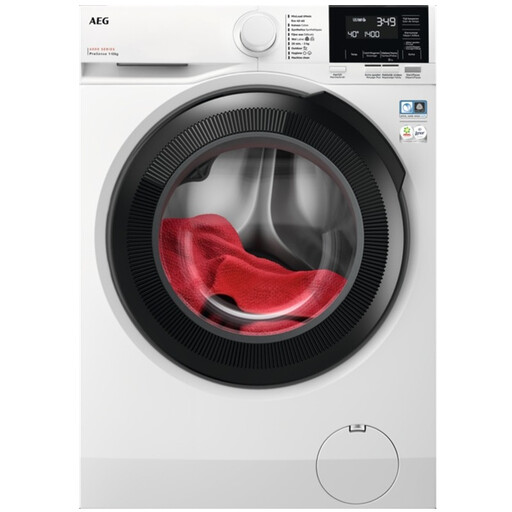
AEG LR63R144 6000 Series, 10 kg, 1400 rpm
An option to compare if you have larger loads; the capacity doesn’t tell you whether an individual duvet will fit.
The product name lists a washing capacity of 10 kg and 1400 rpm.
View at Joybuy
 No image available
AEG LR73R862 7000 Series, 8 kg, 1600 rpm
Worth considering if a stated washing capacity of 8 kg suits your usual loads.
The product name lists a washing capacity of 8 kg and 1600 rpm. For bedding, always check the care instructions and programme load limit.
View at Joybuy
 No image available
AEG LR73S840 7000 Series, 8 kg, 1400 rpm
This model is worth considering if a stated washing capacity of 8 kg suits the loads you usually wash.
The product name lists a washing capacity of 8 kg and 1400 rpm. Check that your largest individual item fits within the drum and programme limits.
View at Joybuy
 No image available
AEG LF61R840 6000 Series, 8 kg, 1400 rpm
An option to compare if a stated capacity of 8 kg suits your regular laundry and guest bedding.
The product name lists a washing capacity of 8 kg and 1400 rpm. Check the full space needed for installation and the bedding’s care instructions.
View at Joybuy
 No image available
Comfee CFP01EW70W-JD, 7 kg, design depth 400 mm
An option to compare if depth is limited; remember to measure the space needed for connections and to open the door, too.
The product name lists a capacity of 7 kg and a design depth of 400 mm.
View at Joybuy
Frequently asked questions
Can you wash a duvet just because the machine has a duvet programme?
No. A duvet programme doesn’t mean that every duvet is suitable for machine washing. Check the care label first, then make sure the duvet fits in the drum and is within the programme’s load limit. Bosch Nederland points out that some materials, including wool and silk, are best not machine-washed.
What should you check when installing the machine and before using it for the first time?
Allow space for hoses and for the door or lid to open. Follow the installation instructions, remove the transit bolts and level the machine. AEG Support lists transit bolts left in place and an unstable position as possible causes of excessive vibration.
What maintenance is useful if you only wash a large guest load occasionally?
Follow the model’s maintenance instructions. Milieu Centraal recommends, among other things, running a wash at 60 degrees once a month to help prevent detergent and dirt build-up and unpleasant smells. This is usage advice, not a legal requirement.
In the Netherlands, do you always have to pay for a fault yourself after two years?
No. According to ACM ConsuWijzer, there isn’t one fixed statutory guarantee period for every product. If a product used normally breaks down sooner than you could reasonably expect, the seller is responsible for providing a suitable solution at no cost.
Can a retailer charge you to take away your old washing machine when you buy a similar new one?
Retailers can’t charge private customers to take away an old appliance when supplying a new one. According to the Dutch government, this also applies to online purchases; agree in advance how the collection will be arranged at delivery. Paid installation or dismantling is a separate service.


