For machine-washable gardening clothes, choose a washing machine that suits your usual load and the care labels, rather than automatically going for the largest drum. Consumentenbond and Milieu Centraal emphasise that capacity should match your laundry. If needed, treat mud beforehand, following Bosch Nederland’s advice, and don’t assume a quick programme will remove stubborn dirt. If your clothes need to be dry before the working week, compare programme times and spin results too.
Who is this buying guide for?
For washing muddy gardening clothes
If your main concern is getting machine-washable clothes clean after gardening, pay attention to the care label, programme choice and any pre-treatment needed. For mud, Bosch Nederland recommends using cold water and detergent, then washing the clothes.
For those with a Sunday deadline
If you want your clothes washed and dried before the working week, look beyond the wash time. Check the load limit for each programme and the spin results too. Consumentenbond includes programme duration and spinning in its washing machine tests.
For those who wash small, separate loads
If you often wash gardening clothes separately, weigh a typical load and compare it with a model’s capacity and programme load limits. Consumentenbond and Milieu Centraal recommend choosing a drum size that suits your laundry.
What should you look for when choosing?
Let the care label and the size of your usual load guide your choice. Then consider how soon the clothes will be ready to wear again, and compare energy use on the same basis.
| What to consider |
What to look for |
Most relevant for |
| Mud and stains |
Check the care label and programme; pre-treat visible mud if needed. |
If I spot mud on my clothes after gardening, I want to know which approach is right for the care label. Around 31% of consumers put removing dirt at the top of their buying priorities. |
| Washing and drying on time |
Compare programme duration, permitted load and spin results; spin speed alone doesn’t tell you how much moisture will remain. |
I need to wash and dry my clothes before the working week, so the total time matters. Around 31% of consumers put meeting a deadline at the top of their priorities. |
| A drum that suits your needs |
Compare your usual load with both the maximum capacity and the limit for your chosen programme. |
If I usually wash gardening clothes separately, I don’t want a drum that’s much larger than my usual load. Around 23% of consumers prioritise a suitable capacity. |
| Energy use in everyday operation |
Compare the energy label and kWh per 100 eco 40-60 cycles; this figure doesn’t automatically apply to other programmes. |
I want to weigh up energy use alongside the capacity and programme I actually need. Around 15% of consumers prioritise energy and water use. |
Common buying mistakes
-
Assuming a short programme will remove mud
A programme name or manufacturer’s claim doesn’t prove that a cycle will remove your particular type of dirt. Test results for other stains and conditions don’t guarantee it either.
Check the care label, look for cleaning results for relevant programmes and pre-treat mud if needed.
-
Choosing the largest drum for a small, separate load
A larger capacity is only useful if you regularly make use of it. The permitted load for a programme may also be lower than the machine’s maximum capacity.
Weigh a typical load and check the programme’s load limit for the fabric you’re washing.
-
Relying solely on spin speed and the energy label
A higher spin speed doesn’t guarantee that your washing will come out drier. The energy label provides a basis for comparing eco 40-60, not every programme.
Compare spin results, programme duration and energy use on the label on their own terms.
Brands to compare
AEG
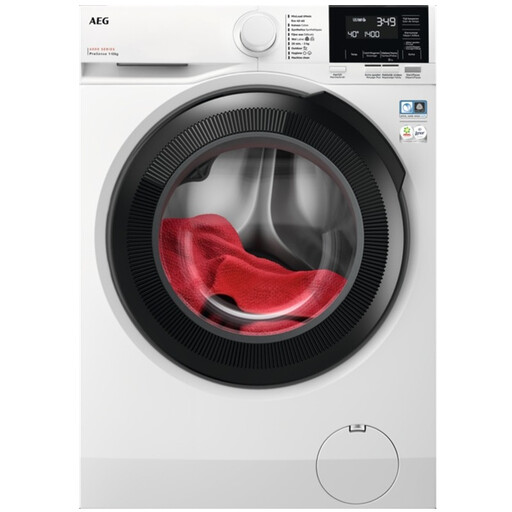
The LF628600 is an 8kg front-loading machine worth considering if your load sizes vary.
- For the LF628600, AEG lists a spin speed of 1600 rpm and an eco 40-60 cycle time of 3:25 at the rated load.
- ProSense is the manufacturer’s description of load detection; the feature doesn’t prove that a short cycle will remove stubborn mud.
Bosch
The WGJ23400NL is an 8kg front-loading machine with a reload function; check whether this feature suits your routine.
- Bosch Nederland lists a maximum spin speed of 1400 rpm and dimensions of 845 × 598 × 590 mm for this model.
- Check the exact model’s water protection rather than assuming it from the brand name.
Hisense
When comparing a Hisense washing machine, check the full model code and the features of the specific version you’re considering.
- Comparing the exact version helps you assess its capacity and programmes against your own laundry needs.
- Don’t assume that features of one version apply to every model from the brand.
Samsung
The range includes different capacities, so drum size is an important factor when choosing a model.
- Samsung Nederland lists 9kg models and larger versions among its range.
- The manufacturer’s catalogue isn’t an independent comparison of washing performance for gardening clothes; check the features and programme load limits for each model.
Miele
The WEE395 WPS PWash&Steam&8kg is an 8kg front-loading machine worth comparing if programme duration matters to you.
- Miele lists a duration of 49 minutes and a spin speed of 1400 rpm for QuickPowerWash.
- The programme time quoted is a manufacturer’s claim, not independent proof that it will remove heavily dried-on mud.
Washing machines at Joybuy
The models below have a stated capacity of 8 to 10 kg. Choose based on the size of your usual gardening clothes load and whether you sometimes want to combine it with larger household loads.
 No image available
Samsung WW90DG6U25LE, 9 kg, 1400 rpm
The stated capacity of 9 kg may suit you if you regularly want to wash larger loads.
Specifications: 9 kg; 1400 rpm.
View at Joybuy
 No image available
AEG LR63R144, 10 kg, 1400 rpm
The stated capacity of 10 kg is worth considering if you can regularly combine larger loads in line with the care labels.
Specifications: 6000 Series; 10 kg; 1400 rpm; ProSense.
View at Joybuy
 No image available
AEG LR73R862, 8 kg, 1600 rpm
The stated capacity of 8 kg is a useful comparison point if you regularly wash medium-sized loads.
Specifications: 7000 Series; 8 kg; 1600 rpm; PreciseWash.
View at Joybuy
 No image available
AEG LR73S840, 8 kg, 1400 rpm
The stated capacity of 8 kg may suit a typical load of that size; also check the load limit for the programme you need.
Specifications: 7000 Series; 8 kg; 1400 rpm; PreciseWash.
View at Joybuy
 No image available
AEG LF61R840, 8 kg, 1400 rpm
Compare the stated capacity of 8 kg with your usual load, and make sure it suits the limit for the programme you want to use.
Specifications: 6000 Series; 8 kg; 1400 rpm; ProSense.
View at Joybuy
Frequently asked questions
Can I put muddy gardening clothes straight onto a quick programme?
Not without checking the care label and the type of dirt first. For mud, Bosch Nederland recommends using cold water and detergent, then washing the clothes; pre-treat visible stains if needed. A short programme alone doesn’t prove it will remove stubborn mud.
How do I work out which drum size is right for my gardening clothes?
Weigh a typical load and compare it with both the maximum capacity and the load allowed for the relevant programme and fabric. Consumentenbond and Milieu Centraal advise against choosing a larger capacity than you can use regularly.
What should I look for if my washing needs to be dry before the working week?
Compare the duration of a programme that suits your clothes and load with its spin results. Consumentenbond includes programme duration and spinning in its tests; spin speed alone doesn’t tell you how much moisture will remain in your washing.
What do the energy label figures tell me about energy use?
The European Commission describes energy use per 100 eco 40-60 cycles as part of the comparison information for household washing machines. This figure doesn’t automatically reflect the energy use of a shorter programme or one with different settings for gardening clothes.
Does this advice also apply to professional protective gardening clothes?
Not necessarily. For clothing used as personal protective equipment against a work-related hazard, care and use depend on the garment and the risk. Arboportaal covers this type of clothing separately; follow the relevant instructions rather than applying this advice for ordinary machine-washable clothes.


