If you have somewhere to hang your gardening clothes after washing, choose a standard washing machine with a suitable drum capacity. When comparing models, focus on the spin efficiency class on the energy label, not just the maximum spin speed. If you don’t have a suitable place to hang them, compare washer-dryers by their separate washing and drying capacities, as well as the energy use of the combined cycle. The Consumentenbond points out that the drying load may be smaller than the washing load. Treat soil and mud stains before washing, and follow the garment care label, as Milieu Centraal and the Consumentenbond also advise.
Who is this buying guide for?
Gardening clothes and a small airer
You have somewhere to hang your washing, but space on the airer is limited. Compare the spin performance and drum capacity with the amount of laundry you usually wash. Milieu Centraal advises taking the drying result on the label into account too.
Gardening clothes with nowhere to dry
You don’t have a suitable place to hang this load and are considering a washer-dryer. Pay attention to the difference between its washing and drying capacities, as the Consumentenbond advises.
Regular muddy garden loads
You often wash clothes with soil or mud stains and want to choose a programme that suits both the level of dirt and the garment care label. Compare programme details carefully: a programme name alone doesn’t prove how well it will remove mud.
What should you look for when buying?
Standard washing machine
Choose this if: you still have enough room to hang your gardening clothes after spinning.
Trade-off: your washing will still need to dry on an airer or washing line. Choose a spin speed that’s suitable for the garment care label.
Washer-dryer
Choose this if: there’s no room for an airer for your gardening clothes and you only have space for one appliance.
Trade-off: the drying capacity may be lower than the washing capacity. According to the Consumentenbond, drying programmes can take longer and use more energy than an efficient heat pump tumble dryer, although a washer-dryer with a heat pump may be different.
Separate washing machine and heat pump tumble dryer
Choose this if: you have room for two appliances despite limited drying space, and regularly want to tumble dry your clothes.
Trade-off: you’ll need space for both appliances. Milieu Centraal recommends separate appliances because they use less energy for washing and drying.
| What to consider |
What to look for |
Who is this important for? |
| Moisture left after spinning |
Compare the spin efficiency class on the energy label and check which spin speed the garment care label allows. |
If I have little room on my airer, I want to know how much moisture the laundry retains according to the label. Around 36% of consumers put reducing the amount of wet laundry when drying space is limited at the top of their list. |
| Soil and mud stains |
Check the available programmes and temperature settings. Follow the garment care label and pre-treat stains if necessary. |
If I regularly wash dirty gardening clothes, I want an appropriate way to wash them without relying on a programme name alone. Around 29% of consumers prioritise removing soil and mud stains. |
| Drying without somewhere to hang clothes |
Compare the drying capacity with the washing capacity, and check the energy use and duration of the combined cycle. |
If I have nowhere to hang my gardening clothes, the load I want to wash needs to fit into one drying cycle. Around 21% of consumers put drying without a suitable place to hang clothes at the top of their list. |
| Drum capacity and energy use |
Choose a drum capacity to suit your usual load and compare the energy and water information on the product label. |
I don’t want to choose a drum based on an unusually large wash, but on the load I usually do. Around 14% of consumers prioritise a suitable drum capacity and clear information about energy use. |
Common buying mistakes
-
Choosing based only on the maximum spin speed
The maximum spin speed doesn’t tell you how well every garment will be spun. That’s why Milieu Centraal also advises checking the spin efficiency class on the label.
Compare the result shown on the label and check which spin speed your gardening clothes can handle according to their care label.
-
Assuming the washing and drying capacities are the same
A washer-dryer may not be able to dry in one go the same amount of laundry it can wash. The Consumentenbond advises checking both capacities separately.
Compare the drying capacity with the load you want to wash and dry without having to take anything out in between.
-
Looking only at the energy label for washing
A washer-dryer can have different energy label classes for washing and for the combined cycle. Haier lists class A for washing only and class D for the combined cycle for the HWD90-B14939-S.
Compare the label information for the cycle you actually plan to use.
-
Choosing a larger drum than your laundry requires
A larger capacity isn’t automatically more efficient if your machine is usually not loaded appropriately. Milieu Centraal advises choosing a drum capacity that suits the amount of laundry you usually wash.
Estimate how much gardening clothing and other laundry you normally wash in one load before choosing a capacity.
Brands to compare
Bosch
According to Bosch Nederland, the Bosch Serie 8 WGB256ASNL is a front-loading washing machine with a 10 kg capacity and a maximum spin speed of 1600 rpm.
- The stated capacity and spin speed give you useful points to compare between models.
- The maximum spin speed alone doesn’t determine the actual spin result or whether the machine is suitable for every garden fabric.
AEG
According to AEG, the AEG LR8696UD4M is a front-loading washing machine with a 9 kg capacity, a maximum spin speed of 1600 rpm and a PowerClean 59 min function.
- You can compare the capacity and stated spin speed with your laundry loads and the drying space you have at home.
- Check the programme conditions and garment care label. The function name doesn’t prove how well it will remove mud stains.
LG
According to LG Nederland, the LG GC3R709S1 is a washing machine with a 9 kg capacity and programme and fabric care features.
- LG lists AI DD for three cycles: cotton, mixed fabrics and easy-care.
- The listed steam and AI features don’t prove that it will wash gardening clothes better.
Haier
According to Haier, the Haier HWD90-B14939-S is a washer-dryer with a 9 kg washing capacity and a 6 kg drying capacity.
- The separate washing and drying capacities make the difference between the two loads clear.
- Haier lists energy class A for washing only and D for the combined cycle. Consider which one applies to the cycle you’ll use.
Siemens
According to Siemens, the Siemens WG44G2ZBNL includes an Outdoor programme for water-repellent clothing.
- The Outdoor programme may be useful if the garment care label allows you to use one.
- The antiVlekken feature’s reference to four common stains doesn’t confirm that mud is one of them. Check the programme information and garment care label.
Washing machines at Joybuy
These washing machines are options for gardening clothes that you can hang on an airer or washing line after washing.
 No image available
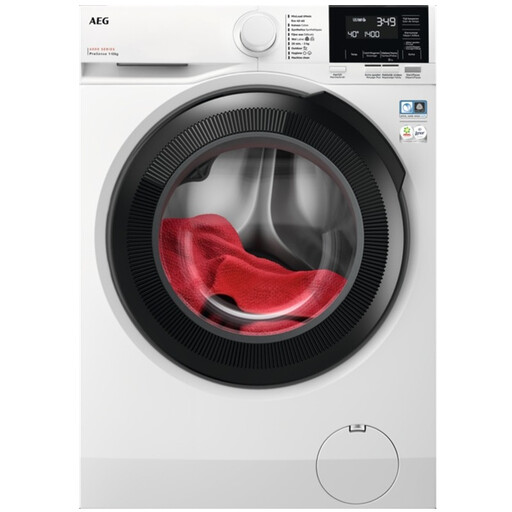
AEG LR63R144 6000 Series, 10 kg, 1400 rpm
Suitable for a typical load that fits the capacity, with enough drying space available afterwards.
Drum capacity: 10 kg. Stated spin speed: 1400 rpm. Energy class: A.
Joybuy
 No image available
AEG LR73R862 7000 Series, 8 kg, 1600 rpm
Suitable for a typical load within the stated capacity that you can hang out to dry after washing.
Drum capacity: 8 kg. Stated spin speed: 1600 rpm. Energy class: A.
Joybuy
 No image available
AEG LR73S840 7000 Series, 8 kg, 1400 rpm
Suitable for a typical load up to the stated capacity if you have somewhere to dry the clothes afterwards.
Drum capacity: 8 kg. Stated spin speed: 1400 rpm.
Joybuy
 No image available
AEG LF61R840 6000 Series, 8 kg, 1400 rpm
An option to compare if your usual load is within 8 kg and you have somewhere to hang the washing afterwards.
Drum capacity: 8 kg. Stated spin speed: 1400 rpm.
Joybuy
No image available
AEG LR73S862 7000 Series, 8 kg, 1600 rpm
Suitable for a typical load within the stated capacity, with drying space available afterwards.
Drum capacity: 8 kg. Stated spin speed: 1600 rpm.
Joybuy
Frequently asked questions
Is 1600 rpm automatically better for gardening clothes than 1400 rpm?
No. To find out how dry your washing will be, first check the spin efficiency class on the label, and only choose a spin speed that’s suitable for the garment care label. The maximum spin speed doesn’t predict how dry every fabric will be when it comes out of the machine.
Can heavily muddied clothes go straight into the eco programme?
Not without considering the garment care label and how dirty the clothes are. The Eco 40-60 programme is intended for normally soiled laundry that’s suitable for it. Remove loose dirt and pre-treat stubborn soil or mud stains. Then choose a programme and temperature that follow the garment care label.
What should I consider when installing and maintaining my washing machine?
Before buying, check the dimensions and make sure there’s room for the connections and to use the machine. Follow the manual for cleaning, and pay attention to parts where dirt and detergent residue can collect, such as the door seal, detergent drawer and accessible filter.
Does everyone in the Netherlands automatically get exactly two years’ statutory warranty?
No. According to the Dutch Government, statutory warranty in the Netherlands has no fixed time limit: you’re entitled to a product that meets what you could reasonably expect. If there’s a problem, contact the seller. A manufacturer’s guarantee is separate.
Can I hand in my old washing machine when I buy a new one online?
Yes. According to the Dutch Government, the free take-back scheme for an old appliance when you buy a new, similar one also applies to online purchases and delivery. Check with the seller how the handover will work at delivery or at a collection point.


