
If you wash large covers
You want a large duvet cover to fit in the machine without being crammed in. So look beyond the kilogram figure on the front.


If you wash duvet covers regularly, don’t automatically choose the largest drum. Pick a machine that can accommodate your largest cover with room to move, and that also suits your usual laundry load. The stated capacity is for a cotton wash and doesn’t prove that a cover will physically fit. So match the capacity to your own laundry, and check the care label and the space available for the machine.
You want a large duvet cover to fit in the machine without being crammed in. So look beyond the kilogram figure on the front.
You wash a duvet cover when the seasons change, but don’t want a machine that’s usually too large for your laundry for the rest of the year.
You need to get the machine through the doorway and connect it in the space available, without losing sight of whether it’s suitable for bedding.
A large-capacity front-loading machine is worth considering if you regularly wash bulky items and can also fill the larger drum for everyday loads. If you mostly wash smaller loads, start with a capacity that suits them. If space is tight, also look at alternative designs and how practical they are to load.
A good fit if: you regularly wash large covers or other bulky cotton items, and your everyday laundry load is also enough to fill the drum adequately.
Consider: a higher capacity doesn’t prove that a cover will fit through the door or move freely inside the drum.
A good fit if: you only wash duvet covers occasionally and your usual laundry load is small, provided your largest cover fits according to its care label and the programme instructions.
Consider: there’s less spare capacity for washing several bulky items at once.
A good fit if: there isn’t room for a standard front loader. Check the door opening, programme load limits and, where relevant, the separate drying capacity.
Consider: if there’s room for a separate washing machine and tumble dryer, Milieu Centraal recommends this set-up over a washer-dryer because of its energy consumption.
| What to consider | What to look for | Who should pay extra attention? |
|---|---|---|
| Room for the cover | Compare the stated cotton capacity with your own dry laundry load, and check the door opening and programme load limit. The figure alone doesn’t tell you whether the cover will physically fit. | I want my largest cover to move freely in the drum, not just for its weight to be within the stated limit. Around 33% of consumers prioritise whether the cover fits. |
| Everyday laundry load | Weigh a typical load and compare it with the drum capacity. Also check the consumption figures for the labelled eco 40–60 programme; the Consumentenbond warns that load detection doesn’t accurately compensate for a drum that isn’t full. | If I usually wash smaller everyday loads, I don’t want to choose a machine just for an occasional large cover. Around 27% of consumers prioritise suitability for everyday use. |
| Installation space | Measure the route to the machine and the space where it will go. Check the exact model’s external dimensions, door swing, connections and installation instructions. | If the space at home or the doorway limits my choice, I need to know whether the machine will fit and whether a large cover will be practical to load. Around 20% of consumers prioritise installation. |
| Wash programme | Read the cover’s care label and check that the programmes and permitted load suit it. Follow the care instructions for the temperature. | I want to choose a treatment that suits the fabric and care label, as not every cover needs the same wash. Around 20% of consumers prioritise fabric care. |
The stated capacity is for a cotton wash. A high figure doesn’t tell you whether the cover will fit through the door or have enough room to move.
Weigh a typical laundry load, and also check your largest cover, the door opening and the load limit for a suitable programme.
A cover and a complete duvet are different textile items. Their materials and care instructions may call for different treatment.
Check the care label on the specific item and the programme’s load limit before washing.
The route to the installation space, the doorway, hoses, connections and flooring can all affect installation.
Measure the entire route and the installation space, and read the instructions for the exact model.
If installation isn’t possible, you may need to adapt the space.
According to the Dutch Government, your right to a product that works properly exists alongside any manufacturer’s guarantee.
Check what an additional guarantee covers, and contact the retailer if a product is faulty.
An additional guarantee may cost money; its terms determine what extra cover it provides.
These models show which product specifications you can compare. Features of one model don’t automatically apply to the whole brand.
The Serie 6 WGH24407NL is a front loader with a stated capacity of 9 kg, which may be relevant if its capacity and dimensions suit your needs.
The LR74CB94 has a stated capacity of 9 kg and several programmes, so you can compare their names with the care label on your cover.
The WW90DG6U25LEU3 is an example of a 9 kg front loader whose capacity and stated depth can be considered together.
According to Miele, the WER875WPS from the W1 range combines a 9 kg capacity with automatic dosing and a range of fabric-care programmes.
This Joybuy selection features AEG front loaders with stated capacities of 8 or 10 kg. Compare their capacity with your everyday laundry load, and check that your largest cover will physically fit.
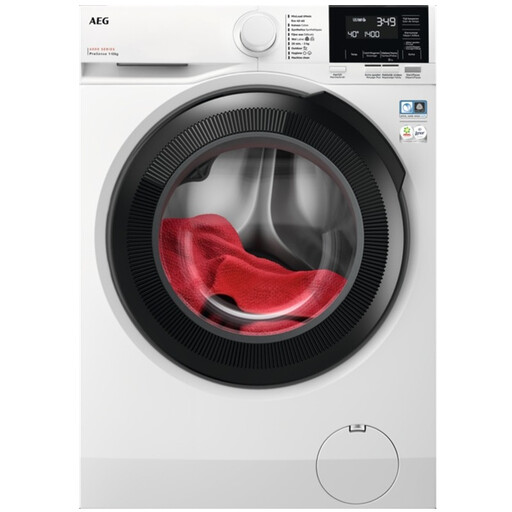 No image available
May suit you if you regularly wash larger loads. A stated capacity of 10 kg doesn’t, by itself, tell you whether a duvet cover will physically fit in the drum.
The product information lists ProSense load detection, TimeSave Plus and a wool programme.
Dimensions according to the product information: 847 × 597 × 660 mm.
 No image available
May suit you if you’re looking for a front loader with a stated capacity of 8 kg. Check separately that your cover fits through the door and within the programme’s load limit.
The product information lists MixLoad 69, PreciseWash and ProSteam.
Dimensions according to the product information: 847 × 596 × 602 mm.
 No image available
May suit you if you’re looking for a front loader with a stated capacity of 8 kg. Choose a machine that suits your own laundry load and the dimensions of your largest cover.
The product information lists MixLoad 69, PreciseWash and ProSteam, and states that water and energy use adjust to the load.
 No image available
May suit you if you’re looking for a front loader with a stated capacity of 8 kg. Check that your cover fits through the door and within the chosen programme’s load limit.
The product information lists ProSense load detection and an Anti Allergy Vapour programme.
Dimensions according to the product information: 847 × 596 × 577 mm.
No image available
May suit you if you’re looking for a front loader with a stated capacity of 8 kg. The maximum capacity alone doesn’t determine whether a large cover will fit comfortably.
The product information lists MixLoad 69, PreciseWash and a CareDrum.
Dimensions according to the product information: 847 × 596 × 602 mm.
No. The stated capacity is the maximum load for a cotton wash. Also check the size of your cover, the door opening and the permitted load for the programme you choose.
Always check the care label first and choose a programme to suit the fabric. There isn’t one temperature that’s right for every cover, and higher temperatures use more energy.
Check that the floor is stable, the water supply and drainage are connected, and that you’ve read the installation instructions for the exact model. Also remove the transit bolts before use, as Bosch advises in its installation instructions.
According to the Dutch Government, you’re entitled to a product that works properly and should contact the retailer if it’s faulty. There’s no fixed statutory guarantee period. Any manufacturer’s guarantee is in addition to your statutory rights.
The Dutch Government lists washing machines among the appliances that must carry an energy label. The European Commission says that, since 1 March 2021, EU labels for household washing machines have used a scale from A to G. Compare the figures on the stated programme basis.