What to look for in a shared washing machine
Start with the weight of your typical loads and your largest duvet cover. Then compare how capacity, washing schedules, consumption, noise and installation will work in your home.
7–8 kg front-loader
Choose this option: if your usual loads are modest and your largest duvet cover fits without being crammed in.
Bear in mind: also check the drum volume, door opening and maximum load for the programme.
9 kg front-loader
Choose this option: if you regularly wash larger shared loads or find an 8kg drum too small.
Bear in mind: a higher stated cotton capacity doesn’t prove that small loads will wash just as well; compare programmes and consumption.
10 kg or larger front-loader
Choose this option: only if your usual loads make use of the extra space or you want to wash exceptionally bulky items.
Bear in mind: in a Consumentenbond test of ten large machines, a 40%-capacity cotton load did not come clean in eight of them.
| Consideration |
What to check before buying |
Who is this most important for? |
| Room for duvet covers |
Weigh a typical load and check the load capacity, drum volume, door opening and programme load limit. |
If I want to wash my largest duvet cover without cramming it in, I’ll also consider my usual smaller loads; around 36% of consumers give having enough room for bedding their highest priority. |
| Sharing washing times |
Compare the duration and maximum load of the programmes you’ll actually use. Also consider whether a delay-start function would be useful. |
If several housemates want to do their washing one after another, I want to know how long a suitable cycle takes; around 28% of consumers prioritise a practical shared washing schedule. |
| Purchase price and running costs |
Compare EU labels on the same basis: kWh per 100 eco 40-60 cycles and litres of water per cycle. |
If we share the cost of the machine and its use, I want to take ongoing expenses into account; around 22% of consumers give shared purchase and running costs their highest priority. |
| Noise and installation |
Compare the spin noise in dB and measure the space, access route and clearance needed for connections. |
If the machine is close to living or sleeping areas, I want to consider noise and whether there’s a suitable place for it; around 14% of consumers prioritise quiet operation and practical installation. |
Washing machines on Joybuy for shared use
This selection features models with a stated capacity of 8 or 9 kg. Compare the capacity with your usual loads and check separately that your largest duvet cover fits freely in the drum.
 No image available
Samsung WW90DG6U25LE, 9 kg
The stated capacity may suit you if you regularly wash larger shared loads; check that your largest duvet cover fits loosely in the drum.
Stated specifications: 9 kg, 1400 rpm and energy rating A.
SuperSpeed: 5 kg in 39 minutes. A bedding programme is also listed.
View at Joybuy
 No image available
Midea MF110W80BA10/W-NL, 8 kg
The stated capacity offers an 8kg option for everyday loads and bedding. Check the programme’s maximum load for the cycle you want to use.
Stated specifications: 8 kg, 1400 rpm, energy rating A-10% and 16 programmes, including a bedding programme.
AquaStop and an end-time delay of 0–24 hours are also listed.
View at Joybuy
 No image available
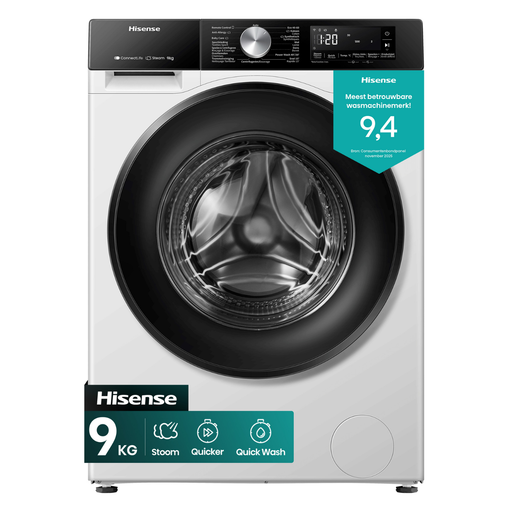
Hisense WF3S9043BW3, 9 kg
The stated 9 kg capacity is an option to compare for larger shared loads; capacity alone doesn’t confirm that a particular duvet cover will fit.
Stated specifications: 9 kg, 1400 rpm, energy rating A and 15 programmes.
A 49-minute Power Wash programme, start/end time delay and Pause & Add are also listed.
View at Joybuy
 No image available
Beko BM3WFU38412CW, 8 kg
This 8kg model is an option to compare for modest everyday loads; check that your largest duvet cover fits loosely.
Stated specifications: 8 kg, maximum 1400 rpm, energy rating A and spin noise of 76 dB(A).
An XL door and a 14-minute Daily Xpress programme for lightly soiled laundry are also listed.
View at Joybuy
 No image available
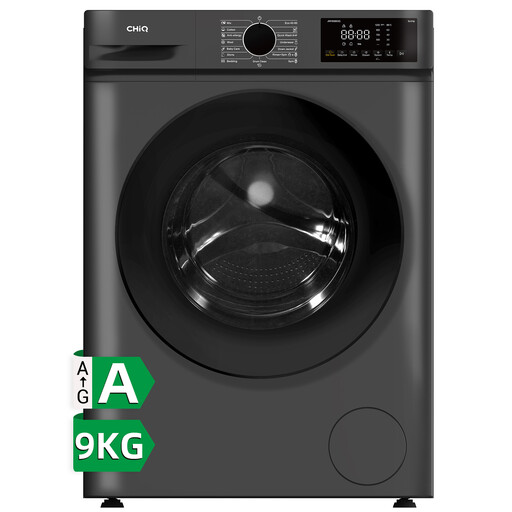
CHiQ JW95883G, 9 kg, dark grey
The stated capacity is an option for larger loads; drum size alone doesn’t guarantee that your largest duvet cover will fit without being crammed in.
Stated specifications: 9 kg, 1400 rpm, energy rating A and a 530 mm drum.
16 programmes, including a bedding programme, and a 1-Touch Smart Wash function that detects the load and fabric type are also listed.
View at Joybuy
Frequently asked questions
Do we always need to buy a 9kg machine for a duvet cover?
No, not necessarily. Weigh a typical load and check that your largest duvet cover fits in the drum and through the door opening without being crammed in. The stated load capacity applies to cotton; other programmes may have a lower maximum load.
Should a duvet cover be washed at 60 °C?
Always check the care label first and choose a suitable programme. Bosch recommends 60 °C for bedding, while Milieu Centraal says an eco programme is suitable for normally soiled laundry and notes that lower temperatures save energy. A hot programme may be advisable in certain situations where hygiene is a priority.
What should we check before using the machine in a shared laundry room?
Measure the space and consult the installation manual for the model. Make sure the machine is stable and level; AEG notes that an unbalanced load can be one reason a washing machine won’t spin.
What if a large, wet load won’t spin?
Check the manual and how the laundry is distributed in the drum. AEG warns that bulky wet textiles, including a filled duvet, can throw the drum off balance; that doesn’t automatically mean a duvet cover on its own will have the same effect.
What do the EU label and Dutch guarantee mean when buying?
The EU label for household washing machines uses A–G classes and compares consumption and noise using a prescribed testing method, as explained by the European Commission. There is no fixed statutory guarantee period in the Netherlands; if a product is faulty, the seller is your point of contact for a solution, according to the Dutch government.


