Choose a washing machine with a drum capacity that suits both your usual towel load and your everyday laundry, and check that its cotton programme can reach the temperature shown on the care label. Eco 40-60 does not automatically mean the wash reaches 60 °C. Compare the energy labels too, and measure your available space before choosing a model.
Who is this buying guide for?
If you wash musty towels
You want to know which programme is right for damp, possibly musty-smelling cotton towels. So check the settings and care label, rather than relying on the name Eco 40-60 alone. The Consumers' Association explains that the measured temperature of this programme can vary.
If you wash larger towel loads
You want to wash towels in a practical-sized load, without choosing a drum capacity based only on the occasional seasonal wash. The Consumers' Association and Milieu Centraal recommend comparing capacity with the loads you usually wash.
If space and running costs matter to you
You’re comparing the space available and energy and water use. If a front-loader won’t fit, a top-loader could be an option. The Consumers' Association points out that top-loaders are generally narrower, but usually have a smaller capacity.
What should you look for when buying?
Start with the care label and the programme you need. Then compare the drum capacity with your usual loads, and finally check energy and water use and the space available.
| What to consider |
What should you check? |
Who is this important for? |
| Programme and temperature |
Check whether the cotton programme can be set to the temperature shown on the care label. Eco 40-60 is not the same as a guaranteed wash at 60 °C. |
If you mainly want to know how to wash damp cotton towels appropriately, pay attention to the programme and permitted temperature; around 36% of consumers put this first. |
| Drum capacity |
Compare the stated capacity with your usual towel loads and other laundry. |
If you want to wash towels in a practical-sized load without disrupting your usual routine, drum capacity matters; around 29% of consumers prioritise load size. |
| Energy and water use |
Compare the energy labels of the exact models. Label information does not necessarily show the consumption of a 60 °C cotton wash. |
If you wash frequently, you’ll want to consider energy and water use alongside the temperature your laundry needs; around 21% of consumers prioritise running costs. |
| Space and connections |
Measure the space and check there is room for the door or lid to open, as well as for the connections specified in the installation instructions. |
If the space available determines which type of machine will fit, the external dimensions and connections are decisive; around 14% of consumers start with where the machine will go. |
Common buying mistakes
-
Assuming Eco 40-60 is a 60 °C wash
The programme name does not guarantee that the wash reaches 60 °C. The Consumers' Association explains that the measured temperature can vary from one machine to another.
If you want to wash at 60 °C, check whether the model has a cotton programme that can be set to that temperature, and whether the care label allows it.
-
Choosing a drum capacity based on just one large seasonal wash
A capacity that suits an occasional large load may not be right for your everyday laundry routine.
First work out the size of your usual loads, then compare them with the capacity and programmes of the models you’re considering.
-
Assuming a high spin speed or a new machine will solve every musty smell
A musty smell can also be linked to a build-up of dirt, stagnant water or a drainage problem. The maximum spin speed may also be reduced if the load is unbalanced.
Check maintenance and drainage as well as the machine’s programmes and specifications. The Consumers' Association lists a build-up of dirt and detergent, and drainage problems, among the possible causes of a smelly machine.
Brands to compare
AEG
According to AEG, the 6000 ProSense LF628600 is a front-loader with an 8 kg capacity, a maximum spin speed of 1600 rpm and a separate anti-allergy programme.
- AEG says ProSense adjusts the cycle to suit the load.
- This is a manufacturer claim about the model, not an independent measurement of its performance with damp towels. Check the programme instructions for your laundry.
Bosch
According to Bosch, the Serie 6 WGG244ZONL is a front-loader with a 9 kg capacity and a maximum spin speed of 1400 rpm, making it worth comparing if you’re considering larger loads.
- The stated capacity and maximum spin speed help you compare the model’s specifications with your load.
- Bosch says the maximum spin speed may be reduced automatically if the load is unbalanced; the stated figure is not a guarantee of the speed for every wash.
Siemens
According to Siemens, the iQ500 WG44G2ZWNL is a front-loader with a 9 kg capacity, a maximum spin speed of 1400 rpm and dimensions of 845 × 598 × 590 mm.
- The capacity and external dimensions are specific details you can compare with your load and available space.
- These specifications alone do not show a difference in washing performance.
Miele
According to Miele, the W1 WEA135 WCS 8kg Active has an 8 kg capacity and a maximum spin speed of 1400 revolutions per minute.
- The stated capacity and features such as CapDosing and AddLoad are worth comparing with what you’re looking for.
- The drum and dosing features listed do not, by themselves, demonstrate an independent benefit when washing damp towels.
Washing machines at Joybuy
This selection includes front-loaders with a range of capacities and programme features, so you can find one to suit your towel load, care label and available space.
 No image available
Samsung WW90DG6U25LE, 9 kg
Compare the stated 9 kg capacity with the size of your usual towel load.
Maximum 1400 rpm; energy rating A; cotton programme and Hygienic Steam. The stated dimensions are 600 × 550 × 850 mm, and the door opens to the side. Hygienic Steam does not prove that a cotton wash reaches 60 °C.
View on Joybuy
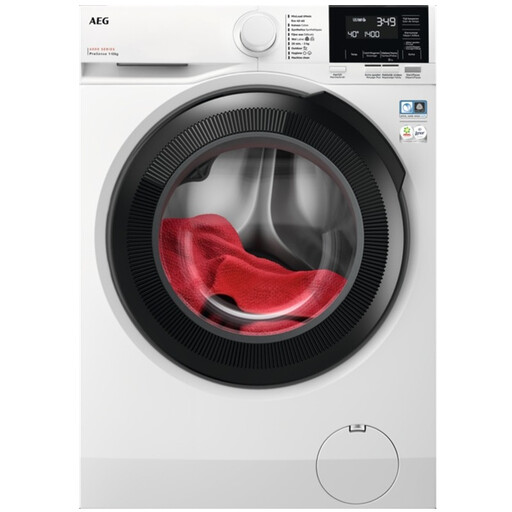 No image available
AEG LR63R144, 10 kg
The capacity and ProSense load detection are worth comparing if your loads vary in size.
Maximum 1400 rpm; energy rating A; the product information lists ProSense and TimeSave Plus, as well as an Anti Allergy Vapour programme.
View on Joybuy
 No image available
AEG LR73R862, 8 kg
With an 8 kg capacity, you can compare this model with the size of your usual towel load.
Maximum 1600 rpm; energy rating A; the product information lists PreciseWash load detection and MixLoad 69 at 30 °C.
View on Joybuy
 No image available
AEG LR73S840, 8 kg
The 8 kg capacity and stated load detection are useful points of comparison if you’re looking for a model that can handle loads of different sizes.
Energy rating A-40%; 42 kWh per 100 Eco 40-60 cycles according to the product information. Hygiene Steam and MixLoad 69 at 30 °C are also listed. A hygiene feature is not the same as a 60 °C cotton wash.
View on Joybuy
 No image available
AEG LF61R840, 8 kg
The 8 kg capacity can help you decide whether the machine is right for your usual towel load.
Maximum 1400 rpm; energy rating A; 47 kWh per 100 Eco 40-60 cycles according to the product information. The description mentions ProSense and Anti Allergy Vapour at 60 °C. Check the care label and the programme you want to use.
View on Joybuy
Frequently asked questions
Does Eco 40-60 wash your damp towels at 60 °C?
Not necessarily. According to measurements by the Consumers' Association, the temperature reached can vary from one machine to another. If you want to wash at 60 °C, check whether the model offers that setting on its cotton programme and whether the care label allows it.
What should you check before installing a washing machine?
Measure the space and check there is room for the door or lid to open, as well as for the connections. Bosch recommends, among other things, a stable surface, an earthed socket and removing the transit bolts. Follow the instructions for the model you choose.
What can you do if the machine or clean laundry smells musty?
As well as checking the wash programme, check the machine’s maintenance and drainage. The Consumers' Association lists a build-up of detergent and dirt, a dirty filter, stagnant water and drainage problems as possible causes.
Does the statutory guarantee in the Netherlands always last exactly two years?
No. According to the Dutch government, there is no fixed statutory guarantee period in the Netherlands: a product must do what you can reasonably expect of it. If something goes wrong, contact the seller; a manufacturer’s guarantee is an extra.
Does a washing machine need an energy label?
Yes. The Dutch government states that washing machines must have an energy label, which also includes information about water use. Use the label to compare models, not to predict the consumption of every individual programme.


