
Parent facing a last-minute school wash
You need a few damp items ready before the working week and need to plan the programme time, suitable load and drying time together.


For a few damp school items, a suitable small or short-load programme matters more than automatically choosing a larger drum. For regular, full family washes, look for a capacity you can usually fill. Check the load limit and care label for your chosen programme, and allow time for the clothes to dry afterwards. The Consumentenbond advises choosing a large washing machine only if you can usually fill it; the energy label compares the eco 40-60 programme and doesn’t directly show the energy use of a quick programme.
You need a few damp items ready before the working week and need to plan the programme time, suitable load and drying time together.
You wash school clothes with the rest of the family’s laundry and want a drum that suits your usual load.
You want to consider more than just speed: avoid leaving laundry wet for too long and keep the machine well maintained.
For damp school clothes, don’t focus only on the maximum drum capacity. The load limit for your chosen programme and the time needed to dry clothes afterwards are just as important.
| What to consider | What should you check? | Who is this important for? |
|---|---|---|
| Washing and drying in time | Check the duration and load limit of the exact programme; also take the care label and drying time into account. | If I need just a few damp school items ready before the working week, I want to know when they’ll be washed and dry. Around 36% of consumers say having their laundry ready on time is their top priority. |
| Fresh-smelling, clean results | Check which programme suits the fabric and level of soiling, and how to maintain the machine according to the manual. | If my laundry keeps coming out musty, I want to choose the right wash and avoid leaving wet clothes in the drum for too long. Around 29% of consumers put fresh smells and clean washing first. |
| Suitable drum capacity | Compare the weight of a typical load with the machine’s maximum capacity and the relevant programme; check the external dimensions too. | If I usually wash school clothes with the family’s laundry, I’m looking for a capacity that suits the loads I actually do. Around 21% of consumers give suitable capacity top priority. |
| Energy use and installation | Compare energy label figures on the same basis, and check the dimensions, connections and space needed for installation. | If I’m mainly considering running costs and where to put the machine, I want to know whether it will fit and how the label figures relate to my use. Around 14% of consumers put these considerations first. |
The maximum drum capacity doesn’t tell you how much laundry will fit in a specific quick wash. Programme duration and the suitable load can vary by model and programme.
Check the programme table for the exact model and, if necessary, weigh your usual school wash.
A standard washing machine washes clothes but doesn’t dry them completely. A washer-dryer can do both, but its drying capacity may be lower than its washing capacity.
Factor in drying time too. If you’re considering a washer-dryer, compare its separate washing and drying capacities.
The figures on a washing machine’s energy label apply to eco 40-60 and don’t directly show the energy use of a quick programme.
Compare models using the same label basis, and look for separate energy-use figures for other programmes if they’re important to your decision.
The features listed apply to the specific models below. Check the programme load limits, dimensions and instructions for each version.
The Bosch WGJ23400NL is an 8 kg front-loader with programmes including Quick/Mix, Sports and SuperQuick 15/30 min.
Beko lists a maximum washing load of 8 kg, 1400 rpm and Daily Xpress/Xpress Super Short for the BM3WFT3841B1.
LG lists a capacity of 9 kg and TurboWash360˚ for the F4X5009THB.
The Samsung WW10FG6U94LBU3 is a 10 kg model with an A energy rating and app features.
This selection includes washing machines with listed short programmes and capacities to suit different load sizes, plus one washer-dryer for anyone who wants to complete both steps in the same machine.
 No image available
Worth comparing if you want to weigh up a small, time-sensitive wash alongside larger loads.
The product information lists Quick 15 and Super Speed, which takes 39 minutes for 5 kg. The 9 kg capacity in the product name is the maximum; check the load limit for your chosen programme and the care label.
 No image available
Worth comparing if you want to weigh up small and larger loads using the same machine.
The product information lists Mini Load, Extra Quick 15'/30' and SpeedPerfect. The product name lists a 9 kg capacity and an NL/FR panel; check which load is suitable for your chosen programme.
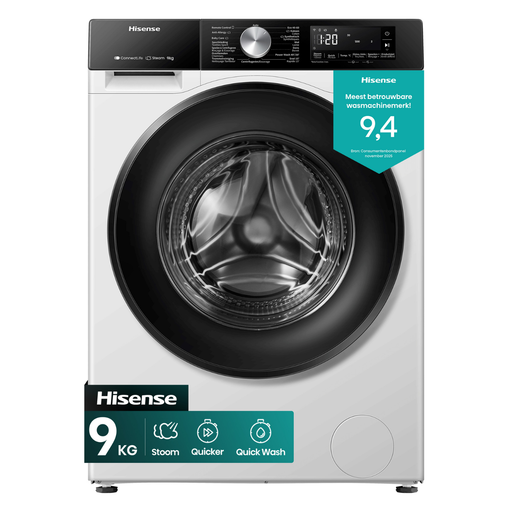 No image available
Worth comparing if you want to consider a 9 kg capacity alongside the listed short programme options.
The product information lists Quick 15 and Quicker Wash. Check the suitable load for the programme and whether its duration fits your schedule.
 No image available
Worth comparing if you’re looking for a quick option for lightly soiled laundry and your usual load fits within 8 kg.
The product information lists a 14-minute Daily Xpress programme for lightly soiled laundry; the product name lists an A energy rating. Check the care label and programme load limit.
 No image available
Worth comparing if you want to wash and dry clothes in the same machine.
The product information lists a 10 kg washing capacity and 6 kg drying capacity, as well as a 15-minute Quick Wash and a 60-minute wash-and-dry cycle. The drying capacity is lower than the washing capacity, so check how much you want to dry in each cycle.
Not necessarily. Choose a programme that suits the care label and level of soiling, and check the load limit for the exact model. Allow time for drying afterwards too; the Consumentenbond advises against leaving wet laundry in the drum for a long time.
Check that the location is level, sturdy and frost-free, and that the water supply, drain and earthed socket are within reach. Remove the transit bolts according to the manual, and check the dimensions and any installation requirements before you buy.
Remove the laundry from the drum when the cycle ends, and leave the door and detergent drawer open to dry. Clean the seal and filter regularly according to the manual. The Consumentenbond also recommends running a hot programme periodically, while taking care to follow the care label and instructions for use.
No. The comparable energy-use and duration figures on a washing machine’s label are based on eco 40-60 and don’t directly show the energy use of a quick programme. The Dutch government states that an energy label is compulsory for the household appliances concerned in the Netherlands.
No. According to the Dutch government, the Netherlands has no fixed statutory warranty period. You’re entitled to a product that meets the standard you can reasonably expect. If something goes wrong, contact the seller; a manufacturer’s or additional warranty comes on top of your statutory rights.