
Anyone with a narrow space for a washing machine
Your choice depends on the available space beside, above and in front of the machine. Measure the space needed for connections too before comparing drum capacities.


First, measure the entire space where the machine will stand and check whether there’s room for a front door or a top lid. Then choose a drum capacity that suits your usual washing and check that the programmes match the care label on your covers. If you live in a flat where noise carries, compare spin noise levels and installation requirements too.
Your choice depends on the available space beside, above and in front of the machine. Measure the space needed for connections too before comparing drum capacities.
You’ll want programmes that suit the care instructions on your covers, without choosing a drum that’s too large for your usual washing.
You’ll want to consider spin noise and vibration, and you’ll need a stable space with a suitable water supply, drain and earthed socket.
Measure the space first, then check the wash programmes, noise level and drum capacity against your usual washing.
| What matters | What should you check? | Who is this important for? |
|---|---|---|
| Will the machine and connections fit? | Measure the space, room for hoses and the door or top lid; check the manual for the exact model. | If my laundry space is tight, I want to know in advance whether the machine can be installed and opened. Around 33% of consumers say space and connections are their main concern. |
| Are the programmes suitable for my covers? | Check the care label on each cover against the programme’s permitted temperature, treatment and load size. | I want to follow the care instructions for my covers, even if they differ. Around 27% of consumers prioritise suitable fabric care. |
| How much noise and vibration is acceptable? | Compare the spin noise level on the EU energy label and make sure the machine is installed on a stable, level surface. | In a flat where noise carries, I want to know what the spin cycle will be like in my home. Around 20% of consumers say noise and vibration are their main concern. |
| Does the drum capacity suit my washing? | Compare the rated drum capacity and programme load with your usual washing; check the consumption details on the EU label too. | I want enough room for my usual washing, but don’t want a drum I’ll usually underfill. For around 20% of consumers, drum capacity and consumption matter most. |
The machine also needs enough room for the hoses and must remain accessible so you can load the drum.
Measure the entire space and check the installation and opening clearances for the exact model.
A top-loader isn’t automatically quieter, and its lid needs enough clearance to open fully above the machine.
Choose this type when the width works and there’s enough space above it; compare noise levels separately.
A larger capacity isn’t necessarily better if you’ll usually underfill the machine with your regular washing.
Compare drum capacity with all your usual washing, not just your cushion covers.
AEG has a range of top-loaders; the LTR87ULM is one option for a narrow space.
The Beko B1W764BB BE is a front-loader to consider if depth is your main space constraint.
The WAN28242NL is an example of a Bosch front-loader for a space where this type of machine will fit.
These front-loaders may suit you if the width and door clearance work for your space; some versions have a stated cabinet depth that’s on the shorter side. Allow room for hoses too, and check that the programmes are suitable for your covers.
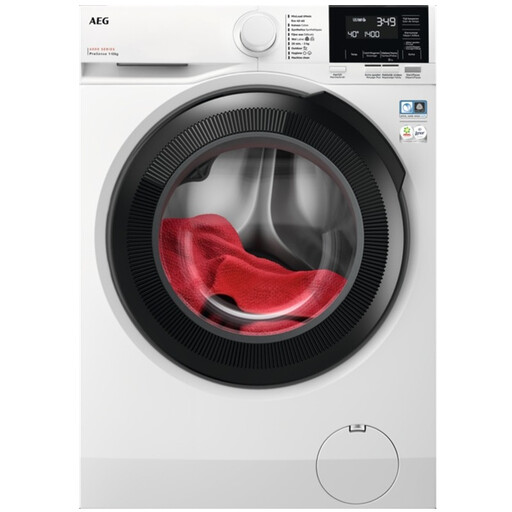 No image available
A front-loader to consider if you also wash larger loads as well as covers.
Capacity: 10 kg. Dimensions: 847 × 597 × 660 mm. The product description mentions ProSense load detection.
 No image available
A front-loader to compare if you want to wash mixed loads.
Capacity: 8 kg. Dimensions: 847 × 596 × 602 mm. The product description mentions a MixLoad programme and PreciseWash load detection.
 No image available
A front-loader to consider if a shallower cabinet would help.
Capacity: 8 kg. Stated dimensions: 84.7 × 59.6 × 57.2 cm. You’ll also need room for the connections and door when installing it.
 No image available
A front-loader to compare if you’re looking for a machine for different types of washing.
Capacity: 8 kg. Dimensions: 84.7 × 59.6 × 57.7 cm. The product description mentions ProSense load detection.
No image available
A front-loader to compare if you wash mixed loads as well as covers.
Capacity: 8 kg. Dimensions: 847 × 596 × 602 mm. The product description mentions a MixLoad programme and PreciseWash load detection.
No, follow the care label on your cover. For example, the IKEA GURLI cover can be machine-washed at a maximum of 40 °C and must not be tumble-dried. These instructions don’t automatically apply to other covers.
Follow the manual for your chosen model. Bosch recommends a stable surface, a suitable water supply and drain, an earthed socket, and removing the transit bolts before use.
Always start by following the care instructions for your model. Milieu Centraal recommends running a 60 °C wash about once a month to help remove residue and odours. Don’t automatically use covers for this if their care label specifies a lower temperature.
The EU energy label for household washing machines includes energy consumption per 100 cycles, water consumption per cycle and noise emissions. The European Commission explains the label information; compare models using the same basis.
For distance purchases from a business, the Dutch government says you’ll generally have 14 days to change your mind. Check the terms and any exceptions that apply to your specific purchase.