What should you look for when buying?
Start with the care labels and the loads you usually wash together or separately. Then compare the available space, noise levels and the features that will make a difference to how you use the machine.
| What to consider |
What should you check? |
Who is this most important for? |
| Wash programme and temperature |
Check the cotton programme and whether its adjustable temperature suits the care label. |
If I want to wash underwear according to its care label, I’m looking for a suitable programme without having to set every load to a higher temperature by default. Around 33% of consumers are most concerned about wash results when buying. |
| Suitable drum capacity |
Compare the capacity in kg with the loads you usually wash together; for small loads, also look for information about partial loads. |
If housemates regularly combine their laundry, I want enough room for those shared loads without choosing a drum that’s often much bigger than necessary. Around 27% of consumers give suitable capacity top priority. |
| Noise and positioning |
Check the noise information during the spin cycle and measure the space, including room for the connections. |
If my room is close to the laundry room, I want to consider noise and vibration and check that the machine can stand securely. Around 20% of consumers are most concerned about noise or positioning when buying. |
| Consumption and service |
Compare kWh per 100 eco cycles and water per eco cycle on the EU energy label; check the service information too. |
If several people use the machine, I want to be able to compare consumption figures and know in advance who to contact if something goes wrong. Around 20% of consumers put consumption or support first. |
The EU energy label gives consumption figures for the standardised eco cycle; it doesn’t show how much every other selected cycle uses. So check the programme information for the model you’re considering too.
Washing machines at Joybuy
This selection includes 8kg and 9kg washing machines with a range of features for cotton washes and small or shared loads. Check that each model’s programmes and dimensions suit how you’ll use it and the space available.
 Image unavailable
Samsung WW90DG6U25LE, 9 kg
The capacity may suit housemates who regularly combine their laundry.
9 kg; 1400 rpm; energy class A; cotton programme; spin noise 72 dB; SmartThings control.
View at Joybuy
 Image unavailable
Bosch WGB2440BFG Serie 8, 9 kg
The listed Mini Load feature may come in handy if housemates run small washes as well as shared loads.
9 kg; 1400 rpm; energy class A; Mini Load for small loads; spin noise 69 dB; AquaStop.
View at Joybuy
 Image unavailable
Midea MF110W80BA10/W-NL, 8 kg
A cotton programme and adjustable temperature are listed for anyone who wants to match the programme to the care label.
8 kg; 1400 rpm; energy class A; cotton programme; adjustable temperature; steam function and a small-load function.
View at Joybuy
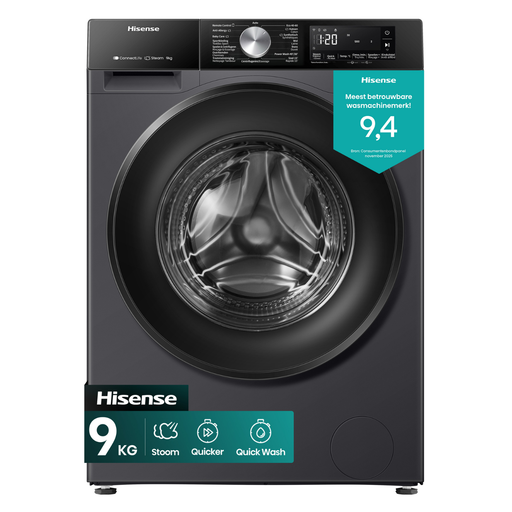 Image unavailable
Hisense WF3S9043BB3, 9 kg
The stated capacity and small-load programme offer options for housemates who sometimes wash together and sometimes separately.
9 kg; 1400 rpm; Quick 15’ for small loads; Pause & Add and a steam function.
View at Joybuy
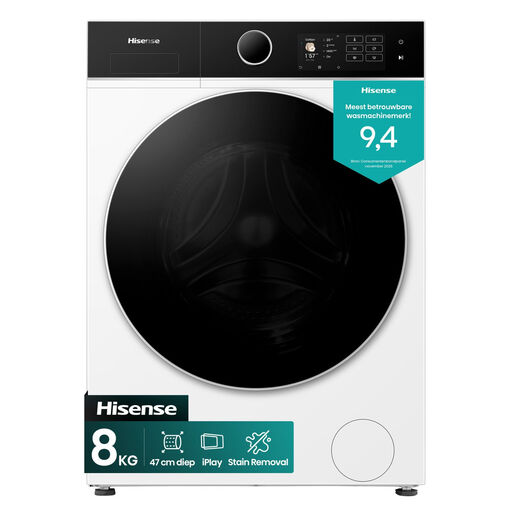 Image unavailable
Hisense WF5I8043BWF, 8 kg
The stated depth may be useful when space is limited; remember to allow room for the connections too.
8 kg; 1400 rpm; depth 47 cm; energy class A(-30%); Wi-Fi control and a steam function.
View at Joybuy
Frequently asked questions
Can I choose Eco 40–60 if the underwear needs to be washed at 60 °C according to specific advice?
Don’t rely on the programme name alone. Eco 40–60 is intended for normally soiled cotton that can be washed at 40 or 60 °C according to its care label. For scabies, Thuisarts recommends washing the clothing worn in the relevant situation at 60 °C. Follow that specific advice and check the care label and the machine’s instruction manual.
How can housemates keep a frequently used washing machine fresh?
Agree on who will check and clean the drawer, door seal and filter. The Consumers’ Association also recommends leaving the door and detergent drawer open to dry after use and running a hot programme periodically. Check the instruction manual for your chosen model too.
What should I check before installing a machine in a shared laundry room?
Measure the space and check the water supply, drain, an earthed socket and a stable floor. Follow the installation instructions for removing the transit bolts and levelling the machine.
Does my right to help if something goes wrong automatically end after two years?
No, not automatically. According to ACM ConsuWijzer, Dutch statutory guarantee rights apply alongside any manufacturer’s or seller’s guarantee. The seller is responsible for a faulty product that has been used normally. What you can expect from a product depends partly on the product itself and the circumstances.
Which consumption figures can I compare for models sold in the Netherlands?
The EU energy label for household washing machines lists, among other things, energy consumption per 100 cycles, water consumption per cycle and noise emissions. These figures relate to the standardised eco cycle and don’t describe the consumption of every other programme.


